• Submit Poetry
  • Support SCP
  • About Us
  • Members
  • Join
Tuesday, June 30, 2026
Society of Classical Poets
  • Poems
    • Beauty
    • Culture
    • Satire
    • Humor
    • Children’s
    • Art
    • Ekphrastic
    • Epic
    • Epigrams and Proverbs
    • Human Rights in China
    • Music
    • Performing Arts
    • Riddles
    • Science
    • Song Lyrics
    • The Environment
    • The Raven
    • Found Poems
    • High School Poets
    • Terrorism
    • Covid-19
  • Poetry Forms
    • Sonnet
    • Haiku
    • Limerick
    • Villanelle
    • Rondeau
    • Pantoum
    • Sestina
    • Triolet
    • Acrostic
    • Alexandroid
    • Alliterative
    • Blank Verse
    • Chant Royal
    • Clerihew
    • Rhupunt
    • Rondeau Redoublé
    • Rondel
    • Rubaiyat
    • Sapphic Verse
    • Shape Poems
    • Terza Rima
  • Great Poets
    • Geoffrey Chaucer
    • Emily Dickinson
    • Homer
    • Henry Wadsworth Longfellow
    • Dante Alighieri
    • John Keats
    • John Milton
    • Edgar Allan Poe
    • William Shakespeare
    • William Wordsworth
    • William Blake
    • Robert Frost
  • Love Poems
  • Contests
  • SCP Academy
    • Educational
    • Teaching Classical Poetry—A Guide for Educators
    • Poetry Forms
    • The SCP Journal
    • Books
No Result
View All Result
Society of Classical Poets
  • Poems
    • Beauty
    • Culture
    • Satire
    • Humor
    • Children’s
    • Art
    • Ekphrastic
    • Epic
    • Epigrams and Proverbs
    • Human Rights in China
    • Music
    • Performing Arts
    • Riddles
    • Science
    • Song Lyrics
    • The Environment
    • The Raven
    • Found Poems
    • High School Poets
    • Terrorism
    • Covid-19
  • Poetry Forms
    • Sonnet
    • Haiku
    • Limerick
    • Villanelle
    • Rondeau
    • Pantoum
    • Sestina
    • Triolet
    • Acrostic
    • Alexandroid
    • Alliterative
    • Blank Verse
    • Chant Royal
    • Clerihew
    • Rhupunt
    • Rondeau Redoublé
    • Rondel
    • Rubaiyat
    • Sapphic Verse
    • Shape Poems
    • Terza Rima
  • Great Poets
    • Geoffrey Chaucer
    • Emily Dickinson
    • Homer
    • Henry Wadsworth Longfellow
    • Dante Alighieri
    • John Keats
    • John Milton
    • Edgar Allan Poe
    • William Shakespeare
    • William Wordsworth
    • William Blake
    • Robert Frost
  • Love Poems
  • Contests
  • SCP Academy
    • Educational
    • Teaching Classical Poetry—A Guide for Educators
    • Poetry Forms
    • The SCP Journal
    • Books
No Result
View All Result
Society of Classical Poets
No Result
View All Result
Home Poetry Beauty

Essay: Are Shakespeare and Dante Dead White European Males? (Part 1)

October 30, 2017
in Beauty, Essays, Poetry, William Shakespeare
A A
5
poems Essay: Are Shakespeare and Dante Dead White European Males? (Part 1)

By David Gosselin

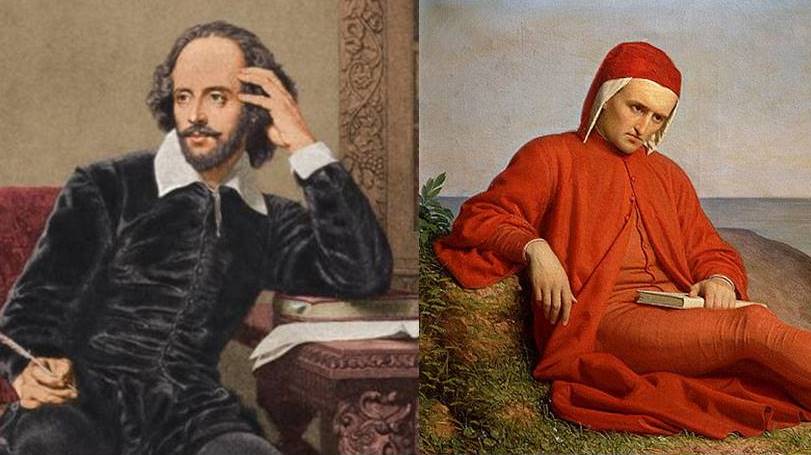
The answer to the above question is of course no. Shakespeare and Dante are not dead because every true poet is immortal.

However, much of our contemporary thinkers seem to be under the impression that they are dead, and that they are not as relevant and talented as first thought, but that rather their qualities were simply exaggerated because they happened to belong to a ‘historically dominant gender and ethnic group’. However any discerning eye will notice that such a ‘dead white European male’ argument avoids actually taking on the content of a Shakespeare’s or Dante’s ideas, which in fact have a continuity spanning over thousands of years, through the Golden Renaissance, through the Dark Ages, back to the times of ancient Greece and the Homeric epics. Moreover these ideas address some of the most fundamental questions concerning the human condition.

However, before we continue, I can hear protests saying that the canon above mentioned, really only refers to dead white European males. But the truth is that this kind of humanist thinking has parallels in virtually every culture, from the Confucian traditions in China, to those of Tilak and Tagore in India, to those of Ibn Sina of Persia and the many bards of Moorish Spain. There are great thinkers from cultures across the world.

Therefore, what the contemporary brand of thinking is really dismissing, is not a specific grouping or period, as the ideas embodied by these individuals span virtually as far back as recorded history, but rather they are wittingly or unwittingly dismissing those humanist ideas traced throughout history.

Unfortunately much of what is referred to by the ‘contemporary’ and modernist schools of thinking, renders itself largely irrelevant by virtue of the fact that they wish to treat the recent decades of modernist thinking, which span mere seconds on the scale of human history, as some isolated phenomena detached from the entirety of that continuity out of which it unfolded.

Were they to compare those few seconds with the universal arc of history, they would quickly discover the relevancy of a Shakespeare or Dante’s ideas.

Take but one small example from Shakespeare, which in only 14 lines manages to capture and develop the most fundamental of paradoxes underlying our individual mortal existence:


From fairest creatures we desire increase,
That thereby beauty’s rose might never die,
But as the riper should by time decease,
His tender heir might bear his memory:
But thou, contracted to thine own bright eyes,
Feed’st thy light’s flame with self-substantial fuel,
Making a famine where abundance lies,
Thyself thy foe, to thy sweet self too cruel.
Thou that art now the world’s fresh ornament
And only herald to the gaudy spring,
Within thine own bud buriest thy content
And, tender churl, makest waste in niggarding.
___Pity the world, or else this glutton be,
___To eat the world’s due, by the grave and thee.


Shakespeare opens by saying we are all attracted to beauty and long for it, and desiring ‘increase’ i.e. to reproduce, yet even in the first two lines, it’s stated that this beauty fades and that even the fairest of creature’s is no match for time. Yet, in recognizing that this beauty does fade, only then is one ready to discover an even higher order of beauty:  the power to generate new beauty.

What does a world look like, where each individual is acting with the conscious idea that they are responsible for the recreation and continued development of the human species; that they are not a mere individual but are defined and in turn define themselves by this eternal process for which they are now a mediating part. What does that look like versus someone who has a baby because they made a mistake or someone who does not want children because it takes to much time and costs too much? What image of beauty are they after?

The truth is they have not truly considered the paradox of their mortality, likely, they refuse to face it, and prefer to hang on to that ever fleeting image of earthly beauty, which so entices the senses, but ultimately ‘eats itself by the grave and thee.’


Originally published on TheChainedMuse.com

David Bellemare Gosselin is a student in classics and languages in Montreal.
ShareTweetPin
The Society of Classical Poets does not endorse any views expressed in individual poems or commentary.
Read Our Comments Policy Here

RandomPoems

‘A Case of Ghosts’ and Other Poetry by Julian Woodruff
Culture

‘A Case of Ghosts’ and Other Poetry by Julian Woodruff

July 6, 2020

A Case of Ghosts (Full Fathom Five parodied) In cradling case my fiddle lies, Waiting for the owner’s hand. Strings...

A Poem for Notre-Dame de Paris Cathedral’s Reopening, by Margaret Coats
Beauty

A Poem for Notre-Dame de Paris Cathedral’s Reopening, by Margaret Coats

December 7, 2024

. Notre Dame Re-Opens To touch this holiness we have no right, Nor did we earn the privilege to restore...

Next Post
‘Ode to Autumn’ by Joseph Charles MacKenzie (with Audio)

'Ode to Autumn' by Joseph Charles MacKenzie (with Audio)

‘Sweet Recollections’ and Other Poetry by Dusty Grein

'Sweet Recollections' and Other Poetry by Dusty Grein

On the Recent Terrorist Attack in New York City by Joe Tessitore

On the Recent Terrorist Attack in New York City by Joe Tessitore

Comments 5

  1. David Watt says:
    9 years ago

    Your essay illustrates the fleeting nature of our own mortality, and also of much contemporary thought. Denial of our rich history of literate ideas makes for a poorer world. Well done!

    Reply
    • David B. Gosselin says:
      9 years ago

      There has been a rather vicious assault on classical culture generally, which I think should be seen as an attack against the nature of man and creativity. The popularized idea in art and as a result in the idea of human nature is that man is irrational and ultimately just a product of his five senses; that there is no higher order of intelligibility than that of our direct senses and feelings… What distinguishes classical culture from other approaches is that classical culture recognizes the fundamental difference between man and beast; most others don’t, in fact they do the opposite. I hope to produce a lot more on this question shortly. Do checkout my website for more: http://www.thechainedmuse.com

      Reply
      • James Sale says:
        9 years ago

        Yes, David you are right: there has been a sustained attack on the classic culture and the traditional canon, and one can see why from an historic viewpoint in that it is associated with the feudalism that is so endemic in (and to) England, and which the Mayflower pilgrims (which I believe are now called Americans) sought to escape from so long ago. Your essay is really good and important; the thing is, it’s all very well attacking the canon but what is being offered to replace it? And that is where we find the thinking, and the creativity, to be so thin and insubstantial. Indeed, on the topic of white, middle class males, of which I am one, the attacks seem only to be motivated by one of the three lowest vices: in this instance, the vice of envy.

        Reply
    • David B. Gosselin says:
      9 years ago

      Hi James,

      I only saw your reply now. You may or may not see this since it’s rather late, so I apologize.

      First I would say we shouldn’t be mistaken in regards to the most general aim of poetry, which Keats succinctly put as “To soothe the cares and lifts the thoughts of man.” Poetry treats the question of creativity as such, which is the same creativity expressed by any true scientist discovering some new universal principle which governs the ordering of the universe. Poetry is concerned with the ordering of the soul, of the heart’s deepest fathoms. It comes from that deep place of insight, which many modern commentators refer to as some sort of esoteric quality, especially in science. It is also traced within all expressions of new technology, which increase the human species’ ability to further develop itself and further uncover the lawful ordering of the universe. All this stems from the root of poetic insight.

      I say this because poetry is that thing that awakes the spirit of insight and creativity inside people, it brings peoples’ minds alive, and develops that instinct for pursuing some great idea, often because they are provoked by its sheer beauty. The result: they are inspired by the beauty and creativity of life and are moved to become an acting part of it and the universe at large.

      However, that being said, much of this depends on there being some meaningful progress and purpose within society. That’s why poetry and politics and the overall economic development of a society are deeply intertwined. If poetry dies, or if it is perverted, then all society suffers. People become denatured, and their ideas become denatured. It becomes like a child who before their reasoning faculties have a chance to be developed, are indoctrinated by some radical ideology. As a result, their ideas can no longer be in coherence with the lawful ordering of the universe, and the universe, so to speak, comes down on that society.

      Therefore the poets should be committed to upholding a truthful image of man, which is creative man, and should as a result be acting based on the knowledge of the lawful ordering of the universe in which he inhabits. Poetry becomes simply a reflection of that beautiful reality, and in fact it serves as beacon and preserver of the highest ideals.

      As Schiller says:

      The dignity of Man into your hands is given,
      Its keeper be!
      It sinks with you! With you it will be risen!

      Reply
  2. Satyananda Sarangi says:
    9 years ago

    Hello David, greetings!

    This essay is a guideline for young poets who pursue the passion and a support to others who have been going on with formal poetry for years. It does bring out some of the strong reasons as to why rhyme, rhythm and meter are closely related to nature.

    Best wishes.

    Reply

Leave a Reply Cancel reply

Your email address will not be published. Required fields are marked *

  1. Joseph S. Salemi on ‘Archaic Torso of Apollo’ by Rainer Maria Rilke, Translated by Mary Jane MyersJune 30, 2026

    Brian -- yes, I think "or pulse as starlight flares" would be absolutely right. It gets rid of "quasar" and…

  2. Brian Yapko on ‘Archaic Torso of Apollo’ by Rainer Maria Rilke, Translated by Mary Jane MyersJune 30, 2026

    Mary Jane, this is a wonderful translation of Rilke's original German. I love how you maintained the rhyme-scheme and the…

  3. Zumwalt on ‘Archaic Torso of Apollo’ by Rainer Maria Rilke, Translated by Mary Jane MyersJune 30, 2026

    Wow! Very impressive, and imaginatively creative, translation feat!

  4. James Sale on ‘Then and Now’: A Sonnet by James SaleJune 30, 2026

    Good advice Nathan - totally agree.

  5. Russel Winick on ‘Not Small At All’ and Other Short Poems by Russel WinickJune 29, 2026

    Thanks Margaret. Speaking of Langston Hughes, it’s an endless fascination to me that my (and many other people’s) two favorite…

Subscribe to Daily Poems

Enter your email address to subscribe to this blog and receive notifications of new posts by email.

Join 1,592 other subscribers

Recent Poems

  • ‘Archaic Torso of Apollo’ by Rainer Maria Rilke, Translated by Mary Jane Myers
  • ‘The Council of Infinite Opinions’: A Poem by David Lee
  • Odyssey Audiobook Serialization Begins: First Fully Dramatized Version
  • ‘Not Small At All’ and Other Short Poems by Russel Winick
  • ‘The Roommate’: A Poem by Jeffrey Essmann
  • ‘Pouting Polly’: A Poem by Robert Nachtegall
  • Two Satirical Sonnets by Joseph S. Salemi
  • ‘Then and Now’: A Sonnet by James Sale
  • ‘The Ministry of Twee’: A Poem by Susan Jarvis Bryant
  • ‘Breath of Night’: A Poem by Paulette Calasibetta
  • A Song Inspired by Edward Rowland Sill’s ‘Among the Redwoods’, by Gunny Markefka
  • ‘Kaddish for My Father’: A Poem by Brian Yapko
  • ‘Canceled’ and Other Limericks by Joseph Mason
  • ‘The Diamond’: A Marriage Proposal Poem by Adam Sedia
  • ‘The Dancer’ and Other Rondeaux by David Murphy
  • ‘Chastity’: A Sonnet Sequence by Justin Dasher
  • Horace Odes I.11 and III.30, Translated by Mary Jane Myers
  • ‘The Bird with the Ugly Voice’: A Poem by Scharlie Meeuws
  • ‘The Dryads’: A Poem by Patricia Rogers Crozier
  • ‘Stories of Saint Anthony’: Poems by Margaret Coats
  • ‘An Englishman to World Cups Past’: A Poem by Paul A. Freeman
  • ‘Faux Pas’ and Other Poetry by C.B. Anderson
  • ‘Trip to Italy: A Poetry Travel Journal’ by James A. Tweedie
  • ‘Spring Song’: A Poem by Rohini Sunderam
  • ‘The Eagle’: A Poem by Bruce Dale Wise
  • ‘Good Night’ and Other Poetry by Kevin Ahern
  • ‘Mothiavelli’ and Other Poetry by Susan Jarvis Bryant
  • ‘Poetic Justices: The Poetry of United States Supreme Court Justices’: An Essay by Adam Sedia
  • ‘Blur’ and Other Poems by Anna J. Arredondo
  • ‘The Cottage on the Ridge’ and Other Poetry by Martin Rizley

Categories

  • Acrostic
  • Alexandroid
  • Alliterative
  • Art
  • Best Poems
  • Blank Verse
  • Chant Royal
  • Classical Poets Live
  • Clerihew
  • Covid-19
  • Deconstructing Communism
  • Educational
  • Epic
  • Epigrams and Proverbs
  • Essays
    • Interviews with Poets
    • Poetry Reviews
  • Featured
  • From the Society
  • Great Poets
    • Dante Alighieri
    • Edgar Allan Poe
    • Emily Dickinson
    • Geoffrey Chaucer
    • Henry Wadsworth Longfellow
    • Homer
    • John Keats
    • John Milton
    • Robert Frost
    • William Blake
    • William Shakespeare
    • William Wordsworth
  • Human Rights in China
  • Limerick
  • Love Poems
  • Music
  • Pantoum
  • Performing Arts
  • Poetry
    • Beauty
    • Children's Poems
    • Culture
    • Ekphrastic
    • Found Poems
    • High School Poets
    • Humor
    • Riddles
  • Poetry Challenge
  • Poetry Contests
  • Poetry Forms
    • Curtal Sonnet
    • Haiku
  • Poetry Readings
  • Rhupunt
  • Rondeau
  • Rondeau Redoublé
  • Rondel
  • Rubaiyat
  • Sapphic Verse
  • Satire
  • Science
  • Sestina
  • Shape Poems
  • Short Stories
  • Song Lyrics
  • Sonnet
  • Symposium
  • Terrorism
  • Terza Rima
  • The Environment
  • Translation
  • Triolet
  • Video
  • Villanelle

Quick Links

  • About Us
  • Submit Poetry
  • Become a Member
  • Members List
  • Support the Society
  • Advertisement Placement
  • Comments Policy
  • Terms of Use

Welcome Back!

Login to your account below

Forgotten Password?

Retrieve your password

Please enter your username or email address to reset your password.

Log In
No Result
View All Result
  • Poems
    • Beauty
    • Culture
    • Satire
    • Humor
    • Children’s
    • Art
    • Ekphrastic
    • Epic
    • Epigrams and Proverbs
    • Human Rights in China
    • Music
    • Performing Arts
    • Riddles
    • Science
    • Song Lyrics
    • The Environment
    • The Raven
    • Found Poems
    • High School Poets
    • Terrorism
    • Covid-19
  • Poetry Forms
    • Sonnet
    • Haiku
    • Limerick
    • Villanelle
    • Rondeau
    • Pantoum
    • Sestina
    • Triolet
    • Acrostic
    • Alexandroid
    • Alliterative
    • Blank Verse
    • Chant Royal
    • Clerihew
    • Rhupunt
    • Rondeau Redoublé
    • Rondel
    • Rubaiyat
    • Sapphic Verse
    • Shape Poems
    • Terza Rima
  • Great Poets
    • Geoffrey Chaucer
    • Emily Dickinson
    • Homer
    • Henry Wadsworth Longfellow
    • Dante Alighieri
    • John Keats
    • John Milton
    • Edgar Allan Poe
    • William Shakespeare
    • William Wordsworth
    • William Blake
    • Robert Frost
  • Love Poems
  • Contests
  • SCP Academy
    • Educational
    • Teaching Classical Poetry—A Guide for Educators
    • Poetry Forms
    • The SCP Journal
    • Books

© 2025 SCP. WebDesign by CODEC Prime.