• Submit Poetry
  • Support SCP
  • About Us
  • Members
  • Join
Tuesday, June 30, 2026
Society of Classical Poets
  • Poems
    • Beauty
    • Culture
    • Satire
    • Humor
    • Children’s
    • Art
    • Ekphrastic
    • Epic
    • Epigrams and Proverbs
    • Human Rights in China
    • Music
    • Performing Arts
    • Riddles
    • Science
    • Song Lyrics
    • The Environment
    • The Raven
    • Found Poems
    • High School Poets
    • Terrorism
    • Covid-19
  • Poetry Forms
    • Sonnet
    • Haiku
    • Limerick
    • Villanelle
    • Rondeau
    • Pantoum
    • Sestina
    • Triolet
    • Acrostic
    • Alexandroid
    • Alliterative
    • Blank Verse
    • Chant Royal
    • Clerihew
    • Rhupunt
    • Rondeau Redoublé
    • Rondel
    • Rubaiyat
    • Sapphic Verse
    • Shape Poems
    • Terza Rima
  • Great Poets
    • Geoffrey Chaucer
    • Emily Dickinson
    • Homer
    • Henry Wadsworth Longfellow
    • Dante Alighieri
    • John Keats
    • John Milton
    • Edgar Allan Poe
    • William Shakespeare
    • William Wordsworth
    • William Blake
    • Robert Frost
  • Love Poems
  • Contests
  • SCP Academy
    • Educational
    • Teaching Classical Poetry—A Guide for Educators
    • Poetry Forms
    • The SCP Journal
    • Books
No Result
View All Result
Society of Classical Poets
  • Poems
    • Beauty
    • Culture
    • Satire
    • Humor
    • Children’s
    • Art
    • Ekphrastic
    • Epic
    • Epigrams and Proverbs
    • Human Rights in China
    • Music
    • Performing Arts
    • Riddles
    • Science
    • Song Lyrics
    • The Environment
    • The Raven
    • Found Poems
    • High School Poets
    • Terrorism
    • Covid-19
  • Poetry Forms
    • Sonnet
    • Haiku
    • Limerick
    • Villanelle
    • Rondeau
    • Pantoum
    • Sestina
    • Triolet
    • Acrostic
    • Alexandroid
    • Alliterative
    • Blank Verse
    • Chant Royal
    • Clerihew
    • Rhupunt
    • Rondeau Redoublé
    • Rondel
    • Rubaiyat
    • Sapphic Verse
    • Shape Poems
    • Terza Rima
  • Great Poets
    • Geoffrey Chaucer
    • Emily Dickinson
    • Homer
    • Henry Wadsworth Longfellow
    • Dante Alighieri
    • John Keats
    • John Milton
    • Edgar Allan Poe
    • William Shakespeare
    • William Wordsworth
    • William Blake
    • Robert Frost
  • Love Poems
  • Contests
  • SCP Academy
    • Educational
    • Teaching Classical Poetry—A Guide for Educators
    • Poetry Forms
    • The SCP Journal
    • Books
No Result
View All Result
Society of Classical Poets
No Result
View All Result
Home Poetry Beauty

‘The Incarnation Sonnets’ by Joseph Charles MacKenzie

September 26, 2017
in Beauty, Culture, Poetry
A A
6
poems 'The Incarnation Sonnets' by Joseph Charles MacKenzie


Incarnation I: Ego Mater Pulchrae Dilectionis

I blossom forth delights on fruitful vine;
My grapes are opulent and fair,
Productive of a deep, supernal wine
Of highest knowledge, hope, and fear.

Late summer’s honey, heavy in the comb,
Shall never be as golden nor as sweet
As I am sweet. O thou who yearnest, come,
And taste my fruits and rest thy weary feet!

Yet, they who eat of me shall hunger still,
And those who drink yet thirst from more to more.
My branches bend to all who bend their will
And seek the gifts I keep in endless store.

Time stops for those who wander in my grove,
That they may know the Mother of Fair Love.


Incarnation II: Vox Dilecti Mei

My lover cometh like a youthful stag
Leaping on light across the ageless hill,
A wild gazelle, bright morning’s beauteous brag,
Bounding off rock and crag and crystal rill!

The tree puts forth its figs upon the bough;
The flowers bend, the pruning time is nigh;
The vines give grapes, the barn receives the plough;
The gentle zephyr waves through fields of rye.

Arise, my soul’s desire, my tender dove!
In the clefts of the rock I hear Thy voice;
For, Thou art sweet, my one, my only love!
In the cliff’s secret nook dost Thou rejoice,

Whilst I prepare Thy Spirit’s nuptial bed,
That human flesh be lifted from the dead.


Incarnation III: Fœderis Arca

Law’s words on tablets made of stone
We kept within our man-made chest of gold;
But she, the untouched Ark of flesh, alone,
Would bear the Living Word our seers foretold.

The manna man once ate but perished by,
Within a golden jar we there preserved;
But she, who won the heart of the Most High,
The Bread of Life within her tent reserved.

She flowered, like the bloom of Aaron’s Rod,
But gave her blood to form the higher Priest:
Her virgin flesh would veil the unseen God,
That we should see His rising in the East.

In her fair garden Heaven would conceive
The one Redeemer of the sons of Eve.


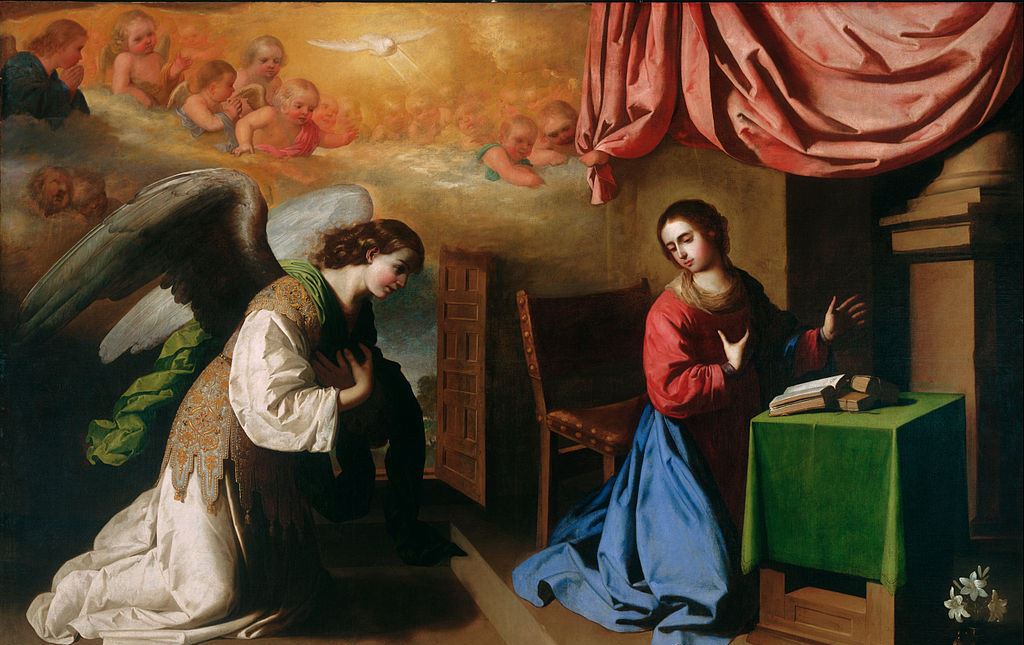
Incarnation IV: Fiat

Mine eyes shall hold the sun, yet not go blind;
And I shall hear the voice of my First Cause,
But neither deafen nor grow mute: God’s mind
Had held me ere He fixed the heavens’ laws.

And though I be encompassed in His shade,
That timelessness touch time within my womb,
I yet remain inviolate, the Maid
Of Him who comes to lift man from the tomb.

Alas, what greater scandal could there be
Than the Almighty swathed in human flesh?
The darkened eyes of hate shall cease to see,
And men of blood renew their wars afresh.

Send up my answer, angel, undeterred:
“Let it be done me, keeping with Thy word!”


Incarnation V: Et Incarnatus Est

Descending from the heavens’ highest throne,
To one of dust, He keeps His Father’s height;
Beyond our ken, He’s yet completely known;
Invisible, He now shows forth His light!

Preceding all that ever was in time,
A Virgin’s utterance begins His days;
The Lord of all that is, beyond sublime,
He comes to us a servant stripped of praise!

True man by nature and by nature God,
In Him the human and divine are one,
Though these be twain and each remain unflawed:
The Father is revealed in Mary’s Son!

That we should call her blessed, the Scriptures proved:
The Unmoved Mover by her heart was moved.


Joseph Charles MacKenzie is a traditional lyric poet, First Place winner of the Scottish International Poetry Competition (Long Poem Section). His poetry has appeared in The New York Times, The Scotsman (Edinburgh), The Independent (London), US News and World Report, Google News, and many other outlets. He writes primarily for the Society of Classical Poets (New York).
ShareTweetPin
The Society of Classical Poets does not endorse any views expressed in individual poems or commentary.
Read Our Comments Policy Here

RandomPoems

‘The Twilight’s Last Gleaming?’ and Other Poetry by Cynthia Erlandson
Culture

‘For the Sake of Ten Thousand: A Supplication from New Sodom’: A Poem by Cynthia Erlandson

November 9, 2024

. For the Sake of Ten Thousand: A Supplication from New Sodom And Abraham came near and said, ‘Would You...

‘Thoughts on January 31, 2018’s Complete Lunar Eclipse’ and Other Poetry by Amy Foreman
Poetry

‘Thoughts on January 31, 2018’s Complete Lunar Eclipse’ and Other Poetry by Amy Foreman

January 31, 2018

Read about last night's lunar eclipse here. Thoughts on January 31, 2018’s Complete Lunar Eclipse Reflected Glory, full and bright,...

Next Post
‘Life Science’ by N. Ram

'Life Science' by N. Ram

‘The Luna Moth, the Poet, and Philosopher’ by Phillip Whidden

'The Luna Moth, the Poet, and Philosopher' by Phillip Whidden

‘Morning Ecstasy’ by Sandeep Kumar Mishra

'Morning Ecstasy' by Sandeep Kumar Mishra

Comments 6

  1. Joseph S. Salemi says:
    9 years ago

    These sonnets are magnificent.

    Will they be fully understood by a modern readership? Perhaps not by everyone, since knowledge of the Scriptures is not as common as it once was. These allude to the Song of Solomon, the Ark of the Covenant, the Annunciation, Aaron’s Rod, the Vine of Salvation… and all of it carefully linked together in a narrative of enfleshment in the Blessed Virgin Mary.

    MacKenzie is able to do what many poets are no longer capable of doing: putting theological truth into profoundly powerful and arresting language.

    Reply
  2. Joseph Charles MacKenzie says:
    9 years ago

    I am greatly honored by Dr. Salemi’s observations, especially as the illustrious editor of TRINACRIA (whose latest issue is very soon to burst forth upon the world) has perfectly summarized my poetic endeavor, which is to put theological truth into language that speaks not to this or that “readership,” modern or otherwise, but to the human soul itself.

    Indeed, in my world—if only readers could visit New Mexico!—there is but God and man within a stark and timeless landscape which I can only describe as “theophanic.”

    So, for me, the “loquens” of poetry is not the “poeta,” but the “Deus loquens patribus in propheti,” if you will, as Dr. Salemi has perfectly suggested by indicating the fairly lush system of scriptural allusions in the poems. In this sense, the Incarnation Sonnets, the opening sonnets of the” Sonnets for Heaven’s Queen,” speak to the very act of poetry.

    True, “quod recipitur ad modem recipiendis recipitur.” But this is a proverb about instruction, teaching. However, in the world of poetry, whether one receives anything, nothing, or everything from a poem, depends entirely upon the reader’s acceptance of an invitation. And that act of acceptance is determined not “ab interiore,” but “ab exteriore,” that is, from above.

    For, the greatest poetry, like the greatest art, is incarnational. It is in a certain sense the invisible made visible—certainly not a “literal presentation of dry data that rhymes,” to speak of an error Dr. Salemi has attempted more than once to correct in this venue.

    Wherefore I feel I have a special license to say that poetry is nothing other than the incarnation of the eternal Logos in the particularities of human language.

    I realize that, as always, I have offered something which is not easy to comment, and that my verses are a kind of enigma for many, standing quite apart from what is generally expected.

    But I will go further. As Mary conceived God, so the poet must conceive Him in imitation of her. And for me, this is the foundation of the poetical act. So poetry begins, in a way, where God begins for our world of time, in Mary. It is therefore impossible that I should have been called to be the poet of the “Sonnets for Christ the King” without being also being called to write the “Sonnets for Heaven’s Queen.”

    “Ad Jesum per Mariam.”

    But do not the great Mysteries of faith, by virtue of being mysteries, surpass the comprehension of the intellect, and are they therefore not outside the scope of poetry?

    Surpassing the intellect to comprehend, concedo. Beyond the scope of poetry, nego, else Caedmon was never a poet, or St. John of the Cross.

    No matter, in the end.

    For, the inaccessibility of the great Mysteries does not mean they do not cast their supernatural light upon the mind, as indeed they do, as they pertain to the very “lux mundi,” the “lumen Christi,” without which poetry is only a vague shadow wandering in darkness.

    Reply
  3. Satyananda Sarangi says:
    9 years ago

    Greetings, Sir.

    These not only bring forth a divine vision to the reader’s eyes and mind, they transport one to antique ages when truth, beauty and humanity were three boons bestowed upon us by the Almighty.
    Now, taking the example of readers like me ( from different religions and without understanding of scriptures of Christianity or any other religion), these sonnets enchant the hearts with their fruitful words of wisdom; they propagate the path towards a common goal – ‘to lead our lives in the way we have been sent to’.
    It won’t be a surprise if most modern readers may not connect to these kind of art. However, the ones who’ve been blessed, would find great wealth in these.

    Regards and best wishes.

    Reply
    • Joseph Charles MacKenzie says:
      9 years ago

      Kind Sir,

      In fact, very few Christians understand the Scriptures. For, these must be read in the light of the Fathers and Doctors if they are to be understood at all. In the West, the anti-Catholic sects for whom the history begins with Luther, for the most part reject Tradition or treat of it in a non-traditional spirit. Tradition with a capital T is critical. In authentic Christianity, the Sacred Liturgy elucidates the “loci theologici,” as does the ordinary magisterium.

      Modern readers cannot connect with something that is not presented to them.

      Reply
  4. James Sale says:
    9 years ago

    Truly wonderful sonnets. What I like is the exploratory nature of them; the way they invite us into the theology, sometimes lightly with almost cliched classical references, like ‘the gentle Zephyr waves’ but then – always – leading to such sublime concluding couplets or lines: ‘That human flesh be lifted from the dead.’ or ‘That we should call her blessed, the Scriptures proved: / The Unmoved Mover by her heart was moved.’ – that last is simply superb. It is true as Joseph Salemi comments that we have to ask ourselves who can understand these things these days? But the answer is clear: those for whom these wonderful works are intended, AND as witnesses to the world at large. For the Word must be preached in every generation and every generation must find its own way; here is Mackenzie’s way, and how powerful it is.

    Reply
    • Joseph Charles MacKenzie says:
      9 years ago

      James Sale is true reader, because a true poet, and understands that reading is as much a matter of grace as writing, which gives him the last word on the subject of intended audience.

      Reply

Leave a Reply Cancel reply

Your email address will not be published. Required fields are marked *

  1. Mike Bryant on ‘The Council of Infinite Opinions’: A Poem by David LeeJune 30, 2026

    First, I love the poem, it has given rise to some important questions. Second, Doctor Salemi, I find it strange…

  2. Joseph S. Salemi on ‘The Council of Infinite Opinions’: A Poem by David LeeJune 30, 2026

    And I am reminded of all the left-liberal dweebs who are refusing to admit that Europe is being invaded and…

  3. Russel Winick on ‘Not Small At All’ and Other Short Poems by Russel WinickJune 30, 2026

    Thanks for a great comment, Paul. If you write that short story, I’d surely want to read it. And SCP…

  4. Paul Freeman on ‘The Roommate’: A Poem by Jeffrey EssmannJune 30, 2026

    I get a feeling of a roommate who is unable to take control of her life, hence the horoscope. As…

  5. Paul Freeman on ‘Not Small At All’ and Other Short Poems by Russel WinickJune 30, 2026

    It's true we only seem to notice when things go wrong and should appreciate more when everything goes tickety-boo. I…

Subscribe to Daily Poems

Enter your email address to subscribe to this blog and receive notifications of new posts by email.

Join 1,592 other subscribers

Recent Poems

  • ‘Archaic Torso of Apollo’ by Rainer Maria Rilke, Translated by Mary Jane Myers
  • ‘The Council of Infinite Opinions’: A Poem by David Lee
  • Odyssey Audiobook Serialization Begins: First Fully Dramatized Version
  • ‘Not Small At All’ and Other Short Poems by Russel Winick
  • ‘The Roommate’: A Poem by Jeffrey Essmann
  • ‘Pouting Polly’: A Poem by Robert Nachtegall
  • Two Satirical Sonnets by Joseph S. Salemi
  • ‘Then and Now’: A Sonnet by James Sale
  • ‘The Ministry of Twee’: A Poem by Susan Jarvis Bryant
  • ‘Breath of Night’: A Poem by Paulette Calasibetta
  • A Song Inspired by Edward Rowland Sill’s ‘Among the Redwoods’, by Gunny Markefka
  • ‘Kaddish for My Father’: A Poem by Brian Yapko
  • ‘Canceled’ and Other Limericks by Joseph Mason
  • ‘The Diamond’: A Marriage Proposal Poem by Adam Sedia
  • ‘The Dancer’ and Other Rondeaux by David Murphy
  • ‘Chastity’: A Sonnet Sequence by Justin Dasher
  • Horace Odes I.11 and III.30, Translated by Mary Jane Myers
  • ‘The Bird with the Ugly Voice’: A Poem by Scharlie Meeuws
  • ‘The Dryads’: A Poem by Patricia Rogers Crozier
  • ‘Stories of Saint Anthony’: Poems by Margaret Coats
  • ‘An Englishman to World Cups Past’: A Poem by Paul A. Freeman
  • ‘Faux Pas’ and Other Poetry by C.B. Anderson
  • ‘Trip to Italy: A Poetry Travel Journal’ by James A. Tweedie
  • ‘Spring Song’: A Poem by Rohini Sunderam
  • ‘The Eagle’: A Poem by Bruce Dale Wise
  • ‘Good Night’ and Other Poetry by Kevin Ahern
  • ‘Mothiavelli’ and Other Poetry by Susan Jarvis Bryant
  • ‘Poetic Justices: The Poetry of United States Supreme Court Justices’: An Essay by Adam Sedia
  • ‘Blur’ and Other Poems by Anna J. Arredondo
  • ‘The Cottage on the Ridge’ and Other Poetry by Martin Rizley

Categories

  • Acrostic
  • Alexandroid
  • Alliterative
  • Art
  • Best Poems
  • Blank Verse
  • Chant Royal
  • Classical Poets Live
  • Clerihew
  • Covid-19
  • Deconstructing Communism
  • Educational
  • Epic
  • Epigrams and Proverbs
  • Essays
    • Interviews with Poets
    • Poetry Reviews
  • Featured
  • From the Society
  • Great Poets
    • Dante Alighieri
    • Edgar Allan Poe
    • Emily Dickinson
    • Geoffrey Chaucer
    • Henry Wadsworth Longfellow
    • Homer
    • John Keats
    • John Milton
    • Robert Frost
    • William Blake
    • William Shakespeare
    • William Wordsworth
  • Human Rights in China
  • Limerick
  • Love Poems
  • Music
  • Pantoum
  • Performing Arts
  • Poetry
    • Beauty
    • Children's Poems
    • Culture
    • Ekphrastic
    • Found Poems
    • High School Poets
    • Humor
    • Riddles
  • Poetry Challenge
  • Poetry Contests
  • Poetry Forms
    • Curtal Sonnet
    • Haiku
  • Poetry Readings
  • Rhupunt
  • Rondeau
  • Rondeau Redoublé
  • Rondel
  • Rubaiyat
  • Sapphic Verse
  • Satire
  • Science
  • Sestina
  • Shape Poems
  • Short Stories
  • Song Lyrics
  • Sonnet
  • Symposium
  • Terrorism
  • Terza Rima
  • The Environment
  • Translation
  • Triolet
  • Video
  • Villanelle

Quick Links

  • About Us
  • Submit Poetry
  • Become a Member
  • Members List
  • Support the Society
  • Advertisement Placement
  • Comments Policy
  • Terms of Use

Welcome Back!

Login to your account below

Forgotten Password?

Retrieve your password

Please enter your username or email address to reset your password.

Log In
No Result
View All Result
  • Poems
    • Beauty
    • Culture
    • Satire
    • Humor
    • Children’s
    • Art
    • Ekphrastic
    • Epic
    • Epigrams and Proverbs
    • Human Rights in China
    • Music
    • Performing Arts
    • Riddles
    • Science
    • Song Lyrics
    • The Environment
    • The Raven
    • Found Poems
    • High School Poets
    • Terrorism
    • Covid-19
  • Poetry Forms
    • Sonnet
    • Haiku
    • Limerick
    • Villanelle
    • Rondeau
    • Pantoum
    • Sestina
    • Triolet
    • Acrostic
    • Alexandroid
    • Alliterative
    • Blank Verse
    • Chant Royal
    • Clerihew
    • Rhupunt
    • Rondeau Redoublé
    • Rondel
    • Rubaiyat
    • Sapphic Verse
    • Shape Poems
    • Terza Rima
  • Great Poets
    • Geoffrey Chaucer
    • Emily Dickinson
    • Homer
    • Henry Wadsworth Longfellow
    • Dante Alighieri
    • John Keats
    • John Milton
    • Edgar Allan Poe
    • William Shakespeare
    • William Wordsworth
    • William Blake
    • Robert Frost
  • Love Poems
  • Contests
  • SCP Academy
    • Educational
    • Teaching Classical Poetry—A Guide for Educators
    • Poetry Forms
    • The SCP Journal
    • Books

© 2025 SCP. WebDesign by CODEC Prime.