


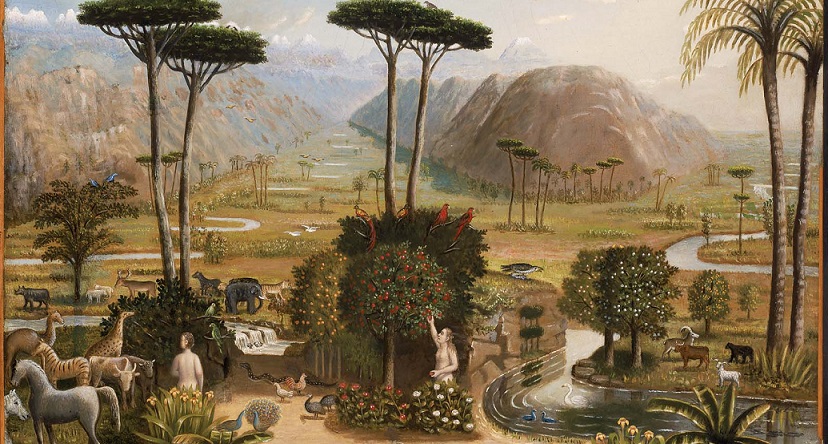
by T.M. Moore
The hectic pace that defines the lives of most of us may be doing more than merely serving as a source of stress and irritation. It may be robbing us of encounters with beauty, wonder, and glory that can thrill and transform us, enrich our lives, and equip us to live more fully. Such opportunities are present at almost every moment; most of us are just too hurried to notice.
In her book, How to Read a Poem…and Start a Poetry Group, Molly Peacock comments on our need to slow down and learn to appreciate the moments of our lives more fully. We simply live too fast-paced lives, rushing from one appointment, responsibility, or diversion to the next, and we’re missing a great deal of wonder and beauty occurring in the moments we ignore, disregard, or simply race right past.
Poetry, she suggests, can help us to overcome this problem and teach us to slow down and appreciate the simple things of life more fully. She writes, “Poetry is the art that offers depth in a moment, using the depth of a moment.” In the short time it takes to read and contemplate a poem, we can penetrate to deeper levels of experience and more profound truths.
A Window on Glory
Wendell Berry can help us learn how to mine the riches of the moments of our lives. He shows us that poetry can be a window to everyday beauty and glory, and launch us through the here and now to more transcendent places and times. The Kentucky agrarian has a keen eye for the moments in which he lives, an astute and wondering theological mind, and a gift of art that makes his poetry particularly valuable for discerning the glory that beckons us in every moment.
We’ll look at one example of his poetry and observe what Berry can teach us about seeing into the depths and discovering the glory of a moment. His keen eye, sensitive faith, and gift for art encourage us to make more use of poetry to this end. The poem we will consider is an untitled Sabbath poem from 1979:
To sit and look at light-filled leaves
May let us see, or seem to see,
Far backward as through clearer eyes
To what unsighted hope believes:
That blessed conviviality
That sang Creation’s seventh sunrise,
Time when the Maker’s radiant sight
Made radiant every thing He saw,
And every thing He saw was filled
With perfect joy and life and light.
His perfect pleasure was sole law;
No pleasure had become self-willed.
For all His creatures were His pleasures
And their whole pleasure was to be
What He made them; they sought no gain
Or growth beyond their proper measures,
Nor longed for change or novelty.
The only new thing could be pain.
Berry’s verse is a “Sabbath poem,” one of a great many he has composed over the years, in which some experience on the Lord’s Day became an occasion for a more far-ranging meditation. In the process of nursing his art to life, Berry exercises the kind of disciplined attention to the moment that we may learn to practice with benefit as well.
Five Disciplines
Berry employs five distinct disciplines as he looks deeply into a single moment of time. We will look at these separately, but that is not to imply that they are necessarily practiced in a logical, step-by-step manner. Rather, the skills required for each discipline are constantly in play, working together in the subconscious mind to accomplish the work of penetrating the depth of the moment. By analyzing Berry’s poem, we may enter into his experience, and his practice of these disciplines, as we are transported to the pristine beauty of that first Sabbath, before being brought, by a rueful irony, back to the imperfect Sabbath of our not-yet-fully-restored present.
(1) Observation. Berry’s first discipline is observation, or, taking the time to look. It is his practice to spend much time amid the creatures of God’s world, making note of things familiar and new, and examining them carefully in an attitude of meditation. Notice that he is sitting, which suggests a deliberateness that itself can be an antidote to the hectic pace of our lives. If one is to penetrate the depth of a moment for the revelation of glory radiating from it, one needs to make the time for such activity.
He observes leaves in a nearby tree, studying them carefully. The light coming through the leaves makes them somehow more than mere leaves. They become symbols of a greater reality, one that exists beyond the present moment and the gaze of physical eyes; perhaps the leaves are even a passageway to that reality. His careful observation of the light-bathed leaves engages his imagination and leads him into the next discipline (keep in mind that all these disciplines operate simultaneously).
(2) Association. Now Berry begins to associate these leaves with the state of creation on the first Sabbath. His experience in this moment of observing such ordinary phenomena strikes a receptive chord in his theological understanding, and summons from his imagination a vision of the creation in its state of pre-lapsarian goodness. He brings his understanding of Scripture into the observation of the moment, associating what he has learned there with what he is experiencing now, and allowing the leaves he is observing to serve as a kind of icon to put him in touch with his knowledge of Genesis 1 and 2.
By association he imagines everything in creation as radiant, “filled/With perfect joy and life and light.” This was a time when God’s pleasure was the only law, and every one of His creatures happily conformed to that law, thus realizing its own reason for being. His experience grows, prompted by the leaves, to become a reverie on the glory of God’s creation on the morning of the seventh day.
(3) Integration. In the third stanza Berry begins to integrate his observations and associations into a meaningful whole. Creation on that first Sabbath was radiant and beautiful beyond description (lines 3 and 4) because the mutuality of love and pleasure between God and His creatures was perfect, unstained with anything like creaturely self-interest. This is the world Berry longs for in all his writings, yet which he knows cannot be achieved in this life. Nevertheless, he has devoted himself, through his own lifestyle as well as his writings, to calling people and the nation away from mere self-indulgence and material acquisitiveness to a clearer vision of the common weal, and a stewardship of creation that will allow a greater measure of its God-given beauty and power to rejuvenate.
The last line of the poem jerks us back to the reality of the moment—the Sabbath on which Berry is making his observation—and insinuates that only the pain inflicted by human sin robs us of a more beautiful, harmonious, and fruitful life as God’s creatures, a life of being contentt as He made us (line 17), and of glad submission to His perfect will and law.
(4) Celebration. Berry found this experience compelling. Art is for him the means whereby he celebrates his experiences of encountering beauty, glory, and God. We do not know when or how this poem took shape in his mind, but the simple beauty of it both heightens the experience of the moment and honors the Lord of the Sabbath.
The poem has three stanzas, which seems a kind of celebration of the triune God. Each stanza has three rhyme schemes—the first line rhymes with the fourth, the second with the fifth, and the third with the sixth—again, a kind of paean to the beauty of the Creator God. The twinned-line rhyme scheme suggests the Creator/creature distinction of the two participants in that first Sabbath’s glory. Each line contains four iambic feet, rather than the more normal five iambic feet characteristic of this meter. In Scripture, as Berry doubtless knows, four is the number of earth and creation—four directions, four winds, etc. He is celebrating the creation with its own number in a near-perfect arrangement of eighteen lines. For the full delight and enjoyment of Berry’s achievement, read the poem aloud.
(5) Proclamation. Finally, Berry makes his private reverie an act of public faith by publishing his poem, first in a literary journal in 1979, and then in the volume entitled A Timbered Choir: The Sabbath Poems 1979-1997 (Counterpoint, 1998). By so doing he makes his experience—and his faith—available to readers everywhere, allowing us to share in his personal encounter of God’s glory, teaching us about proper stewardship of the creation, and inviting us to seek our own experiences of the depth of a moment (note the “May let us” of line 2).
A Call to Attentiveness
Berry’s poem is a call to attentiveness. It offers a lesson in learning to see, through the focused moments of reading and enjoying a poem, the depth of a moment that lasted far longer than is required to read about it.
His poetry encourages and guides us in seeking beauty, glory, and significance in everyday things. Reading his poetry, and that of other poets who take their inspiration from mere moments, can equip us for living more fully in the depths of the glory-filled moments of our own lives.
Each of us can learn to use the five disciplines Berry employs in making his art. While we may practice them differently, we can expect that regularly and intentionally seeking out the glory of the moments of our lives will lead to new and life-changing encounters with beauty, goodness, and truth. But we must be willing to take the time, to slow down our lives, so that we can revel more fully in the glory-filled moments surrounding us all day long.
T. M. Moore is Principal of The Fellowship of Ailbe. He is the author of more than 30 books, including 6 volumes of poetry, and his poems appear in various journals and at several websites. He and his wife and editor, Susie, make their home in the Champlain Valley of Vermont. This essay is the third in a series.
















T. M.
Yet another cogent essay embracing an analysis of an exemplary poem. Well done.
As for the five disciplines you outlined I can readily embrace four of them #1, 2, 3, & 5) as being more or less applicable to any creative process, whether it be ceramics, painting, music, or literature. The one that gives me pause is #4 “Celebration.”
Although “Celebration” is a fitting term for how Berry approached the creation of this particular poem, it is, unlike the other four, not always applicable in a general sense. Not all poems are celebrative. Some are downright depressing, others decadent, disheartening, and others merely descriptive.
I found it insightful that you spent most of your parsing of “Celebration” in discussing the shape and form of the poem–it’s metrical, rhythmic and rhyming schemes. In doing this you hinted at what might be a more useful word for this fourth disciplinary step: “Construction” (or better yet perhaps, “Incarnation”). It is at this point in the creative process where the ideas for the poem are transformed into a particular, tangible shape–A sonnet, perhaps, or a narrative poem in trochaic tetrameter with an abab rhyme scheme. In music, this is where the composer begins to weave the themes into a sonata, a lieder, an overture or a gigue. Or when a potter decides whether to shape the clay into a vase, a bowl, a totem, etc.
This is, of course, just a quibble, and in no way should it detract from the essay as a whole. Beginning artists in any field will be well served by reading and pondering your outline of the creative process.
James:
It is precisely that process of construction that I find so celebratory. Thanks for your encouraging and thoughtful comments.