• Submit Poetry
  • Support SCP
  • About Us
  • Members
  • Join
Tuesday, June 30, 2026
Society of Classical Poets
  • Poems
    • Beauty
    • Culture
    • Satire
    • Humor
    • Children’s
    • Art
    • Ekphrastic
    • Epic
    • Epigrams and Proverbs
    • Human Rights in China
    • Music
    • Performing Arts
    • Riddles
    • Science
    • Song Lyrics
    • The Environment
    • The Raven
    • Found Poems
    • High School Poets
    • Terrorism
    • Covid-19
  • Poetry Forms
    • Sonnet
    • Haiku
    • Limerick
    • Villanelle
    • Rondeau
    • Pantoum
    • Sestina
    • Triolet
    • Acrostic
    • Alexandroid
    • Alliterative
    • Blank Verse
    • Chant Royal
    • Clerihew
    • Rhupunt
    • Rondeau Redoublé
    • Rondel
    • Rubaiyat
    • Sapphic Verse
    • Shape Poems
    • Terza Rima
  • Great Poets
    • Geoffrey Chaucer
    • Emily Dickinson
    • Homer
    • Henry Wadsworth Longfellow
    • Dante Alighieri
    • John Keats
    • John Milton
    • Edgar Allan Poe
    • William Shakespeare
    • William Wordsworth
    • William Blake
    • Robert Frost
  • Love Poems
  • Contests
  • SCP Academy
    • Educational
    • Teaching Classical Poetry—A Guide for Educators
    • Poetry Forms
    • The SCP Journal
    • Books
No Result
View All Result
Society of Classical Poets
  • Poems
    • Beauty
    • Culture
    • Satire
    • Humor
    • Children’s
    • Art
    • Ekphrastic
    • Epic
    • Epigrams and Proverbs
    • Human Rights in China
    • Music
    • Performing Arts
    • Riddles
    • Science
    • Song Lyrics
    • The Environment
    • The Raven
    • Found Poems
    • High School Poets
    • Terrorism
    • Covid-19
  • Poetry Forms
    • Sonnet
    • Haiku
    • Limerick
    • Villanelle
    • Rondeau
    • Pantoum
    • Sestina
    • Triolet
    • Acrostic
    • Alexandroid
    • Alliterative
    • Blank Verse
    • Chant Royal
    • Clerihew
    • Rhupunt
    • Rondeau Redoublé
    • Rondel
    • Rubaiyat
    • Sapphic Verse
    • Shape Poems
    • Terza Rima
  • Great Poets
    • Geoffrey Chaucer
    • Emily Dickinson
    • Homer
    • Henry Wadsworth Longfellow
    • Dante Alighieri
    • John Keats
    • John Milton
    • Edgar Allan Poe
    • William Shakespeare
    • William Wordsworth
    • William Blake
    • Robert Frost
  • Love Poems
  • Contests
  • SCP Academy
    • Educational
    • Teaching Classical Poetry—A Guide for Educators
    • Poetry Forms
    • The SCP Journal
    • Books
No Result
View All Result
Society of Classical Poets
No Result
View All Result
Home Alliterative

Sir Gawain and the Green Knight: Free PDF

November 6, 2021
in Alliterative, Culture, Educational, Essays, Poetry
A A
7
poems Sir Gawain and the Green Knight: Free PDF

Following the introduction below is a translated version of Sir Gawain and the Green Knight in PDF made free for download for teachers, students, and interested readers by the Society of Classical Poets. It can be purchased in book form on Amazon here. If you download, please consider making a donation to the Society of Classical Poets here.


.

Introduction

It’s the Christmas season at King Arthur’s court in Camelot, and all is merry during the holiday festivities… that is until a strange visitor—a half-giant knight all in green—shows up and issues a deadly challenge that will change the Knights of the Round Table forever.

This 14th century tale, written in both alliterative and rhyming poetry, is arguably the peak of all Arthurian literature. Though it is a self-contained, stand alone episode, it tells its tiny tale from start to finish with such ecstatic and ornate splendor and with such an eye to those true virtues that define the very essence of the noble knight that this relatively short work is elevated to a thing of monumental brilliance. This is why you will find an endless stream of translations and movie adaptions of it over the years.

In the broader scope of English literature and Western literature, Sir Gawain and the Green Knight represents an artistic fountainhead, a Springtime in which archetypes and themes are in full bloom—vibrant, pure, and untainted; so good as to define goodness itself. For instance, the vivid descriptions of Sir Gawain’s splendid armor, weapons, and horse stand in stark contrast to what we might consider the Autumn of literature: the old, mismatched, and decayed armor, weapons, and horse of the humorously senile knight Don Quixote, in Miguel Cervantes’ early 17th century work. If we continue further in the timeline and metaphor, we find the Winter of literature in the early 19th century with Sir Walter Scott’s Ivanhoe, in which the Saxon knight has no armor, horse, nor king, and must depend on a foreign Jewish banker and his daughter for all of them. Without Sir Gawain, the delightfulness of these classic characters, Don Quixote and Ivanhoe, simply would not exist.

Amidst today’s cynicism for tradition, Sir Gawain transcends social, cultural, or economic narratives, and succeeds in convincingly correlating great wealth and high social status, both of which he has, with traditional virtue. The story does this so well perhaps because it has such a clear handle on what traditional virtue is, matching five principles—generosity, fellowship, courtesy, chastity, and piety—to the five points on the knight’s symbol and putting those virtues to the test with an unflinching realism that makes for first-rate storytelling.

Who was the author of this great work? We do not know. However, we do know for certain that the phrase written in a different language at the end of the poem “Hony Soyt Qui Mal Pence” (“Shame on him who thinks evil of it”) is the motto of an order of knights, known as the Order of the Garter, who each wear a sash across his chest, a practice that this tale seems to allude to in its last moments. Thus, it is likely that Sir Gawain and the Green Knight was written for the founding of the Order in 1348 or in the order’s honor. The Order of the Garter still exists today and includes members of the British royal family, though their sash is usually blue, not green.

This version of Sir Gawain translates the original Middle English (which is of a particular Northern dialect distinct from the dialect of Chaucer’s Canterbury Tales) into readable plain English while staying true to each original line’s meaning, as well as keeping the style of alliterative lines and short metered and rhyming poems at the end of each paragraph.

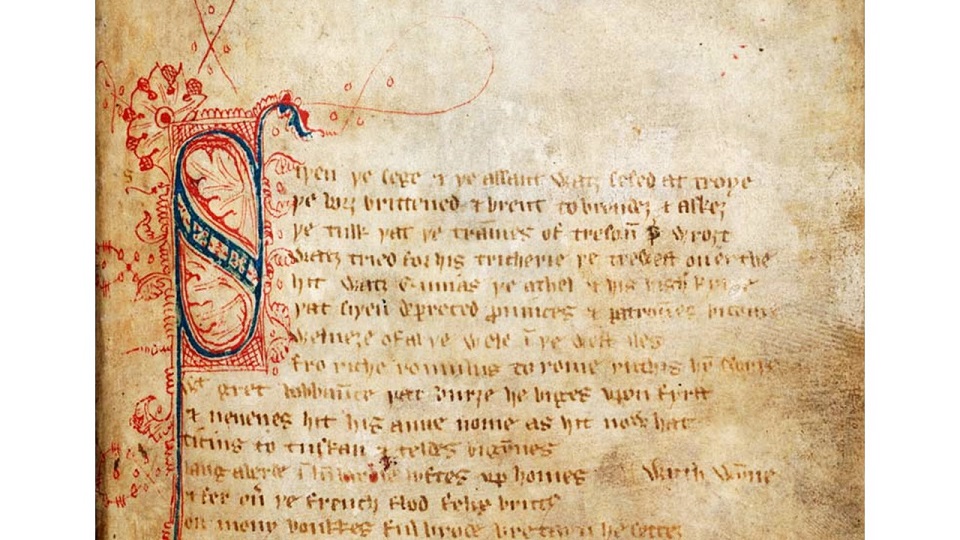
To give you some idea of the difference between the Middle English of Sir Gawain and our English today, here is an example of the two:

Þis kyng lay at Camylot vpon Krystmasse
With mony luflych lorde, ledez of þe best

This king sat at Camelot at Christmas time
with many lovely lords, lieges most noble

As in the above, in many cases the difference isn’t too far to discern for yourself the original lines. If you are interested in reading more of the original Middle English, you can find at least several versions of it for free online viewing offered by Gutenberg.org and my alma mater, the University of Michigan.

Now, let the tale begin!

—Evan Mantyk, Translator & Editor

Download PDF here.

Download PDF with Two Pages of Text Per PDF Page (Ideal for Classroom Instruction) Here.

Sir Gawain_publication version_013023_online pdf for students

.

.

.

ShareTweetPin
The Society of Classical Poets does not endorse any views expressed in individual poems or commentary.
Read Our Comments Policy Here

RandomPoems

‘The Polls’ and Other Poetry by Russel Winick
Culture

‘The Polls’ and Other Poetry by Russel Winick

October 27, 2022

. The Polls The polls are looking up right now, __But my faith’s not complete, Because no poll can measure...

‘When All the World Seems New’ by Father Richard Libby
Beauty

‘The Dance’: A Poem by Margaret Brinton

April 26, 2024

. The Dance __'Tis springtime _And air is a-breezin', Wafting through fair winds that blow. __The blossoms _From flowering jasmine...

Next Post
‘Hypnosis’ by Judy Koren

'Hypnosis' by Judy Koren

How to Write a Rhupunt (with Example)

'Bywords' and Other Poetry by Mike Bryant

‘Robert Jack Eardley’ by Jeff Eardley

'Robert Jack Eardley' by Jeff Eardley

Comments 7

  1. Jeff Eardley says:
    5 years ago

    Evan, thank you for this. We are very fortunate, here in North Staffordshire, to be just a few miles from the supposed site of the Green Chapel. Lud’s Church is a huge cleft in the lonely, wild landscape of the Peak District. It was used as a secret religious site by the Lollards in the 15th C and is a most scary place. Time to dust off my copy for a re-read. Thanks for the reminder.

    Reply
    • Joseph S. Salemi says:
      5 years ago

      Are you near the “wilderness of Wyrral,” where poor Gawain wandered in much discomfort before coming to Lord Bercilak’s castle?

      Reply
      • Jeff Eardley says:
        5 years ago

        From the ridge above the “Green Chapel” the land drops away to the flat plain of Cheshire and the Wyrall or Wirral beyond, about 30 miles away. This land divides Liverpool from the Welsh Coast via the Mersey and Dee estuaries. Despite the many refineries and chemical plants, it is a special place. To stand at sunset and gaze over to Moel Famau and the Clwyd hills is quite magical.

        Reply
  2. Damian Robin says:
    5 years ago

    Thanks Evan for a potential Christmas gift – printed off and bound with ribbon maybe.

    Jeff, which version will you be dusting off?

    Reply
    • Jeff Eardley says:
      5 years ago

      Damian, my version is a paperback translation by Australian Keith Harrison from Oxford World’s Classics. The “Green Chapel” is a very special place in our neck of the woods. Best wishes.

      Reply
  3. Greg Cox says:
    4 years ago

    It is possible to purchase your translation as a book? You did an excellent job.

    Reply
    • The Society says:
      3 years ago

      Yes, here: https://www.amazon.com/Sir-Gawain-Green-Knight-Writer/dp/B09KDW9X7P/ref=sr_1_2?crid=1ZFF2TU4KIAWQ&keywords=sir+gawain+evan+mantyk&qid=1636161951&qsid=138-9110839-8421540&sprefix=sir+gawain+evan+mantyk%2Caps%2C253&sr=8-2&sres=B081C946ZJ%2CB09KDW9X7P%2C145634241X%2CB093K67LSW%2CB08HZC2NP4%2CB08YT3FGZK%2CB00U0HDM1M%2CB0973R6Q8K%2CB000CLTYCW%2CB097QG9JP6%2CB07DR9423C%2CB08BZSHMT2%2CB07J32SZT2%2CB07PJ9Y549%2CB07GCKZKX8%2CB08D1LYQD9%2CB07X1YLC2L%2CB00KDHS8PO%2CB07PK5DZK2%2CB07F3R6DHP&srpt=ABIS_BOOK

      Reply

Leave a Reply Cancel reply

Your email address will not be published. Required fields are marked *

  1. Brian Yapko on ‘Archaic Torso of Apollo’ by Rainer Maria Rilke, Translated by Mary Jane MyersJune 30, 2026

    Mary Jane, this is a wonderful translation of Rilke's original German. I love how you maintained the rhyme-scheme and the…

  2. Zumwalt on ‘Archaic Torso of Apollo’ by Rainer Maria Rilke, Translated by Mary Jane MyersJune 30, 2026

    Wow! Very impressive, and imaginatively creative, translation feat!

  3. James Sale on ‘Then and Now’: A Sonnet by James SaleJune 30, 2026

    Good advice Nathan - totally agree.

  4. Russel Winick on ‘Not Small At All’ and Other Short Poems by Russel WinickJune 29, 2026

    Thanks Margaret. Speaking of Langston Hughes, it’s an endless fascination to me that my (and many other people’s) two favorite…

  5. Margaret Coats on ‘The Council of Infinite Opinions’: A Poem by David LeeJune 29, 2026

    "A system built to leave no lasting trace" sounds like structuralist literary criticism. Contrary to the entertaining Council you describe,…

Subscribe to Daily Poems

Enter your email address to subscribe to this blog and receive notifications of new posts by email.

Join 1,592 other subscribers

Recent Poems

  • ‘Archaic Torso of Apollo’ by Rainer Maria Rilke, Translated by Mary Jane Myers
  • ‘The Council of Infinite Opinions’: A Poem by David Lee
  • Odyssey Audiobook Serialization Begins: First Fully Dramatized Version
  • ‘Not Small At All’ and Other Short Poems by Russel Winick
  • ‘The Roommate’: A Poem by Jeffrey Essmann
  • ‘Pouting Polly’: A Poem by Robert Nachtegall
  • Two Satirical Sonnets by Joseph S. Salemi
  • ‘Then and Now’: A Sonnet by James Sale
  • ‘The Ministry of Twee’: A Poem by Susan Jarvis Bryant
  • ‘Breath of Night’: A Poem by Paulette Calasibetta
  • A Song Inspired by Edward Rowland Sill’s ‘Among the Redwoods’, by Gunny Markefka
  • ‘Kaddish for My Father’: A Poem by Brian Yapko
  • ‘Canceled’ and Other Limericks by Joseph Mason
  • ‘The Diamond’: A Marriage Proposal Poem by Adam Sedia
  • ‘The Dancer’ and Other Rondeaux by David Murphy
  • ‘Chastity’: A Sonnet Sequence by Justin Dasher
  • Horace Odes I.11 and III.30, Translated by Mary Jane Myers
  • ‘The Bird with the Ugly Voice’: A Poem by Scharlie Meeuws
  • ‘The Dryads’: A Poem by Patricia Rogers Crozier
  • ‘Stories of Saint Anthony’: Poems by Margaret Coats
  • ‘An Englishman to World Cups Past’: A Poem by Paul A. Freeman
  • ‘Faux Pas’ and Other Poetry by C.B. Anderson
  • ‘Trip to Italy: A Poetry Travel Journal’ by James A. Tweedie
  • ‘Spring Song’: A Poem by Rohini Sunderam
  • ‘The Eagle’: A Poem by Bruce Dale Wise
  • ‘Good Night’ and Other Poetry by Kevin Ahern
  • ‘Mothiavelli’ and Other Poetry by Susan Jarvis Bryant
  • ‘Poetic Justices: The Poetry of United States Supreme Court Justices’: An Essay by Adam Sedia
  • ‘Blur’ and Other Poems by Anna J. Arredondo
  • ‘The Cottage on the Ridge’ and Other Poetry by Martin Rizley

Categories

  • Acrostic
  • Alexandroid
  • Alliterative
  • Art
  • Best Poems
  • Blank Verse
  • Chant Royal
  • Classical Poets Live
  • Clerihew
  • Covid-19
  • Deconstructing Communism
  • Educational
  • Epic
  • Epigrams and Proverbs
  • Essays
    • Interviews with Poets
    • Poetry Reviews
  • Featured
  • From the Society
  • Great Poets
    • Dante Alighieri
    • Edgar Allan Poe
    • Emily Dickinson
    • Geoffrey Chaucer
    • Henry Wadsworth Longfellow
    • Homer
    • John Keats
    • John Milton
    • Robert Frost
    • William Blake
    • William Shakespeare
    • William Wordsworth
  • Human Rights in China
  • Limerick
  • Love Poems
  • Music
  • Pantoum
  • Performing Arts
  • Poetry
    • Beauty
    • Children's Poems
    • Culture
    • Ekphrastic
    • Found Poems
    • High School Poets
    • Humor
    • Riddles
  • Poetry Challenge
  • Poetry Contests
  • Poetry Forms
    • Curtal Sonnet
    • Haiku
  • Poetry Readings
  • Rhupunt
  • Rondeau
  • Rondeau Redoublé
  • Rondel
  • Rubaiyat
  • Sapphic Verse
  • Satire
  • Science
  • Sestina
  • Shape Poems
  • Short Stories
  • Song Lyrics
  • Sonnet
  • Symposium
  • Terrorism
  • Terza Rima
  • The Environment
  • Translation
  • Triolet
  • Video
  • Villanelle

Quick Links

  • About Us
  • Submit Poetry
  • Become a Member
  • Members List
  • Support the Society
  • Advertisement Placement
  • Comments Policy
  • Terms of Use

Welcome Back!

Login to your account below

Forgotten Password?

Retrieve your password

Please enter your username or email address to reset your password.

Log In
No Result
View All Result
  • Poems
    • Beauty
    • Culture
    • Satire
    • Humor
    • Children’s
    • Art
    • Ekphrastic
    • Epic
    • Epigrams and Proverbs
    • Human Rights in China
    • Music
    • Performing Arts
    • Riddles
    • Science
    • Song Lyrics
    • The Environment
    • The Raven
    • Found Poems
    • High School Poets
    • Terrorism
    • Covid-19
  • Poetry Forms
    • Sonnet
    • Haiku
    • Limerick
    • Villanelle
    • Rondeau
    • Pantoum
    • Sestina
    • Triolet
    • Acrostic
    • Alexandroid
    • Alliterative
    • Blank Verse
    • Chant Royal
    • Clerihew
    • Rhupunt
    • Rondeau Redoublé
    • Rondel
    • Rubaiyat
    • Sapphic Verse
    • Shape Poems
    • Terza Rima
  • Great Poets
    • Geoffrey Chaucer
    • Emily Dickinson
    • Homer
    • Henry Wadsworth Longfellow
    • Dante Alighieri
    • John Keats
    • John Milton
    • Edgar Allan Poe
    • William Shakespeare
    • William Wordsworth
    • William Blake
    • Robert Frost
  • Love Poems
  • Contests
  • SCP Academy
    • Educational
    • Teaching Classical Poetry—A Guide for Educators
    • Poetry Forms
    • The SCP Journal
    • Books

© 2025 SCP. WebDesign by CODEC Prime.