• Submit Poetry
  • Support SCP
  • About Us
  • Members
  • Join
Tuesday, September 29, 2026
Society of Classical Poets
  • Poems
    • Beauty
    • Culture
    • Satire
    • Humor
    • Children’s
    • Art
    • Ekphrastic
    • Epic
    • Epigrams and Proverbs
    • Human Rights in China
    • Music
    • Performing Arts
    • Riddles
    • Science
    • Song Lyrics
    • The Environment
    • The Raven
    • Found Poems
    • High School Poets
    • Terrorism
    • Covid-19
  • Poetry Forms
    • Sonnet
    • Haiku
    • Limerick
    • Villanelle
    • Rondeau
    • Pantoum
    • Sestina
    • Triolet
    • Acrostic
    • Alexandroid
    • Alliterative
    • Blank Verse
    • Chant Royal
    • Clerihew
    • Rhupunt
    • Rondeau Redoublé
    • Rondel
    • Rubaiyat
    • Sapphic Verse
    • Shape Poems
    • Terza Rima
  • Great Poets
    • Geoffrey Chaucer
    • Emily Dickinson
    • Homer
    • Henry Wadsworth Longfellow
    • Dante Alighieri
    • John Keats
    • John Milton
    • Edgar Allan Poe
    • William Shakespeare
    • William Wordsworth
    • William Blake
    • Robert Frost
  • Love Poems
  • Contests
  • SCP Academy
    • Educational
    • Teaching Classical Poetry—A Guide for Educators
    • Poetry Forms
    • The SCP Journal
    • Books
No Result
View All Result
Society of Classical Poets
  • Poems
    • Beauty
    • Culture
    • Satire
    • Humor
    • Children’s
    • Art
    • Ekphrastic
    • Epic
    • Epigrams and Proverbs
    • Human Rights in China
    • Music
    • Performing Arts
    • Riddles
    • Science
    • Song Lyrics
    • The Environment
    • The Raven
    • Found Poems
    • High School Poets
    • Terrorism
    • Covid-19
  • Poetry Forms
    • Sonnet
    • Haiku
    • Limerick
    • Villanelle
    • Rondeau
    • Pantoum
    • Sestina
    • Triolet
    • Acrostic
    • Alexandroid
    • Alliterative
    • Blank Verse
    • Chant Royal
    • Clerihew
    • Rhupunt
    • Rondeau Redoublé
    • Rondel
    • Rubaiyat
    • Sapphic Verse
    • Shape Poems
    • Terza Rima
  • Great Poets
    • Geoffrey Chaucer
    • Emily Dickinson
    • Homer
    • Henry Wadsworth Longfellow
    • Dante Alighieri
    • John Keats
    • John Milton
    • Edgar Allan Poe
    • William Shakespeare
    • William Wordsworth
    • William Blake
    • Robert Frost
  • Love Poems
  • Contests
  • SCP Academy
    • Educational
    • Teaching Classical Poetry—A Guide for Educators
    • Poetry Forms
    • The SCP Journal
    • Books
No Result
View All Result
Society of Classical Poets
No Result
View All Result
Home Poetry Beauty

A Translation and Musical Setting of Victor Hugo’s Poem, ‘Demain, dès l’Aube,’ by James A. Tweedie

May 9, 2022
in Beauty, Music, Poetry, Translation
A A
11
poems A Translation and Musical Setting of Victor Hugo’s Poem, 'Demain, dès l'Aube,' by James A. Tweedie

.

“Tomorrow, at Dawn” Sung in English

https://classicalpoets.org/wp-content/uploads/2022/04/Tomorrow-in-English-mp3.mp3

.

“Tomorrow, at Dawn” Sung in French

https://classicalpoets.org/wp-content/uploads/2022/04/Tomorrow-in-French-mp3.mp3

.

Tomorrow, at Dawn

by Victor Hugo (1802-1885)
Translation by James A. Tweedie

Tomorrow, when the countryside is kissed by dawn,
I’ll leave. For you are waiting there for me I know.
Through forests, over mountains I will journey on;
For we have been apart too long—I miss you so.

And I will walk with eyes so fixed upon my thoughts
That outside sounds and sights I’ll neither hear nor see.
Alone, unknown, back bent, hands crossed as tight as knots,
And sad, so that the day will seem as night to me.

I will not heed the sunset’s gold at close of day
Or note the distant sails descending on Harfleur.
When I at last arrive, upon your grave I’ll lay
Green holly and the finest heather in full flower.

.

.

Demain, dès l’Aube

Demain, à l’heure où blanchit la campagne,
Je partirai. Vois-tu, je sais que tu m’attends.
J’irai par la forêt, j’irai par la montagne.
Je ne puis demeurer loin de toi plus longtemps.

Je marcherai les yeux fixés sur mes pensées,
Sans rien voir au dehors, sans entendre aucun bruit,
Seul, inconnu, le dos courbé, les mains croisées,
Triste, et le jour pour moi sera comme la nuit.

Je ne regarderai ni l’or du soir qui tombe,
Ni les voiles au loin descendant vers Harfleur,
Et quand j’arriverai, je mettrai sur ta tombe
Un bouquet de houx vert et de bruyère en fleur.

.

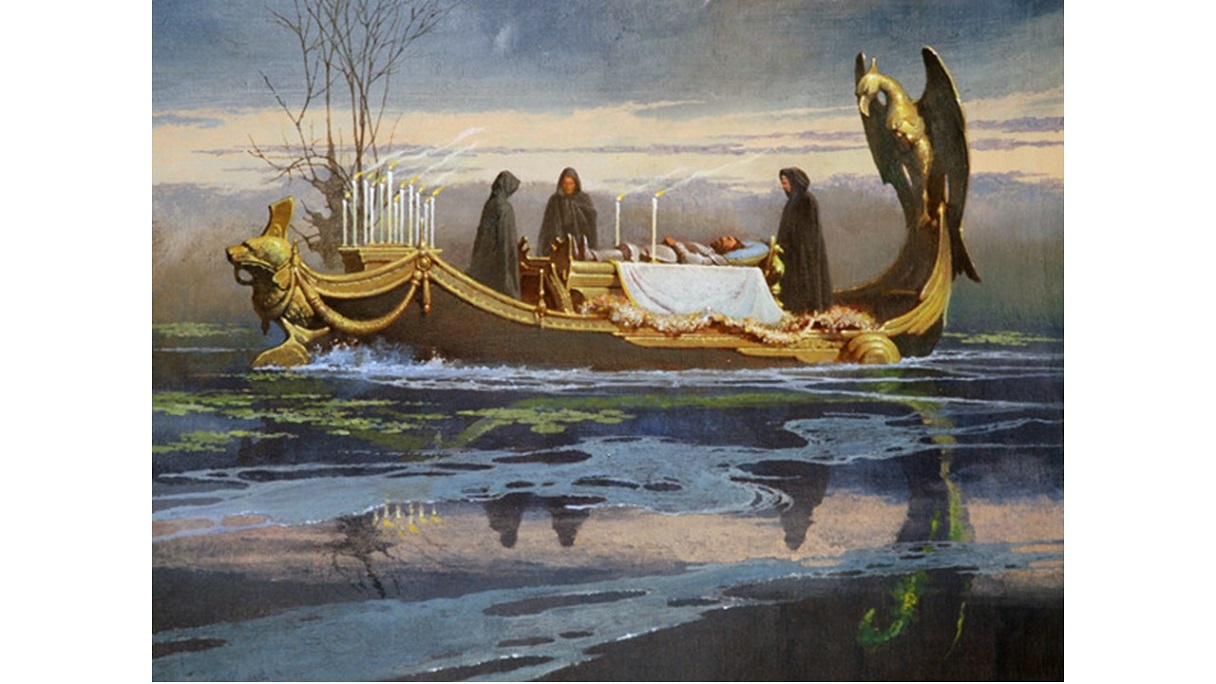
Translator’s note: The French novelist, Victor Hugo, 1802-1885—famous for Le Miserables, and The Hunchback of Notre Dame—was also among the most admired poets of his generation. His poem, “Demain, dès l’aube,” is, arguably, his most well-known and beloved poem. The poem is in three stanzas each comprised of four Alexandrine lines with alternating rhymes (abab). The first stanza is written in such a way that allows it to be interpreted as being a man traveling to visit his lover after a time of separation. It is then revealed that the poem’s true meaning is to describe Hugo’s journey from Paris to Harfleur (a village adjacent to La Havre) to visit the grave of his eldest daughter, Leopoldine, who died in 1843 at the age of 19—drowned in the Seine along with her husband in a boating accident. As translator, I have made it my priority to render the meaning of the poem into English while following the poetic form of rhyme and meter as closely as possible. Doing this required several minor changes to the literal reading of the text (most notably in line 4) with the guiding principle being to consider how Hugo himself might have composed the poem if he had been writing it in English. I am more than satisfied that my efforts have been successful. In translating, I used my own knowledge of the French language, my skill as a formal English poet along with a number of French-to-English translation programs on the internet. A marvelous essay on the origins and history of the poem as well as a line-by-line critical commentary can be found online here.

.

.

James A. Tweedie is a retired pastor living in Long Beach, Washington. He has written and published six novels, one collection of short stories, and three collections of poetry including Mostly Sonnets, all with Dunecrest Press. His poems have been published nationally and internationally in The Lyric, Poetry Salzburg (Austria) Review, California Quarterly, Asses of Parnassus, Lighten Up Online, Better than Starbucks, WestWard Quarterly, Society of Classical Poets, and The Chained Muse.

ShareTweetPin
The Society of Classical Poets does not endorse any views expressed in individual poems or commentary.
Read Our Comments Policy Here

RandomPoems

‘Spring Song’: A Poem by Rohini Sunderam
Poetry

‘Spring Song’: A Poem by Rohini Sunderam

June 9, 2026

  Spring Song Spring sings through the woods, her own special song Sometimes short ’n’ sweet and sometimes too long....

Book Review: Songs of My Life and Death by Peter Hartley
Poetry

Book Review: Songs of My Life and Death by Peter Hartley

December 21, 2023

. . Reviewed Book: Songs of My Life and Death by Peter Hartley, Grosvenor House Publishing Limited, May, 2023 by...

Next Post
Re-imagining Spenser: A Review of ‘Virtue’s End’ by Joseph Sale

Re-imagining Spenser: A Review of 'Virtue’s End' by Joseph Sale

In Response to the ‘In This House’ Sign: A Poem by Brian Yapko

In Response to the 'In This House' Sign: A Poem by Brian Yapko

On the Jan. 6 D.C. Protest: ‘Patriotic’ by Mike Bryant

On the Jan. 6 D.C. Protest: 'Patriotic' by Mike Bryant

Comments 11

  1. DONALD PETER McCRORY says:
    4 years ago

    A truly beautiful and deeply moving translation of a poem that I had not read before! So I have to thank you James for alerting me to such a text. I am sure that many readers will write a thankyou- comment, and desrvedly so. Maybe you could add another V.HUGO poem soon?

    Reply
  2. jd says:
    4 years ago

    Lovely morning greeting. Thank you.

    Reply
  3. Wayne says:
    4 years ago

    Thank you James for the education

    Reply
  4. Paul Freeman says:
    4 years ago

    Nicely done.

    Thanks for an entertaining listen and a fine read.

    Reply
  5. Cheryl Corey says:
    4 years ago

    My French is very rusty, but I had fun trying to translate as I compared it to what you’ve written. Your version stands as an excellent poem in its own right.

    Reply
  6. Margaret Coats says:
    4 years ago

    Congratulations, James, on a beautiful rendering of this poem in English. Rarely do English hexameters maintain their flow so well, and it seems to me you have done this by careful phrasing in which regular accent always falls on more important syllables. That is masterful construction. There is a little waver only at the final word (“flower” often pronounced as two syllables rather than the one regular in your meter). But that is appropriate. Hugo set translators an impossible challenge in the last stanza with both rhymes identical. Your final imperfect rhyme word is also possibly feminine, which emphasizes the end of the poem as do Hugo’s double identical rhymes. And your last two lines ending “lay” and “flower” contribute an aura of rest at the end of a ritual.

    I will, however, disagree that the first stanza can be read as if the speaker’s journey anticipates a happy meeting. The very title contradicts any notion that this is an aubade, or dawn song of lovers. That kind of lyric unwillingly ends a night of love at dawn, while Hugo’s poem is not about love, the night, or dawn. He is talking about what happens tomorrow FROM dawn. That doesn’t mean I want you to change your English title. You know what he’s saying and you manage it your way. Your interpretation leads you to having dawn kiss the countryside, and that first line is thus the one that departs most from the French, where the countryside simply whitens. The word “dawn” is not in the French poem, only in the title. This is Hugo’s anti-aubade. And your poem presents that sad idea in “the day will seem as night to me.” This would be pleasant to an aubade speaker. In your poem and Hugo’s, it’s supremely sad.

    You’ve caught Hugo’s meaning and the music, and put in a bit of your own interpretation, as translators must do. It is your English poem, and a splendid one!

    Reply
    • James A. Tweedie says:
      4 years ago

      Margaret, As always I appreciate your careful, thoughtful and cogent comment. However, I must make it clear that my reference to the opening lines suggesting the possibility of a trip to reunite with a living lover or friend is not original to me, but is the near-universal opinion of those who have written of the poem. Both English and French critics agree on this. Here are two examples:

      “La première strophe de « Demain dès l’aube » suggère que le poète s’adresse à une femme aimée et vivante qu’il est impatient de rejoindre.” Amélie Vioux

      “First, the poet takes us for a walk through Normandy’s countryside. The destination of the journey is a mystery: one first imagines a lover’s date… but the poem will unravel a meaning much deeper to the poet’s heart.” Camille Chevalier-Karfis

      As for the first line’s use of the poetic phrase “kissed by dawn” in place of “whitening” the word seemed directly referential to the title which Hugo gave to the poem. As I mention, it is the fourth line in the first stanza where I took some liberties that stray from the literal to an equivalency.

      Thanks again for sharing your thoughts.

      Reply
      • Margaret Coats says:
        4 years ago

        James, I challenge the romanticist conformist critics of this poem because they pay so little attention to its actual words or to the lyric genre to which the poem belongs. All of the initial misreaders must admit they are wrong before they get halfway through the poem, and even more so when they pay any attention to its place in the author’s life.

        Reply
  7. Cynthia Erlandson says:
    4 years ago

    Beautiful!

    Reply
  8. David Watt says:
    4 years ago

    James, the scholarly work you put in to translate this beautiful poem has paid off handsomely in the form of an equally fine poem.. Victor Hugo deserves more recognition as a poet. I suppose that being an outstanding novelist tends to overshadow Hugo’s additional talents.

    Reply
  9. Mia says:
    4 years ago

    This is such a beautiful poem. Thank you. I am a little late in commenting but I have read it many times and each time I wanted to comment I couldn’t really find the words to do it justice so this will have to do.

    Reply

Leave a Reply Cancel reply

Your email address will not be published. Required fields are marked *


  1. Roy Eugene Peterson on ‘No Body Here on Earth’: A Poem by Gerard MaritatoSeptember 29, 2026

    Such a deep heartfelt poem remembering the struggles of a loved one to hang on to life while imparting final…

  2. Cynthia L Erlandson on ‘No Body Here on Earth’: A Poem by Gerard MaritatoSeptember 29, 2026

    Beautifully written; deeply felt by this reader. Thank you for sharing it.

  3. Gerard Maritato on ‘No Body Here on Earth’: A Poem by Gerard MaritatoSeptember 29, 2026

    Thank you Mr DiLauro. Your generous message came out fine. Blessings, Gerard

  4. Robert Thomas on ‘No Body Here on Earth’: A Poem by Gerard MaritatoSeptember 29, 2026

    This is a beautiful and powerful poem. It is particularly timely and touching for me. One of my siblings just…

  5. Diana Elhrisse on The Society of Classical Poets 2026 Haiku CompetitionSeptember 29, 2026

    Green stillness in trees Promised forgiveness in land Beauty in each hand Plump red lips, curved hips Years, days, seconds,…

Subscribe to Daily Poems

Enter your email address to subscribe to this blog and receive notifications of new posts by email.

Join 1,660 other subscribers
No Result
View All Result

Resources

       1. A Guide to Writing Poetry

      2. The Best Poems of 2020      

      3. Poetry and Writing Contests

      4. Journals Accepting Formal Verse

Recent Poems

  • ‘No Body Here on Earth’: A Poem by Gerard Maritato
  • A Visualized Reading of The Odyssey: Book 1, Produced by Andrew Benson Brown
  • ‘Now?’ and Other Poetry by Stephen DiLauro
  • ‘From California to Louisiana’: A Sonnet by Mark F. DeWitt
  • ‘A Pot of Tea’ and Other Poetry by Samuel Gregg
  • Eight Riddles for the 2026 Mid-Autumn Festival, by Evan Mantyk
  • ‘Swallowtails’ and Other Poetry by Mary Jane Myers
  • ‘All Flesh Is Grass’: A Poem by Cynthia Erlandson
  • ‘May a Smile Be Your Umbrella’: A Poem by Roy E. Peterson
  • ‘Flexibility’ and Other Poems by Russel Winick
  • ‘Sabin Howard’ and Other Poetry by Bruce Dale Wise
  • ‘Ode to a Dragonfly’ and Other Poetry by Adam Sedia
  • ‘Hobby Horse’: A Poem by A.R. Pereira
  • ‘Big Cat Dance’: A Poem by Paul Erlandson
  • ‘Freedom’s Wring’: A Poem by C.B. Anderson
  • ‘Island of Poets’: A Poem in Sapphic Verse by Margaret Coats
  • ‘Military Quatrains, or the Modern Archilochus’: A Poem by Joseph S. Salemi
  • ‘The Secret Rose’ and Other Poetry by Luke Perera
  • ‘The Family Archive’: A Poem by Robert Thomas
  • ‘Pedagogy’: A Poem by Jonathan Kinsman
  • ‘Who Are the Villains?’ and Other Poetry by Adam Wasem
  • ‘Isle of Romance’: A Poem by Margaret Brinton
  • ‘Professional Mourner’: A Poem by Brian Yapko
  • A Distillation of Shakespeare’s ‘A Midsummer Night’s Dream’ by Martin Briggs
  • ‘How the Mighty Fell!’: A Poem by Jeff Kemper
  • ‘The One Lone Juror’: A Poem by Joseph S. Salemi
  • ‘Soul of a Prophet’: A Trialog Poem by T.M. Moore
  • ‘Nelson and George’: A Poem by David Filpula
  • ‘When She Arrives’: A Poem by Bhairab Barman
  • ‘On to Better Days’: A Poem by Bruce Dale Wise

Categories

  • Acrostic
  • Alexandroid
  • Alliterative
  • Art
  • Best Poems
  • Blank Verse
  • Chant Royal
  • Classical Poets Live
  • Clerihew
  • Covid-19
  • Deconstructing Communism
  • Educational
  • Epic
  • Epigrams and Proverbs
  • Essays
    • Interviews with Poets
    • Poetry Reviews
  • Featured
  • From the Society
  • Great Poets
    • Dante Alighieri
    • Edgar Allan Poe
    • Emily Dickinson
    • Geoffrey Chaucer
    • Henry Wadsworth Longfellow
    • Homer
    • John Keats
    • John Milton
    • Robert Frost
    • William Blake
    • William Shakespeare
    • William Wordsworth
  • Human Rights in China
  • Limerick
  • Love Poems
  • Music
  • Pantoum
  • Performing Arts
  • Poetry
    • Beauty
    • Children's Poems
    • Culture
    • Ekphrastic
    • Found Poems
    • High School Poets
    • Humor
    • Riddles
  • Poetry Challenge
  • Poetry Contests
  • Poetry Forms
    • Curtal Sonnet
    • Haiku
  • Poetry Readings
  • Rhupunt
  • Rondeau
  • Rondeau Redoublé
  • Rondel
  • Rubaiyat
  • Sapphic Verse
  • Satire
  • Science
  • Sestina
  • Shape Poems
  • Short Stories
  • Song Lyrics
  • Sonnet
  • Symposium
  • Terrorism
  • Terza Rima
  • The Environment
  • Translation
  • Triolet
  • Video
  • Villanelle

Quick Links

  • About Us
  • Submit Poetry
  • Become a Member
  • Members List
  • Support the Society
  • Advertisement Placement
  • Comments Policy
  • Terms of Use

Welcome Back!

Login to your account below

Forgotten Password?

Retrieve your password

Please enter your username or email address to reset your password.

Log In
No Result
View All Result
  • Poems
    • Beauty
    • Culture
    • Satire
    • Humor
    • Children’s
    • Art
    • Ekphrastic
    • Epic
    • Epigrams and Proverbs
    • Human Rights in China
    • Music
    • Performing Arts
    • Riddles
    • Science
    • Song Lyrics
    • The Environment
    • The Raven
    • Found Poems
    • High School Poets
    • Terrorism
    • Covid-19
  • Poetry Forms
    • Sonnet
    • Haiku
    • Limerick
    • Villanelle
    • Rondeau
    • Pantoum
    • Sestina
    • Triolet
    • Acrostic
    • Alexandroid
    • Alliterative
    • Blank Verse
    • Chant Royal
    • Clerihew
    • Rhupunt
    • Rondeau Redoublé
    • Rondel
    • Rubaiyat
    • Sapphic Verse
    • Shape Poems
    • Terza Rima
  • Great Poets
    • Geoffrey Chaucer
    • Emily Dickinson
    • Homer
    • Henry Wadsworth Longfellow
    • Dante Alighieri
    • John Keats
    • John Milton
    • Edgar Allan Poe
    • William Shakespeare
    • William Wordsworth
    • William Blake
    • Robert Frost
  • Love Poems
  • Contests
  • SCP Academy
    • Educational
    • Teaching Classical Poetry—A Guide for Educators
    • Poetry Forms
    • The SCP Journal
    • Books

© 2025 SCP. WebDesign by CODEC Prime.