


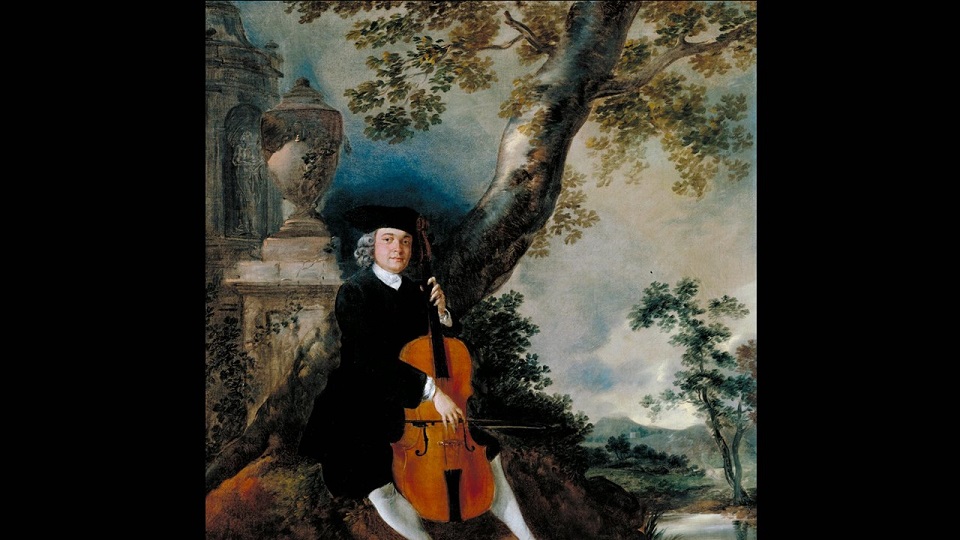
.
Ode to the Cello
Fingered strings upon the cello
Vibrate by the moving bow.
Autumn tones in red and yellow
Echo from the to and fro
Through the eight-shaped box’s hollow,
Out the narrow, curving holes.
Oaken humming sounds must follow
Movements of the bow that rolls.
Violins sing high with tension,
Flutes all tweet like chirping birds,
Horn sounds bubble in suspension,
Clarinets speak notes like words,
Yet my ears prefer the cello
Over winds and higher strings.
None can sound as rich and mellow
As the notes the cello sings!
.
.
The Campfire Sing-Along
Four families sit down in a circle at camp
By pines lit by sky white with stars and a fire
And, one by one, people start singing along
When one of the fathers picks up his guitar.
The children, excited to hear the guitar,
Will always remember that night in the camp
When all of the families were singing along
As one single voice that encircled the fire.
The logs turn to ash; night is fading the fire.
They stop one by one, with detuning guitar
And voices too tired for singing along,
And children get carried to tents in the camp.
The fire put out, all are plodding along
In the camp, with their minds filled with song and guitar.
First published in Snakeskin
.
.
Synesthesia
The violin plays shades of blues
The viola moans its tones of oak
The cello hums rich autumn hues
The colors rise in curves like smoke
The piano plucks its bubble notes
Myriad colors float and pop
Each horn, an orange circle floats
The flutes shoot out their dark blue dots
The circles vibrate till they stop
Harmonious colors fill my thoughts
First published in The Lyric
.
.
Joshua C. Frank works in the field of statistics and lives near Austin, Texas. His poetry has been published in Snakeskin, The Lyric, Sparks of Calliope, Westward Quarterly, Atop the Cliffs, Verse Virtual, and The Asahi Haikuist Network, and his short fiction has been published in Nanoism.”







All three music saturated poems remind me of the great times I had in the autumn to which these allude. Keeping warm and singing by campfires is something I have always enjoyed, You certainly brought color to the forefront in these poems that titillate the sight as accompaniment to the sounds made by the various instruments. All three are delightful for their visual and auditory sensations.
Thank you Roy!
Joshua, your poetry should be fixed to the door of every school music room, to remind us of the life-enhancing power of an instrument played well. I am a little biased, being a guitarist, but the sound of a cello sends me to a higher plane. These are three lovely musical masterworks. Thank you.
Thank you, Jeff. That’s such a huge compliment.
It was Yo-Yo Ma who made me fall in love with the cello. I love to listen to him play!
Joshua! These are some of my favorite poems of yours! I may be biased–I love music and it features in a lot of my writing (poetry and fiction)–but I do think your poetic skill is on full display here.
I used to play the cello, and I quite agree, its rich and mellow tones are among my favorite instrumental sounds. And your synesthesia poem is spectacular. I have to ask, are you a synesthete?
Thank you Alena! I’m glad to hear that these are some of your favorites! How nice to hear that my poetic skill is on full display!
I love music as well. Folk songs and hymns are a huge influence on my work, as are the songs of Georges Brassens (a French classical-style poet and folk singer). In fact, it was through hymns that I learned about meter in the first place.
To answer your question, yes. When I hear any sound, I automatically picture it as a colored shape in my mind, and have all my life, as described in the poem. (I also associate letters, numerals, and other written symbols and characters, even foreign ones, with colors.) I assume you are as well, since you know the word “synesthete?”
I also love hymns and I am learning more folk songs! There has been a revival of folk songs in my community recently, which is wonderful. I’m not familiar with Georges Brassens, but he must have been a good influence.
I was about to say I am not a synesthete, but reading Dr. Salemi’s comment about a student who associated a particular sex with each number made me do some more reading. I did that as a child, and still do, though the association is not so strong now. It seems like I have some spacial-sequential synesthetic tendencies. Cool!
I looked up spatial-sequential, and I guess I have some of that, though I consider that to be an aspect of the fact that I have a strong visual imagination—whenever I hear a story, I picture the scene in my mind as if it were a movie.
I’m glad we have similar tastes in music! Georges Brassens’s music is a mix of folk songs and classical poetry, sometimes leaning more toward one or the other, but in French, using French poetic conventions but sometimes breaking from them. Some of his songs are so heavily influenced by the classic French poets that when he set their actual poems to music (the ones I’ve translated into English, published right here on the SCP site), even a lot of French people thought they were his original songs and still do!
My other major influences among the great poets of the past are Robert Frost and William Wordsworth. Among living poets, my influences are some of our SCP members.
I thought the spacial-sequential thing was interesting because I do not consider myself to have a strong visual imagination. When I read (which I do a lot), I don’t picture things in much detail. I have trouble picturing faces especially. However, I do have a strong sense of space in my imagination. If I don’t know “where” a person or place I’m reading about is, I am too distracted to read. I have to put it somewhere. And then the agony when the author drops a comment and I realize I put it in the wrong place! This is all made ironic by the fact that in the physical world, I have a terrible sense of direction.
I began writing poetry because I read it and memorized it growing up, lots of A. A. Milne, Robert Louis Stevenson, and Henry Wadsworth Longfellow. I would say Wordsworth was a strong influence as I grew older. I really enjoy Frost now, and Edna St Vincent Millay, and most recently I have been reading the poetry by living poet A. E. Stallings. She is interesting because she writes in a modern voice but often times with traditional form (including meter and rhyme). I like her a lot and I’ve begun imitating her at times.
I just searched for A. E. Stallings… thank you for giving me the name of a new poet to discover! I love her poems “First Miracle” and “Sestina: Like;” I’m looking forward to reading more and getting to know her work.
That’s really interesting to hear about the strong sense of space in your imagination.
Alicia Stallings is also an excellent translator. She translated the De Rerum Natura of Lucretius some years ago.
Thank you for these lovely poems…my daughter plays the baroque violin and performs all over Europe.
Thank you, Allegra. How wonderful that your daughter does this!
Joshua, all three are mesmerizing.
What form is “The Campfire Sing-Along?” It resembles a sestina, but with four end-words, not six.
Thank you, Mary. “The Campfire Sing-Along” is a form I invented based on the sestina, adapting its algorithm to four end-words; because it has 14 lines, I call it a “sestina sonnet.” It’s the same form as “Red Flags:” https://classicalpoets.org/2023/05/28/red-flags-a-sestina-sonnet-by-joshua-c-frank/ You can read more about the form in the comments there.
I enjoyed these three poems very much, Joshua.
Ode to the Cello fell naturally (for me, anyhow) into the mesmerising rhythm of ‘The Song of Hiawatha’.
Thanks for the reads.
Thank you, Paul. I actually based the meter of “Ode to the Cello” on Beethoven’s “Ode to Joy.” Many poems and songs in English use that same meter.
Josh, I will second all of the admiring comments regarding these three poems. They skillfully capture so much of what is wonderful about music!
I am particularly fascinated by the “Synesthesia” poem because it’s something that I’ve never experienced and yet your poem makes me feel that I have. I think that’s quite a feat!
I’m so glad you explained the meter of the “Ode” and its connection to Beethoven’s Ninth. Now with the melody firmly planted in my head I can enjoy the beauty of the poem that much more. In a sense, what you’ve done is offer alternate lyrics for the piece. With that in mind, I’d really love to hear this poem sung. Putting it out there as a sung piece might be a fun and interesting project…
Thanks, Brian. I’m glad I was able to capture the beauty of music and the experience of synesthesia so well. I hadn’t thought about “Ode to the Cello” as something to be sung, that’s an interesting concept…
You convey very well how music uplifts the soul and stimulates the imagination. I like how you picture music as color and shape, and how deeply music can touch us. That second poem is so life-affirming. Pick up any modern poetry journal today (or search one on the internet) and contrast it with the overwhelming majority of poems that deconstruct and make ugly the whole human experience. Music and camping are great for family bonding. Good rhyme choices, too.
Thank you, Geoffrey. You’ve accurately determined the point of “The Campfire Sing-Along.”
Picturing music as color and shape just naturally happens, it always has. I just wrote what I see in my mind.
Josh, these are fine poems, and they reveal that you have a sophisticated musical side. As for being a synesthete, it is fairly uncommon in general but seems to be a frequent perceptive ability in poets. You mention your association of sounds with shapes, colors, letters, numerals, and various symbols. This is truly unusual. Many years ago, one of the students in my class swore that ever since early childhood she could discern whether any number was male or female, and that the classification followed no discernible pattern. I suppose the depths of human perceptual possibility have not been fully plumbed.
Thank you, Joe! I’m glad you enjoy them.
That’s really interesting that it’s common among poets. (For me, it’s sound -> color and written symbols -> color, but never the other direction.) Also that your student assigned each number a sex. I’ve heard of people having all different combinations of senses associated similarly. It’s true, we know so little about the brain.
Josh, I love every one of these beautifully crafted poems.
The mellifluous flow of Ode to the Cello together with the striking images you create is rather magnificent. Your ‘sestina sonnet’ (an intriguing and effective form) paint a very special picture of moments of joy every child should experience… sadly rare in today’s society. And ‘Synesthesia’ (my favorite of the three) is so good, I can taste the beauty of the words… you manage to turn the state of synesthesia into a gift with your magical images. These poems sing to me! Thank you!
Thanks Susan!
I’m glad you love “Synesthesia.” I didn’t expect it to be as popular as it is because I just wrote what I saw in my mind hearing an orchestra.
As for writing “The Campfire Sing-Along,” showing the joy of such an experience was, of course, exactly the point. It’s not enough to write poems about how everything modern culture teaches us to believe is bogus; I make sure also to write poems that show the alternative.
Speaking of synesthesia, these poems all have such warmth to them: the warmth of music. They show another side of your poetic gift. They are my favorites too of what I’ve seen of yours: a “rich autumn” arrangement of firstfruits. I tend to find a steely note in your verses but these are of a softer, more shining metal.
Thank you, Monika! That’s a really interesting description—all of it, but especially: “I tend to find a steely note in your verses but these are of a softer, more shining metal.”