• Submit Poetry
  • Support SCP
  • About Us
  • Members
  • Join
Thursday, December 18, 2025
Society of Classical Poets
  • Poems
    • Beauty
    • Culture
    • Satire
    • Humor
    • Children’s
    • Art
    • Ekphrastic
    • Epic
    • Epigrams and Proverbs
    • Human Rights in China
    • Music
    • Performing Arts
    • Riddles
    • Science
    • Song Lyrics
    • The Environment
    • The Raven
    • Found Poems
    • High School Poets
    • Terrorism
    • Covid-19
  • Poetry Forms
    • Sonnet
    • Haiku
    • Limerick
    • Villanelle
    • Rondeau
    • Pantoum
    • Sestina
    • Triolet
    • Acrostic
    • Alexandroid
    • Alliterative
    • Blank Verse
    • Chant Royal
    • Clerihew
    • Rhupunt
    • Rondeau Redoublé
    • Rondel
    • Rubaiyat
    • Sapphic Verse
    • Shape Poems
    • Terza Rima
  • Great Poets
    • Geoffrey Chaucer
    • Emily Dickinson
    • Homer
    • Henry Wadsworth Longfellow
    • Dante Alighieri
    • John Keats
    • John Milton
    • Edgar Allan Poe
    • William Shakespeare
    • William Wordsworth
    • William Blake
    • Robert Frost
  • Love Poems
  • Contests
  • SCP Academy
    • Educational
    • Teaching Classical Poetry—A Guide for Educators
    • Poetry Forms
    • The SCP Journal
    • Books
No Result
View All Result
Society of Classical Poets
  • Poems
    • Beauty
    • Culture
    • Satire
    • Humor
    • Children’s
    • Art
    • Ekphrastic
    • Epic
    • Epigrams and Proverbs
    • Human Rights in China
    • Music
    • Performing Arts
    • Riddles
    • Science
    • Song Lyrics
    • The Environment
    • The Raven
    • Found Poems
    • High School Poets
    • Terrorism
    • Covid-19
  • Poetry Forms
    • Sonnet
    • Haiku
    • Limerick
    • Villanelle
    • Rondeau
    • Pantoum
    • Sestina
    • Triolet
    • Acrostic
    • Alexandroid
    • Alliterative
    • Blank Verse
    • Chant Royal
    • Clerihew
    • Rhupunt
    • Rondeau Redoublé
    • Rondel
    • Rubaiyat
    • Sapphic Verse
    • Shape Poems
    • Terza Rima
  • Great Poets
    • Geoffrey Chaucer
    • Emily Dickinson
    • Homer
    • Henry Wadsworth Longfellow
    • Dante Alighieri
    • John Keats
    • John Milton
    • Edgar Allan Poe
    • William Shakespeare
    • William Wordsworth
    • William Blake
    • Robert Frost
  • Love Poems
  • Contests
  • SCP Academy
    • Educational
    • Teaching Classical Poetry—A Guide for Educators
    • Poetry Forms
    • The SCP Journal
    • Books
No Result
View All Result
Society of Classical Poets
No Result
View All Result
Home Poetry Ekphrastic

‘Lady Agnew of Lochnaw, Loved by the Viewer and the Baronet’: A Poem by Phillip Whidden

November 23, 2024
in Ekphrastic, Poetry
A A
11
poems 'Lady Agnew of Lochnaw, Loved by the Viewer and the Baronet': A Poem by Phillip Whidden

.

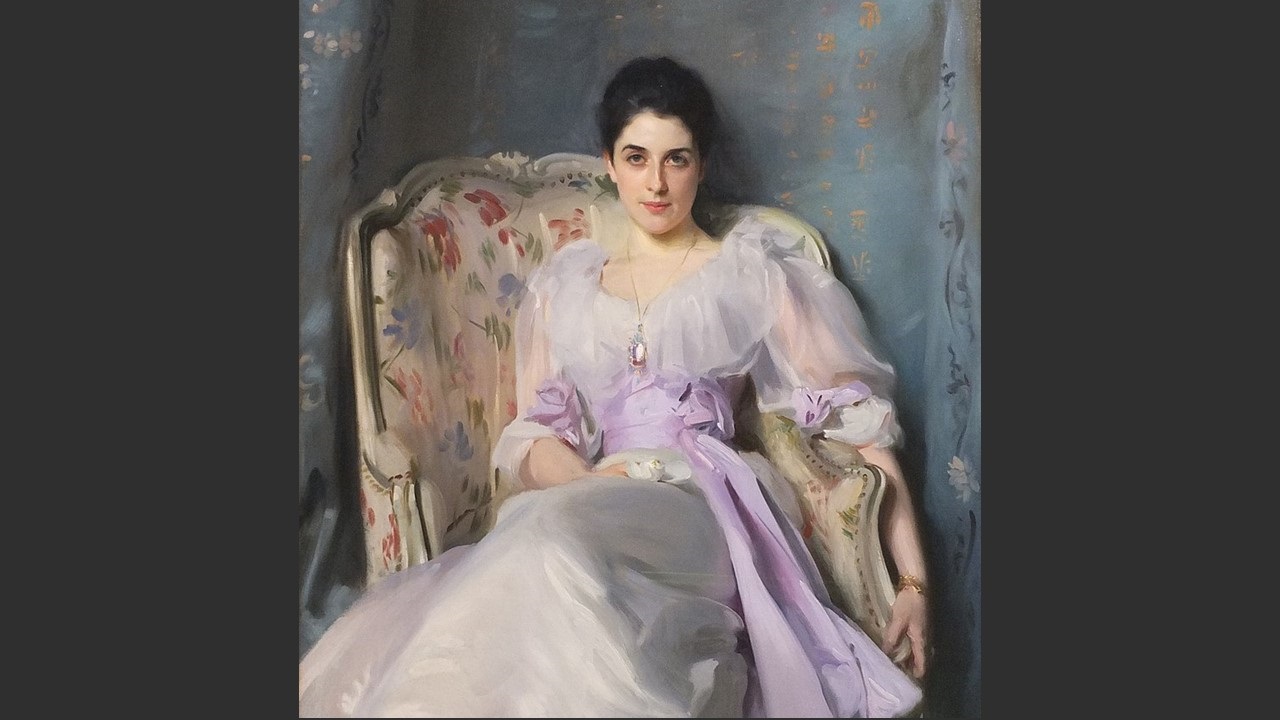
Lady Agnew of Lochnaw, Loved by
the Viewer and the Baronet

The lady wanted prettiness and style.
(The artist wanted pounds.) The chintz
Gave both her wants. A “quizzical half-smile”
Invites a conversation, or it hints
At that. Chiffon hides shoulders, who knows why?
Her breasts are also secret underneath
Its gauziness. From each dark, glinting eye
A depth of prettiness proceeds. The sheath
Of satin wraps around her waist. She holds
A flower, it seems, a swishingness of white.
This prettiness perhaps is linked to folds
Of suaveness, silken freedom, nothing tight.
_Then almost hidden till you notice comes
__The lavender of valentine. That thrums.

.

.

Phillip Whidden is an American living in England who has been published in America, England, Scotland (and elsewhere) in book form, online, and in journals. 

ShareTweetPin
The Society of Classical Poets does not endorse any views expressed in individual poems or commentary.
Read Our Comments Policy Here
Next Post
‘The Lop-Sided House’ and Other Poetry by Brian Yapko

'The Lop-Sided House' and Other Poetry by Brian Yapko

‘Madrigal à la Tasso’: A Poem by Daniel Howard

'Madrigal à la Tasso': A Poem by Daniel Howard

‘The Ballad of Mark and P’Nut’ by Geoffrey Smagacz 

'The Ballad of Mark and P’Nut' by Geoffrey Smagacz 

Comments 11

  1. Joseph S. Salemi says:
    1 year ago

    This is a fine example of an ekphrastic poem — one that takes as its subject a pre-existing work of art and describes it and meditates on it. The locus classicus for the genre is the description in the Iliad of the shield of Achilles fashioned by the god Hephaistos. But any real or imagined work of art can be the subject — a statue, a painting, a lovely vase, a building, or in some cases a piece of music.

    One minor criticism: There’s foot missing in line 2. Perhaps if “pounds” were replaced by the trisyllabic “sovereigns” it would be fixed, though even in the U.K. today I think very few people even remember that “sovereigns” were gold coins.

    Reply
    • Phillip Whidden says:
      1 year ago

      Thank you very much, Joseph S. Salemi, both for the praise and for the corrective comment. I’ll rewrite the line following your lead. I’ll have to change “pounds” to “sovereign’s gold” to get enough syllables properly into the line. This will be slightly unfortunate since the humor in the parentheses comes from the baldness of “pounds.” (A personal friend laughed over the original there.) But, yes, the purity of scansion is what you and I want.) I think I can’t make the correction here on the website above. For some reason the website’s messaging system is not informing me when you or other react to the sonnet. People who do not know what sovereigns were can look up the word on the now sovereign world wide web.

      Reply
  2. Paul A. Freeman says:
    1 year ago

    What a wonderful ekphrastic poem. I cut and pasted them side by side on a Word document for greater effect when reading. The pale complexion the Scots are famed for is clearly visible in Lady Agnew’s arms, neck and face.

    Great stuff, Phillip.

    Reply
    • PHILLIP WINSTON WHIDDEN says:
      1 year ago

      Thank you, Paul A. Freeman. You will see that Joseph S. Salemi has rightly suggested the metrical problem in line 2 needs to be corrected. I very much agree. I will make the correction (see the two messages above yours) but I’ll have to make it on my own website and on my own computer. I’m touched that you put in some work to make a document more suitable to your needs. Personally I have trouble seeing the lavender valentine referred to in the sonnet when I examine the illustration. It’s just too small to let me see the valentine. No, I am not complaining about the small size of the illustration.

      Reply
      • Paul A. Freeman says:
        1 year ago

        Hi, Phillip. Yes, I noticed the ‘pounds’ problem, too. If you want to keep the word, you could always opt for ‘sterling pounds’.

        Reply
  3. Phillip Whidden says:
    1 year ago

    Thanks very much, Paul A. Freeman. I like your suggestion, too. Both yours and his take away the rudeness of bald “pounds.” I’ll have to ponder. My Ukrainian neighbor lady is baking me a pumpkin pie tomorrow. I didn’t even have to ask her to do it. Some people are the sort we should be thankful for. Happy Thanksgiving.

    Reply
  4. Margaret Coats says:
    1 year ago

    Such perfection describing how the lady is “loved by the viewer”! You, Phillip, encourage the reader to look for still more details. The wristwatch, for example. I admit I do not see the valentine (which apparently displays the baronet’s love), but if your minute observation says so, it’s there. “Prettiness and style” of the lavender sash pulls color from the chintz into the foreground. And you haven’t even mentioned the portrait of a lady in white on the cameo, centered in gauziness–though words point delicately in that direction.

    Since you are musing over your wish to keep “pounds” plain, why not do so by adding a two-syllable adjective before “artist”? Pounds bare, and meter as perfect as the description.

    Reply
    • Phillip Whidden says:
      1 year ago

      First, Margaret Coats, please accept my delay in replying. I have been offline due to a software glitch. Thank you for your praise of the poem. Thank you for looking very closely at the image of the painting. Yes, there are other lovely details I did not fit in to the sonnet. The valentine is dark purple on part of the fluff around her left sleeve, though, yes, very small. How about “The Yankee artist wanted pounds.” Thanks for your suggestion.

      Reply
      • Margaret Coats says:
        1 year ago

        “Yankee artist” sounds perfect, Phillip. By emphasizing his pecuniary need as foreigner with fewer resources than a British painter might have had, you give him a strong motive to create a stunning portrait, and at the same time suggest that Lady Agnew’s beauty would shine brilliantly regardless of the artist or his motive.

        Reply
    • Phillip Whidden says:
      1 year ago

      Margaret Coats, I have now rewritten the troublesome line on my website using our agreed improvement about “Yankee artist”. Thank you again.

      Reply
  5. Phillip Whidden says:
    1 year ago

    Dear Margaret Cross, Thank you for tacitly accepting my apology. I’m glad we are agreed about the phrase “Yankee artist.” I suggest that you might want to read the most appropriate article in Wikipedia about her, the painting and John Singer Sarget. https://en.wikipedia.org/wiki/Lady_Agnew_of_Lochnaw .
    I am embarrassed to say that I did not read it myself till this evening. I hope that some day you can experience the painting yourself.

    Reply

Leave a Reply Cancel reply

Your email address will not be published. Required fields are marked *

  1. Bob Elkins on ‘Advice to a Cigar Aficionado’ and Other Poems by Joseph S. SalemiDecember 18, 2025

    Joseph - I especially liked "Advice...", it brought back memories of illicit smokes! But didn't all the good makers flee…

  2. Margaret Coats on ‘Canzone at Evening’ by Francesco Petrarch, Translated by Margaret CoatsDecember 18, 2025

    Thank you, Joseph. That last line was the most difficult to translate, as it speaks literally of where the poet…

  3. Joseph S. Salemi on ‘Advice to a Cigar Aficionado’ and Other Poems by Joseph S. SalemiDecember 18, 2025

    Thank you for your comments, Margaret. There still is a market for cigars, but it is now very upscale and…

  4. Margaret Coats on ‘Advice to a Cigar Aficionado’ and Other Poems by Joseph S. SalemiDecember 17, 2025

    Your period piece on cigars, Joe, brings to mind the era just previous, when I entered first grade in a…

  5. Joseph S. Salemi on ‘Advice to a Cigar Aficionado’ and Other Poems by Joseph S. SalemiDecember 17, 2025

    Well, you know me, Kip -- I really don't give a damn about reader response. I just hammer away at…

Receive Poems in Your Email

Enter your email address to subscribe to this blog and receive notifications of new posts by email.

Join 1,624 other subscribers
Facebook Twitter Youtube

Archive

Categories

Quick Links

  • About Us
  • Submit Poetry
  • Become a Member
  • Members List
  • Support the Society
  • Advertisement Placement
  • Comments Policy
  • Terms of Use

Welcome Back!

Login to your account below

Forgotten Password?

Retrieve your password

Please enter your username or email address to reset your password.

Log In
No Result
View All Result
  • Poems
    • Beauty
    • Culture
    • Satire
    • Humor
    • Children’s
    • Art
    • Ekphrastic
    • Epic
    • Epigrams and Proverbs
    • Human Rights in China
    • Music
    • Performing Arts
    • Riddles
    • Science
    • Song Lyrics
    • The Environment
    • The Raven
    • Found Poems
    • High School Poets
    • Terrorism
    • Covid-19
  • Poetry Forms
    • Sonnet
    • Haiku
    • Limerick
    • Villanelle
    • Rondeau
    • Pantoum
    • Sestina
    • Triolet
    • Acrostic
    • Alexandroid
    • Alliterative
    • Blank Verse
    • Chant Royal
    • Clerihew
    • Rhupunt
    • Rondeau Redoublé
    • Rondel
    • Rubaiyat
    • Sapphic Verse
    • Shape Poems
    • Terza Rima
  • Great Poets
    • Geoffrey Chaucer
    • Emily Dickinson
    • Homer
    • Henry Wadsworth Longfellow
    • Dante Alighieri
    • John Keats
    • John Milton
    • Edgar Allan Poe
    • William Shakespeare
    • William Wordsworth
    • William Blake
    • Robert Frost
  • Love Poems
  • Contests
  • SCP Academy
    • Educational
    • Teaching Classical Poetry—A Guide for Educators
    • Poetry Forms
    • The SCP Journal
    • Books

© 2025 SCP. WebDesign by CODEC Prime.

This website uses cookies. By continuing to use this website you are giving consent to cookies being used. Visit our Privacy and Cookie Policy.