


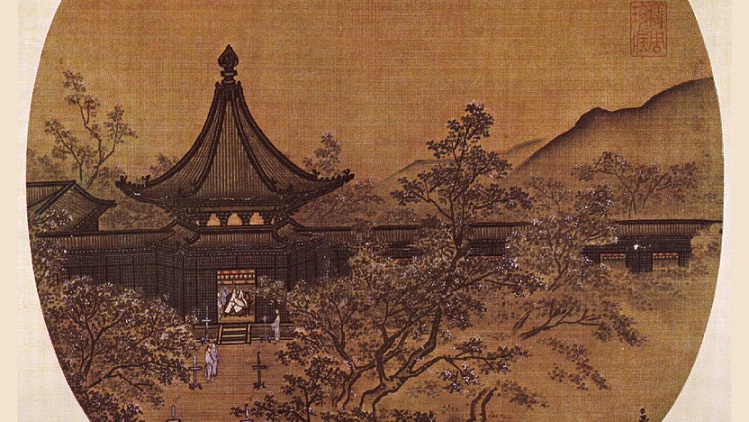
.
Mourning the Dead
by Li Qingzhao, Southern Song (1084-1155) | from Chinese by Talbot Hook
Above in the heavens the star-river flows;
Down on the earth the curtains hang low.
As the air grows chill, and my pillow tear-damp,
I arise, untying my robes just to know
The hours the night has tolled.
The patched emerald lotus of my robe is frayed;
Its gold-gilded leaves of late seem to fade.
Same is the weather, and same are my clothes—
It’s only my feelings that seem to have strayed
From our home-times of old.
.
Notes: This poem was likely written sometime after the death of her husband in 1129 as they fled south after the Jurchen invasion of northern China. 星河 (xīnghé), literally “star-river”, is one of several terms for the Milky Way.
.
Original Chinese
悼亡
天上星河轉 Tiānshàng xīnghé zhuǎn
人間簾幕垂 Rénjiān lián mù chuí
涼生枕簟淚痕滋 Liáng shēng zhěn diàn lèihén zī
起解羅衣聊問 Qǐ jiè luó yī liáo wèn
夜何其 Yè héqí
翠貼蓮蓬小 Cuì tiē liánpeng xiǎo
金銷藕葉稀 Jīn xiāo ǒu yè xī
舊時天氣舊時衣 Jiù shí tiānqì jiù shí yī
只有情懷不似 Zhǐyǒu qíng huái bù shì
舊家時 Jiù jiā shí
.
.
Bamboo-Grove Pavilion
by Wang Wei (699-759) | from Chinese by Talbot Hook
Seated alone in a dim bamboo grove,
Plucking the strings and humming a song —
Deep in the forest and unknown to men,
The glistening moon comes gleaming along.
.
Original Chinese
竹 里 館
獨 坐 幽 篁 裡, Dú zuò yōu huáng lǐ
彈 琴 復 長 嘯. tánqín fù chángxiào
深 林 人 不 知, shēnlín rén bùzhī
明 月 來 相 照. míng yuè lái xiāng zhào
.
.
Qingming
by Du Mu (803-852) | from Chinese by Talbot Hook
On Qingming Day, the rain abounds;
The pilgrims on the road, run-down,
Inquiring, “Where’s the nearest inn?”
A cowherd points to Xinghua Town.
.
Notes: Qingming Festival, or Tomb-Sweeping Day, is a traditional Han Chinese festival celebrated in early April. During Qingming, families visit their ancestors’ tombs in order to clean the graves, pray to their ancestors, and make ritual offerings of incense and food. The festival has been observed for over 2,500 years. Xinghua Town, made famous by this poem, has become a metaphor for refuge for those in mourning; there, one can find peace from sorrow, at least for a little while, at the bottom of one’s cup.
.
Original Chinese
清明
清明时节雨纷纷, Qīngmíng shíjié yǔ fēnfēn
路上行人欲断魂。 Lùshàng xíng rén yù duàn hún
借问酒家何处有? Jièwèn jiǔjiā hé chù yǒu
牧童遥指杏花村 。 Mùtóng yáo zhǐ xìng huācūn
.
.
Talbot Hook is a PhD student and occasional writer currently living in Connecticut.















as per Wu “Sacred Bee” Li:
Mr. Hook’s translations of poems from the Tang and Song dynasties are deeply appreciated. For some, it is rare to read and think about work of the Little Li-Du, and it is good to think anew upon Wang Wei. In fact, I shall return to a poem of Wang Wei’s translated @SCP in 2013, and revise it due to Mr. Hook’s excellent presentation.
Dear BDW, thanks greatly for your comment. I have always enjoyed Wang Wei especially, and Du Mu should not be overlooked, in my estimation. His poetry has great value. I hope your translation goes well. Thanks much for your kind words.
as per Wu “Sacred Bee” Li:
Mr. Hook’s excellent presentation has reignited views on Wang Wei, and caused exploration on the Internet for other works by Mr. Hook.
An Early Audience: January 23, 2022
by Wu “Sacred Bee” Li
The Red-capped Cock-man has announced the Coming of the Dong .
The Keeper of the Robes is bringing terror to Taiwan.
The heavenly nine doors re-ve-al thirty-nine aircraft.
The coats of many countries kowtow to the Golden Calf.
Sunlight has entered into the Cheat’s craven carven plans.
Incense and hatred, round the Dragon, spread to many lands.
The Chengdu J-10 fighters, electronic spotter planes,
and the Shenyang J-16 jets roar out enraged refrains.
The audience hears edicts, blue, black, yellow, red and white,
a Phoenix phalanx sent forth by the Secretariat.
Wu Li is a poet of ancient China, whose courtesy name is “Sacred Bee”. This poem draws on a poem from the Tang dynasty by Wang Wei (王維, 699-759). One of the meanings of “Dong” in Chinese is “East”.
Which poem did you draw influence from for this? (Also, there’s a great deal of allusion and symbolism in your piece!)
“An Early Audience at the Palace of Light (Harmonizing a Poem for Secretary Jia Zhi)” by Wang Wei is the inspiration behind this tennos.
In his opening remarks, Mr. Mantyk has done an excellent job in his analysis of one line of “Mourning the Dead” and in translations of Chinese poetry into English overall. It is fortuitous that SCP has such an editor.
About the use of notes, however, Mr. Hook should not disregard the possible power and importance of prose with his poems.
These are excellent translations, Mr. Hook. It is difficult when translating Chinese not to get carried away with the inner meanings, which can be multitudinous. For translating Chinese, it is important to remember that the language itself, regardless of inner meanings, is very straightforward and elegant, and the poem is using techniques that we also use in English: meter (see the repeating number of characters in each stanza line in the first poem for instance) and end rhyme (which you can see in the Romanized pinyin above.)
Hook’s “Same is the weather, and same are my clothes—” is a perfect straightforward rendering that makes sense in his translation.
This is the original Chinese: 舊時天氣舊時衣 Jiù shí tiānqì jiù shí yī
The “Jiù shí” you can see is repeated. Literally the line is saying “old time weather old time clothes.” Now, you could read a lot into the common word for weather (tiānqì). Literally it could be Heaven’s energy, sky anger, or sky gas, or maybe a relationship to the Emperor, who is known as the Son of Heaven (Tianzi) . But, going this overly nuanced route is really not true to the basic character of the original. Rather, keeping the meter and rhyme as Mr. Hook has done is the best way to really experience the original in English. It captures the sense of harmony, order, and straightforward elegance of the original.
Also, the general flavor of the traditional Chinese culture and thousands of years of continuous civilization is something that comes through, in my opinion, best without being forced by the translator. The simple fact that the poem has been transplanted from one entirely distinct civilization into ours through translation and has such relatable elements captures this universalness well. Dynasty after dynasty rose and fell there, building on top of each other. In a sense, it is like if after Rome fell, another Roman empire rose and then fell, and then another rose again and fell, and then again, and then again. In the West, focusing on Europe, we have never had anything as great as the Roman Empire return. Thus, in Chinese civilization, there is a deep sense of inevitability, of fate, of the inescapability of certain human traits, both virtues and follies, that will be repeated. Just my two cents anyway. Much more could be said about Chinese poetry and Chinese civilization.
Good translations, Mr. Hook!
Dear Evan,
Thanks for such high praise! You’re right to say that people can tend to get bogged down in poetic interpretations of the characters, while overlooking their simpler meanings. A lot of translations from the Chinese end up almost baroque in their ornamentation, which is certainly not the spirit of the original Chinese poem. And, you make a helpful point in drawing the similarities between English and Chinese verse; with some slight differences (e.g., tone patterning), there is much they share in common. Chinese poetry, to me (and which you allude to), always has a melancholic air, and it is that air that I seek foremost to capture in my translations. If I have done that, then I am (largely) content!
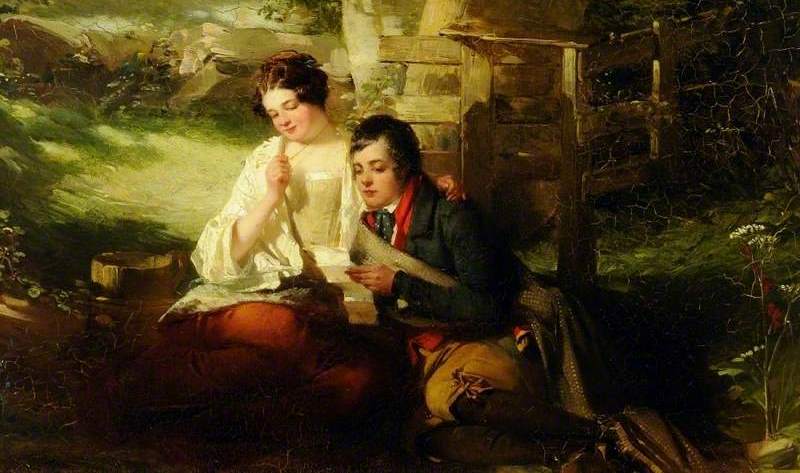
Again, thanks so much, and I love the image choice for this post.
Talbot
Talbot, thanks for your fine work choosing English words and syntax to reveal the compelling details of these poems. I do not know the language or culture as Evan does, but I find each brief poem a scene that invites lingering to fully appreciate it. Much of that effect comes from what you have put together in your own response to the Chinese I can’t read. I do notice the formal structure of rhyme and line length that differs among these three pieces, and I am glad you took care to manifest it.
Dear Margaret, thanks for reading and responding. The “poet’s note” is something of a continual struggle for me; on one hand, poems should speak largely for themselves, yet, on the other, there are certain things, especially when translating pieces hundreds of years old and from a worldview distinct from our Western tradition, that need to be highlighted so that the reader can more fully appreciate a work. I’m positive you know what I mean, given your translation work and skill. You and I are of one mind when it comes to the “lingering” nature of these poems; I’m not sure if I’m lingering in them, or they in me (though it’s probably both and doesn’t ultimately matter).
By the by, your poem “Hagi at My Study Window” is one I continually return to here at the SCP. I am positively enamored of it. Again, thanks for your perception and praise.
I agree with you that poems should speak for themselves, and in my original poems, I sometimes try to explain as much as possible within the poem. But that’s often counterproductive. I could hardly have started the hagi poem with a line or two about what hagi is, for the benefit of readers who have never heard of it. That needed a note. And notes can be absolutely necessary in translations, since the original author assumes a common culture with his readers. Your “Mourning the Dead” probably could stand without a note; if you publish it in a book of your own, consider an explanatory note (grouped with other such notes) at the end of the book. It is of interest to know that the author is a woman of a certain situation in history. A “star-river” is easy to imagine, but the reader of English will not know that means the Milky Way unless you say so. My own poem pages are often filled with notes that are too expansive because I write on the page everything I want to remember about the topic or the word choices or the poetic form. I find this practice valuable, because I do forget! And many things are not apparent even to one’s best poetic friends, who are usually more interested in the information or procedure than the general reader would be. Thanks for mentioning again how much you like “Hagi at My Study Window.” I looked back at it; at this distance and with your opinion, I consider it one of my best poems. That kind of judgment is almost impossible to make without feedback from others!
Absolutely. A line explaining the importance of Qingming Festival in a four-line poem would be ill-advised. But, you’re right, the “Mourning the Dead” piece could’ve stood on its own. I like the idea of filling the poem-page with one’s notes; I should probably get into that habit. My notes are . . . somewhat more dispersed. Thanks again for your helpful feedback and praise!
Loved these. Thank you, Mr. Hook. You demonstrate that Robert Frost’s over-repeated dictum, “poetry is what gets lost in translation,” is really no more than a half-truth. Good translations continue to keep old poets fresh, re-animating them to keep their voices alive and send echoes of ancient wisdom down through the centuries.
Dear Andrew, although I view the Frost line as more of a bon mot than anything else, there’s probably some truth in it. (And, regardless, it’s still very clever.) I agree about the importance of the translation of older works: they tie us to that which has come before, and to more tried-and-true ways of being that are now somewhat unfashionable. This makes such translation all the more necessary! Thanks for your comment, and for reading.