• Submit Poetry
  • Support SCP
  • About Us
  • Members
  • Join
Thursday, September 3, 2026
Society of Classical Poets
  • Poems
    • Beauty
    • Culture
    • Satire
    • Humor
    • Children’s
    • Art
    • Ekphrastic
    • Epic
    • Epigrams and Proverbs
    • Human Rights in China
    • Music
    • Performing Arts
    • Riddles
    • Science
    • Song Lyrics
    • The Environment
    • The Raven
    • Found Poems
    • High School Poets
    • Terrorism
    • Covid-19
  • Poetry Forms
    • Sonnet
    • Haiku
    • Limerick
    • Villanelle
    • Rondeau
    • Pantoum
    • Sestina
    • Triolet
    • Acrostic
    • Alexandroid
    • Alliterative
    • Blank Verse
    • Chant Royal
    • Clerihew
    • Rhupunt
    • Rondeau Redoublé
    • Rondel
    • Rubaiyat
    • Sapphic Verse
    • Shape Poems
    • Terza Rima
  • Great Poets
    • Geoffrey Chaucer
    • Emily Dickinson
    • Homer
    • Henry Wadsworth Longfellow
    • Dante Alighieri
    • John Keats
    • John Milton
    • Edgar Allan Poe
    • William Shakespeare
    • William Wordsworth
    • William Blake
    • Robert Frost
  • Love Poems
  • Contests
  • SCP Academy
    • Educational
    • Teaching Classical Poetry—A Guide for Educators
    • Poetry Forms
    • The SCP Journal
    • Books
No Result
View All Result
Society of Classical Poets
  • Poems
    • Beauty
    • Culture
    • Satire
    • Humor
    • Children’s
    • Art
    • Ekphrastic
    • Epic
    • Epigrams and Proverbs
    • Human Rights in China
    • Music
    • Performing Arts
    • Riddles
    • Science
    • Song Lyrics
    • The Environment
    • The Raven
    • Found Poems
    • High School Poets
    • Terrorism
    • Covid-19
  • Poetry Forms
    • Sonnet
    • Haiku
    • Limerick
    • Villanelle
    • Rondeau
    • Pantoum
    • Sestina
    • Triolet
    • Acrostic
    • Alexandroid
    • Alliterative
    • Blank Verse
    • Chant Royal
    • Clerihew
    • Rhupunt
    • Rondeau Redoublé
    • Rondel
    • Rubaiyat
    • Sapphic Verse
    • Shape Poems
    • Terza Rima
  • Great Poets
    • Geoffrey Chaucer
    • Emily Dickinson
    • Homer
    • Henry Wadsworth Longfellow
    • Dante Alighieri
    • John Keats
    • John Milton
    • Edgar Allan Poe
    • William Shakespeare
    • William Wordsworth
    • William Blake
    • Robert Frost
  • Love Poems
  • Contests
  • SCP Academy
    • Educational
    • Teaching Classical Poetry—A Guide for Educators
    • Poetry Forms
    • The SCP Journal
    • Books
No Result
View All Result
Society of Classical Poets
No Result
View All Result
Home Poetry Beauty

Essay: On George Herbert’s ‘Easter Wings’

March 25, 2018
in Beauty, Culture, Essays, Poetry, Shape Poems
A A
5
poems Essay: On George Herbert’s ‘Easter Wings’

by Jane Blanchard

George Herbert was born into a well-to-do and well-doing family of Montgomery, Wales, in 1593. When he was three years old, his father died, leaving a wife and ten children. Herbert nevertheless received a marvelous education, including studies at Westminster School in London and at Trinity College of Cambridge University. Early in his career, he held academic appointments and even served in Parliament; but, upon the death of King James I, he took holy orders in the Church of England. After marrying Jane Danvers in 1629, Herbert became the rector of a small parish near Salisbury in Wiltshire, where he died of tuberculosis in 1633, just before his fortieth birthday.

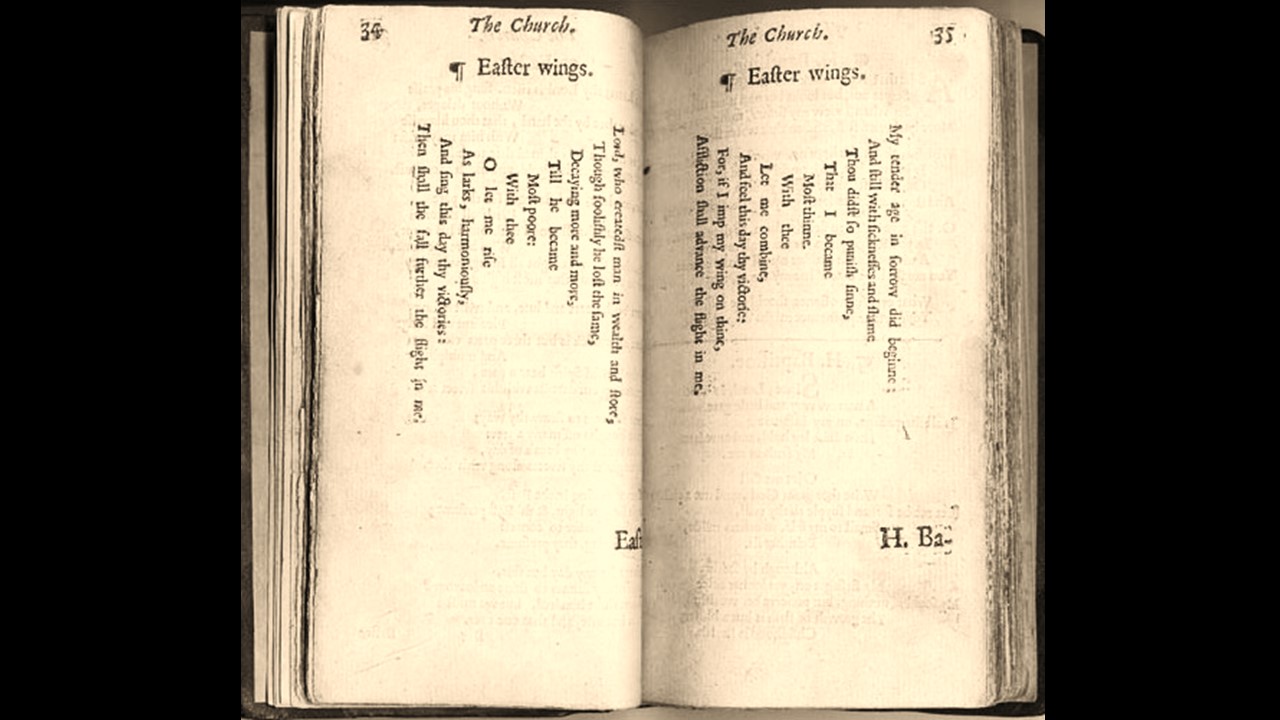
Later that same year, Herbert’s many poems were published in a collection called The Temple. These pieces were intricate representations of religious experience, particularly Herbert’s own passionate struggle to perceive and perform God’s will. The language, meter, imagery, and layout of The Temple established Herbert as an accomplished metaphysical poet, whose work went through eight editions by 1690 and still appears in various anthologies and hymnals today. One of Herbert’s most famous and admired poems is “Easter Wings”:

poems Essay: On George Herbert’s ‘Easter Wings’ poems Essay: On George Herbert’s ‘Easter Wings’

Originally turned on its right side, this composition is a marvelous example of a pattern poem, also known as shaped verse, which originated in ancient times, re-emerged during the Renaissance, and continued with and beyond twentieth-century examples by e. e. cummings, Dylan Thomas, and John Hollander. Obviously, the form of Herbert’s poem visually depicts its content in that the two stanzas look like sets of wings when printed on the page, but the reflective relationship between form and content works line by line as well as section by section.

“Easter Wings” is essentially a prayer incorporating praise, confession, and petition. The first word, “Lord,” establishes the direct address to God with a single strong syllable. The first stanza summarizes the creation of “man in wealth and store” before the loss of “the same” made man “Most poore,” and the decreasing length of the rhyming lines reflects this “Decaying” condition. The poet, of course, as man and of man, shares and suffers this condition and thus asks that he be able to “rise / As larks” and “sing” of God’s “victories” so that he may overcome, even regain, what has been lost so “foolishly.” It is by voicing God’s success that Herbert can achieve his own. With divine assistance he can ascend rather than descend; if truth be told, he can transcend the “fall” of man entirely. Paradoxically and alliteratively, his “flight” can and “shall” go “further” than if man had never fallen at all.

This traditional notion of the fortunate fall continues in the second stanza but becomes more personal. Here Herbert describes his own origin “in sorrow” and decline “with sicknesses and shame.” He states that the divine punishment of “sinne” made him “Most thinne,” a phrase that effectively comprises a full line in the middle of the stanza. Parallelism with the previous stanza continues in the very next line, “With thee,” which is an exact replica of what appeared earlier. At this point, the poet makes his second appeal—to “imp [or graft] his wing” with that of God so that “Affliction” can “advance” his own “flight.” With this unusual avian image, Herbert reasserts man’s dependence upon God to accomplish any “victorie,” especially any measure of health or wealth, whether material or spiritual.


Jane Blanchard lives and writes in Georgia.  One of her sonnets recently won the inaugural Letheon Poetry Prize.  She has two collections—Unloosed and Tides & Currents—both with Kelsay Books.

ShareTweetPin
The Society of Classical Poets does not endorse any views expressed in individual poems or commentary.
Read Our Comments Policy Here

RandomPoems

‘Candle’ by Carter Davis Johnson
Beauty

‘Candle’ by Carter Davis Johnson

July 17, 2018

  My candle burns at both ends Late into the night, And flickers fast, And bounces in my sight. My...

‘Candle’ by C.M. Rivers
Beauty

‘Candle’ by C.M. Rivers

July 31, 2018

  Slender pillar burning bright, remarkably distinguished. I wish that you could stay the night but you must be extinguished....

Next Post
poem/bryant/trolls

'A Tribe of Trolls' by E.V. Wyler

‘The Ride of Godiva’ by David E. Müller

'The Ride of Godiva' by David E. Müller

‘See the Music’ and Other Poetry by Joe Tessitore

'See the Music' and Other Poetry by Joe Tessitore

Comments 5

  1. Amy Foreman says:
    8 years ago

    Thank you, Jane, for this excellent and insightful essay on Herbert’s “Easter Wings.” Herbert has always been a favorite of mine, and this pattern poem is lovely visually and in its deeper meaning. I am also grateful to you for the explanation of “imp,”–meaning “to graft.” I had stumbled on that word before, and wondered what it meant, though the context suggests something close to “attach.” 🙂

    Reply
  2. Jenni Wyn Hyatt says:
    8 years ago

    I agree with Amy, Jane. This was very interesting and informative. Thank you.

    Reply
  3. J. Simon Harris says:
    8 years ago

    Thanks for writing this essay on Herbert’s classic poem. I was glad for the excuse to read this again, and you did a great job leading us through the poem with your essay. I also want to point out the rhyming and metrical structure of the poem. The syllable count goes 10-8-6-4-2-2-4-6-8-10 in each stanza, and the rhyme scheme is ABABACDCDC in each stanza, with some rhyme sounds repeated across the stanzas. The symmetry in form and content are really amazing, which is probably why this poem became so well loved. Thanks again for your essay!

    Reply
  4. Basil Drew Eceu says:
    8 years ago

    1.
    It’s delightful that writers @SCP consistently bring up their literary takes, reminding us, in all this diversity, the manifold possibilities of English. Fertility, variety and musicality are excellent traits in a language; and Mr. Mantyk continues to share those lyrics and criticism that appeal to him that cross his desktop. One of those fine examples is Ms. Blanchard’s microessay on Herbert’s “Easter Wings.”

    2.
    Although upon first sight, such verbal acrobatics, like Herbert’s “pattern poetry,” seem to be restricting exercises without purpose, or even worse, mere verbal tricks, it has the becoming quality of being brief, but “Easter Wings” so appropriate for this week, has remarkable literary depth in such a short work.

    3.
    The rhyme scheme, though over burdensome—ababacdcdc—does not surprisingly detract from the meaning. It adds another one of the agreeable patterns that saturate the work.

    4.
    The “decreasing lines” Ms. Blanchard notes decrease exactly by an iamb with each passing line; and then increase as well by the same, the back and forth through the two stanzas neatly reflective; so from the beginning iambic pentametre, Herbert takes us to tetrametre, trimetre, dimetre, and monometre, and so on.

    5.
    What interests me are the quiet metrical violations in the first stanza, the final anapest in line eight (hardly worth mentioning) and the trochee placed in the middle of line ten. It is exactly here where I hear Donne (as in his songs) and Hopkins in his overly forceful, alliterative sprung rhythm.

    6.
    The beginning parallelism of “With thee” that Ms. Blanchard points out is likewise complemented by the ending repetition of “the flight in me.” Herbert’s attention to detail in his poetic prayer is certainly remarkable.

    7.
    Ms. Blanchard’s explanation of “imp,” as Ms. Foreman has noted, is “informative,” to use Ms. Hyatt’s term. I can think of no writer in the English language who has used the word “imp” as conscientiously as Herbert has in this little poem, one mark of a great poet.

    8.
    With reasoned sentences, Ms. Blanchard guides us through Herbert’s thematic ideas with the sureness of a seasoned critic.

    9.
    As Ms. Blanchard accurately points out: “The first word, “Lord,” establishes the direct address to God with a single strong syllable.” What amazes me about Herbert’s opening word, is that, although one would expect an accent there, followed by “who,” the iamb is preserved; that is sheer artistic talent on the part of Herbert.

    10.
    Pursuing so many arenas, stories and poems from around the globe from all time, one can easily lose sight of these smallest of gems, and for Ms. Blanchard’s reminder to us, I am thankful.

    Reply
  5. James Sale says:
    8 years ago

    Thanks Jane, a great account of a great poem. What I like in poetry is what this poem demonstrates: a deep mimesis. We are familiar with the idea that onomatopoeia is where the sound mimics the sense, which is one example of mimesis. But here we have the shape too imitating the meaning. This is real art.

    Reply

Leave a Reply Cancel reply

Your email address will not be published. Required fields are marked *


  1. Rohini Sunderam on ‘A World Without the Wednesday Child’: A Poem by Kimberly ForeSeptember 3, 2026

    This is so beautiful. I must admit I smiled at: "Friday's altruists... hemorrhaging what misers lose." And thank you for…

  2. Margaret Coats on ‘A World Without the Wednesday Child’: A Poem by Kimberly ForeSeptember 2, 2026

    Very thoughtful verses, Kimberly, that make your readers more thoughtful. I discovered that a recently deceased friend was a Wednesday's…

  3. Thomas A. Hemminger on The Society of Classical Poets 2026 Haiku CompetitionSeptember 2, 2026

    Rain is welcome here— where parched, cracked earth wastes no tears, canyons drink their fill. Rivers wash the world. Eddies…

  4. Robert Nachtegall on ‘A World Without the Wednesday Child’: A Poem by Kimberly ForeSeptember 2, 2026

    Kimberly, a thoughtful and clever poem. I enjoy your vivid imagery and esteem for the melancholic temperament. Well done.

  5. Roy Eugene Peterson on ‘When Opportunity Knocks’: A Poem by Roy E. PetersonSeptember 2, 2026

    Perfect comment, C.B.

Subscribe to Daily Poems

Enter your email address to subscribe to this blog and receive notifications of new posts by email.

Join 1,633 other subscribers

Recent Poems

  • ‘A World Without the Wednesday Child’: A Poem by Kimberly Fore
  • The 2026 Society of Classical Poets International Poetry Competition
  • The 2026 SCP International High School Poetry Competition
  • ‘Realistic Reflections’ and Other Poetry by Anna J. Arredondo
  • ‘China Made’: A Poem by Theresa Werba
  • ‘The Savage Moon’ and Other Poetry by Brian Yapko
  • Poetry Book Review: Love Found, Yearned For, and Lost by James A. Tweedie
  • ‘When Opportunity Knocks’: A Poem by Roy E. Peterson
  • ‘Legend of the Griffin’: A Poem by Iryna Hall
  • ‘Government Issue’ and Other Poems by Joseph S. Salemi
  • ‘Chaucer Announces His Desire to Retire’: A Poem by Paul A. Freeman
  • ‘Advantages of Restaurants’ and Other Poems by Russel Winick
  • ‘Bone China’: A Poem by Mary Gardner
  • ‘On the Death of One Too Young to Die’: A Poem by Jeffrey Essmann
  • ‘This Too Shall Pass’ and Other Poetry by Justin Dasher
  • ‘Humdrum and Harum-Scarum’: A Lecture on Free Verse, by Robert Bridges (1922)
  • ‘Unrest On the Floodplain’: A Poem by Bhikkhu Nyanasobhano
  • ‘Latitude and Loss’: A Poem by Martin Briggs
  • ‘Act III’ and Other Poetry by C.B. Anderson
  • ‘God’s Funeral’: A Poem by James Sale
  • ‘Star Festival’: A Poem by Margaret Coats
  • ‘Song of the Frog Princess’: A Poem by Scharlie Meeuws
  • ‘The Odyssey: Nolan and Solot Compared’: An Essay by Michael Curtis
  • ‘Solitude’ and Other Poems by Mary Jane Myers
  • ‘The River Not Taken’ and Other Poetry by Brian Yapko
  • ‘Totentanz’: A Poem by James A. Tweedie
  • ‘In God Is Our Trust’: A Poem by Roy E. Peterson
  • ‘Confession’: A Poem by Jeffrey Essmann
  • ‘Religious Poetry, and Religionist Poetry’: An Essay by Joseph S. Salemi
  • The Zingers of Adam Sedia: A Review by Theresa Werba

Categories

  • Acrostic
  • Alexandroid
  • Alliterative
  • Art
  • Best Poems
  • Blank Verse
  • Chant Royal
  • Classical Poets Live
  • Clerihew
  • Covid-19
  • Deconstructing Communism
  • Educational
  • Epic
  • Epigrams and Proverbs
  • Essays
    • Interviews with Poets
    • Poetry Reviews
  • Featured
  • From the Society
  • Great Poets
    • Dante Alighieri
    • Edgar Allan Poe
    • Emily Dickinson
    • Geoffrey Chaucer
    • Henry Wadsworth Longfellow
    • Homer
    • John Keats
    • John Milton
    • Robert Frost
    • William Blake
    • William Shakespeare
    • William Wordsworth
  • Human Rights in China
  • Limerick
  • Love Poems
  • Music
  • Pantoum
  • Performing Arts
  • Poetry
    • Beauty
    • Children's Poems
    • Culture
    • Ekphrastic
    • Found Poems
    • High School Poets
    • Humor
    • Riddles
  • Poetry Challenge
  • Poetry Contests
  • Poetry Forms
    • Curtal Sonnet
    • Haiku
  • Poetry Readings
  • Rhupunt
  • Rondeau
  • Rondeau Redoublé
  • Rondel
  • Rubaiyat
  • Sapphic Verse
  • Satire
  • Science
  • Sestina
  • Shape Poems
  • Short Stories
  • Song Lyrics
  • Sonnet
  • Symposium
  • Terrorism
  • Terza Rima
  • The Environment
  • Translation
  • Triolet
  • Video
  • Villanelle

Quick Links

  • About Us
  • Submit Poetry
  • Become a Member
  • Members List
  • Support the Society
  • Advertisement Placement
  • Comments Policy
  • Terms of Use

Welcome Back!

Login to your account below

Forgotten Password?

Retrieve your password

Please enter your username or email address to reset your password.

Log In
No Result
View All Result
  • Poems
    • Beauty
    • Culture
    • Satire
    • Humor
    • Children’s
    • Art
    • Ekphrastic
    • Epic
    • Epigrams and Proverbs
    • Human Rights in China
    • Music
    • Performing Arts
    • Riddles
    • Science
    • Song Lyrics
    • The Environment
    • The Raven
    • Found Poems
    • High School Poets
    • Terrorism
    • Covid-19
  • Poetry Forms
    • Sonnet
    • Haiku
    • Limerick
    • Villanelle
    • Rondeau
    • Pantoum
    • Sestina
    • Triolet
    • Acrostic
    • Alexandroid
    • Alliterative
    • Blank Verse
    • Chant Royal
    • Clerihew
    • Rhupunt
    • Rondeau Redoublé
    • Rondel
    • Rubaiyat
    • Sapphic Verse
    • Shape Poems
    • Terza Rima
  • Great Poets
    • Geoffrey Chaucer
    • Emily Dickinson
    • Homer
    • Henry Wadsworth Longfellow
    • Dante Alighieri
    • John Keats
    • John Milton
    • Edgar Allan Poe
    • William Shakespeare
    • William Wordsworth
    • William Blake
    • Robert Frost
  • Love Poems
  • Contests
  • SCP Academy
    • Educational
    • Teaching Classical Poetry—A Guide for Educators
    • Poetry Forms
    • The SCP Journal
    • Books

© 2025 SCP. WebDesign by CODEC Prime.