• Submit Poetry
  • Support SCP
  • About Us
  • Members
  • Join
Monday, September 14, 2026
Society of Classical Poets
  • Poems
    • Beauty
    • Culture
    • Satire
    • Humor
    • Children’s
    • Art
    • Ekphrastic
    • Epic
    • Epigrams and Proverbs
    • Human Rights in China
    • Music
    • Performing Arts
    • Riddles
    • Science
    • Song Lyrics
    • The Environment
    • The Raven
    • Found Poems
    • High School Poets
    • Terrorism
    • Covid-19
  • Poetry Forms
    • Sonnet
    • Haiku
    • Limerick
    • Villanelle
    • Rondeau
    • Pantoum
    • Sestina
    • Triolet
    • Acrostic
    • Alexandroid
    • Alliterative
    • Blank Verse
    • Chant Royal
    • Clerihew
    • Rhupunt
    • Rondeau Redoublé
    • Rondel
    • Rubaiyat
    • Sapphic Verse
    • Shape Poems
    • Terza Rima
  • Great Poets
    • Geoffrey Chaucer
    • Emily Dickinson
    • Homer
    • Henry Wadsworth Longfellow
    • Dante Alighieri
    • John Keats
    • John Milton
    • Edgar Allan Poe
    • William Shakespeare
    • William Wordsworth
    • William Blake
    • Robert Frost
  • Love Poems
  • Contests
  • SCP Academy
    • Educational
    • Teaching Classical Poetry—A Guide for Educators
    • Poetry Forms
    • The SCP Journal
    • Books
No Result
View All Result
Society of Classical Poets
  • Poems
    • Beauty
    • Culture
    • Satire
    • Humor
    • Children’s
    • Art
    • Ekphrastic
    • Epic
    • Epigrams and Proverbs
    • Human Rights in China
    • Music
    • Performing Arts
    • Riddles
    • Science
    • Song Lyrics
    • The Environment
    • The Raven
    • Found Poems
    • High School Poets
    • Terrorism
    • Covid-19
  • Poetry Forms
    • Sonnet
    • Haiku
    • Limerick
    • Villanelle
    • Rondeau
    • Pantoum
    • Sestina
    • Triolet
    • Acrostic
    • Alexandroid
    • Alliterative
    • Blank Verse
    • Chant Royal
    • Clerihew
    • Rhupunt
    • Rondeau Redoublé
    • Rondel
    • Rubaiyat
    • Sapphic Verse
    • Shape Poems
    • Terza Rima
  • Great Poets
    • Geoffrey Chaucer
    • Emily Dickinson
    • Homer
    • Henry Wadsworth Longfellow
    • Dante Alighieri
    • John Keats
    • John Milton
    • Edgar Allan Poe
    • William Shakespeare
    • William Wordsworth
    • William Blake
    • Robert Frost
  • Love Poems
  • Contests
  • SCP Academy
    • Educational
    • Teaching Classical Poetry—A Guide for Educators
    • Poetry Forms
    • The SCP Journal
    • Books
No Result
View All Result
Society of Classical Poets
No Result
View All Result
Home Poetry Culture

An Alternative Ending to Romeo and Juliet by Reid McGrath

April 13, 2017
in Culture, Educational, Poetry
A A
7
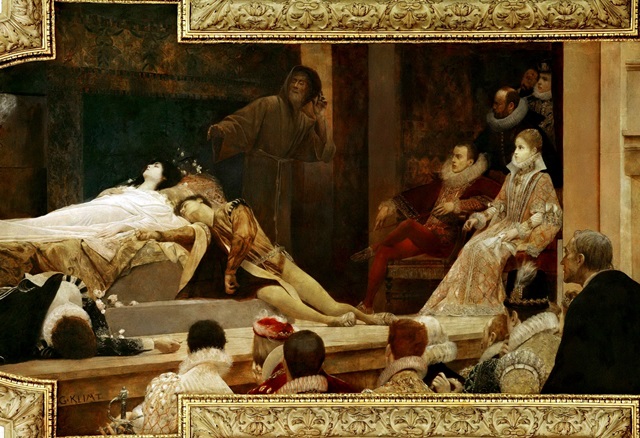
Öèôðîâàÿ ðåïðîäóêöèÿ íàõîäèòñÿ â èíòåðíåò-ìóçåå Gallerix.ru

Öèôðîâàÿ ðåïðîäóêöèÿ íàõîäèòñÿ â èíòåðíåò-ìóçåå Gallerix.ru

If Romeo Had Received the Letter

Part I

Romeo
(in the catacomb, lying down beside Juliet)

The friar’s note said: “Romeo she will wake.”
Thus here I am now with my life at stake.
You’ll resurrect? Or will the potion err?
the anesthesia taken on a dare,
a hope that it will work, won’t stop your brain;
I start to think that this is all insane.
You are my other half; I’m facing you.
Our eyes, like wounds, one inch apart. Into
your mouth, your nose, I breath. I crawl; I turn
beneath the pall, not facing you. Discern
my back now ‘gainst your back. I feel you move!
Aristophanes “whole-human” would approve.
A caterpillar in this sick cocoon;
I’ll wait to morph out of this backwards spoon.

Juliet
(One month later. She is sitting at a plain wooden table with a few crumbs on it, a dirty plate and glass, a vase full of wilted flowers, with some flies in the tepid and murky water. Romeo, who is gazing absentmindedly out of the window into one of Mantua’s more sordid city streets, has two empty wineskins of Cabernet in front of him. The apartment is small and unfurnished and you can hear the mice in the walls.)

So here we are in Mantua. What now?
Where once was sun a darkness clouds your brow.
You stay inside all day in this bare flat.
We don’t have money; yet you’re growing fat…
Tell me how that works, Romeo? Recall
our honeymoon, how ripped you were, the hall
we ran through, to our rooms, sloughing our clothes.
We really were a randy pair: God knows
we sinned; we did; but not in that way, no,
we were married; but Moses said: “I show
you these Commandments blazed into this rock
‘Obey your parents. V.’” Is it a shock
we suffer now financially, are shunned?
The friar’s plan was fry-ered; I just punned.

Romeo
Our honeymoon is done. There is no dough.
We went to where the honeymooners go:
to Rome and then to Ischia where the hares
are raised in pits, and fished out, sat in chairs
out in the yellow sun at some cafe
consuming bread and cheese and wine all day,
prosciutto from an acorn-finished pig;
I clenched in purple teeth an English cig.
We laid in bed all day, or by a pool,
or on the beach, or on the balc’. The cool
sweet air, from off the water, blew the sash.
We burned and burned through bonfires of cash.
For one month, oh; oh, what a life we led?
But now that month is gone. Our love is dead.

Juliet
What were we really thinking? How could we
leave all our fam behind? Just you and me?
It sounded nice while in that catacomb
but Verona’s the place I call my home.
It is the place that you call your home too
and that is why you hate me, why you’re blue.
Our dreams were dashed against the slipp’ry rocks!
Our dreams, like cars, should come with built in shocks
to mitigate the jolt of when they crash,
because of speed and speedbumps ere they smash,
careening towards the cliffs of Life, the sea
of what we know is mere Reality…
We should have got to know each other first.
The play goes poorly when it’s not rehearsed.

Romeo
You say I’m growing fat; I’m growing old.
A young man ages quick pining for gold.
I don’t know what to do; I’ve killed my friends
by getting in the middle. Make amends?
with who? O you Mercutio are dead
who always mocked those silly books I read:
Petrarch’s sad numbers, Dante’s early work
La Vita Nuova. I was wont to shirk
my duties for my father, Montague,
my studies in the classroom: “Oh boohoo!”
I wailed against my fate. My fate was good!
It’s just that I had never understood
the maxim bout the fishes in the sea.
You were, I thought, the only girl for me!

Juliet
I should have put you through more tests—my fault.
I was bombarded by your strong assault
of passion, ardor, language; Paris too
was knocking at my vestal door. I flew
into that bone-crib, drank the vile up,
for you, alas, the better looking pup,
the better talker, poet—Pilgrim, ah
and here we are exiles in Mantua…

Oh Romeo, I’m sorry, you’re not bad;
it’s just that when I think of what we had,
I think that life is one complex mean trick.
The gymnast needs to be coached ere she stick
her landing safely on the padded mat.
My kinsmen hate me; I blame me for that.

Romeo
(after a minute, growing visibly contemplative and remorseful)

You sound like Helen but it’s not your fault.
I was the Trojan Paris. I assault
you even now, when I should go to work,
get off my ass: The breadwinner can’t shirk
the onus that he owes to his nice wife.
The problem though is my entire life
I haven’t worked at all; nor have I said
I’m sorry, when I should have. Oh we’re wed
we might as well get on with it; I’m changed.
What if our marriage wasn’t pre-arranged?
Perhaps you didn’t love me like you thought;
you’re blameless, girl; two Parises had fought
for your white hand. I had the better tongue.
Should we go out tonight? I’m feeling young.

Juliet
We’ll take a walk. I want to talk tonight.
I am so glad we do not have to fight
about this any longer. When they see
us working on our marriage. It will be
clearer to them that we have settled down;
we have matured, are serious. The clown
of our old love has lost its squeaky nose.
Call our old love: “Pinocchio!” It grows
(the lie) despite the fact that one is blind
and ignorant — But that is all behind
us now, our nose has shrunk, and we are true
in that we now know what we have to do:
We have to nurture this, our Love, our seed.
My time of month’s long-gone and I don’t—

Romeo
(interrupting her)

You’re kidding— No, you’re serious. I don’t
know what to think; I have to think; I won’t!
I cannot be a Hamlet-thing; I think
too much (or like the Irish say) I tink.
Tinking is like a chisel and I tick
my Time away in tinking like a mick.
I drink too much; I tink too much; I tock;
I sway as if I were a kind of clock,
a reed; I paint, I draw, I write, I read.
But Doing-Time is here and now I need
to do, (“hacer,” in Spanish), duty mad
to do my duty as a doting dad.
I’ll go to work wherever work may be.
I’ll dig a ditch or I will plant a tree.


Part II

The Nurse
(Back in Verona, having received orders from the friar to go immediately to the two women, who are in a salon getting their hair done. They jump up, startled, in curlers, when the nurse arrives…)

O Lady Montague and Capulet!
I know you have been worried but don’t fret!
I know you have lost sleep over your bond
of friendship, lest your husbands know, abscond
you need not do; but please to Mantua
come see your new grandchild! I just saw
him for myself! He’s healthy and he’s calm!
Delivered just this morning in white balm
that comes with birth: protecting him. On dug
of Juliet herself! I see you hug!
You know that all these family quarrels will
be swallowed and forgiven like a pill
that succors, uplifts. This his name will do:
Mercutio Capulet Montague…!!!


Reid McGrath lives and writes in the Hudson Valley Region of New York.
ShareTweetPin
The Society of Classical Poets does not endorse any views expressed in individual poems or commentary.
Read Our Comments Policy Here

RandomPoems

‘Autism Sonnet’: A Poem by Theresa Werba
Culture

‘Autism Sonnet’: A Poem by Theresa Werba

August 9, 2025

. Autism Sonnet The lights are much too light and sounds too loud; And thoughts are only thought in black...

‘Questions for the Gods: Sisyphus’ by Alan Toltzis
Culture

‘Questions for the Gods: Sisyphus’ by Alan Toltzis

July 29, 2016

for Claudia Why didn’t Sisyphus simply walk away and climb, unencumbered, up the smooth cleft worn in the undulant hillside,...

Next Post
‘Spring Was Near, Now Spring’s Here’ by Carolyn Clark

'Spring Was Near, Now Spring’s Here' by Carolyn Clark

poetry/cook/Sally Cook biography

Poet Bio: Sally Cook

William Trost Richards: A Lesser-Known American Great

'Visiting the Ruins of Tintagel Castle' and Other Poetry by Evan Mantyk

Comments 7

  1. Amy Foreman says:
    9 years ago

    Anachronistically witty and delightful, Reid! I like this ending better than Shakespeare’s. 🙂

    Reply
  2. Kathy F. says:
    9 years ago

    I really enjoyed reading this!

    Reply
  3. Sathyanarayana says:
    9 years ago

    This is a very very interesting ending and of course it’s the natural good ending too. Yes, the boys and girls go mad with love, and never think of their future. No dough, no love. Aging cures some ailments, even love. The language and narrative style and poetic style(without capitalisation of first letter…the style I follow) are all beautiful.

    Reply
  4. Dona Fox says:
    9 years ago

    Delightful.

    Reply
  5. Reid McGrath says:
    9 years ago

    Thank you. I’m glad you all enjoyed it. It was a fun project. There’s actually a father Montague and Capulet section that I clipped for the journal because the whole piece was too long already. But now I am hesitant to share it as this ending seems to be successful.

    Reply
  6. Bob McGinness says:
    9 years ago

    I love it. My favorite line: “The play goes poorly when it’s not rehearsed.”

    Reply
  7. Wilude Scabere says:
    9 years ago

    Nice, down-to-Earth, humourous take on Shakespeare, some fun vernac, chock-a-block with pleasant lines and surprising scenes.

    Reply

Leave a Reply Cancel reply

Your email address will not be published. Required fields are marked *


  1. Robert C. Sibley on The Society of Classical Poets 2026 Haiku CompetitionSeptember 14, 2026

    Ms. Coats: Thank you. Much appreciated. Can I assume my other trio of haiku are available for consideration? Or should…

  2. Robert C. Sibley on The Society of Classical Poets 2026 Haiku CompetitionSeptember 14, 2026

    Ms. Coats: Thank you. Much appreciated. Can I assume my other trio of haiku are still available for consideration? Regards,…

  3. Margaret Coats on The Society of Classical Poets 2026 Haiku CompetitionSeptember 14, 2026

    I've noticed your note, Robert. Have withdrawn your "Resubmitted" selection from consideration by the judges, so don't worry if it…

  4. Rosya Amelia S on The Society of Classical Poets 2026 Haiku CompetitionSeptember 13, 2026

    Where do I come from I want to know who I am Victor Frankenstein

  5. Yael on ‘Professional Mourner’: A Poem by Brian YapkoSeptember 13, 2026

    This is a fascinating poem indeed. A casual reading would suggest that one older and experienced professional mourner is talking…

Subscribe to Daily Poems

Enter your email address to subscribe to this blog and receive notifications of new posts by email.

Join 1,738 other subscribers
No Result
View All Result

Resources

       1. A Guide to Writing Poetry

      2. The Best Poems of 2020      

      3. Poetry and Writing Contests

      4. Journals Accepting Formal Verse

Recent Poems

  • ‘Professional Mourner’: A Poem by Brian Yapko
  • A Distillation of Shakespeare’s ‘A Midsummer Night’s Dream’ by Martin Briggs
  • ‘How the Mighty Fell!’: A Poem by Jeff Kemper
  • ‘The One Lone Juror’: A Poem by Joseph S. Salemi
  • ‘Soul of a Prophet’: A Trialog Poem by T.M. Moore
  • ‘Nelson and George’: A Poem by David Filpula
  • ‘When She Arrives’: A Poem by Bhairab Barman
  • ‘On to Better Days’: A Poem by Bruce Dale Wise
  • ‘Serenade’ and Other Poetry by Adam Sedia
  • ‘Self-Exploration’ and Other Poems by Paul Millan
  • ‘Victory’: A Poem by Jonathan Graver
  • ‘The Cristero Centennial’: A Poem by Margaret Coats
  • ‘A Potpourri of Aphoristic Verses’ by C.B. Anderson
  • ‘The Estuary’: A Poem by Jeff Eardley
  • ‘A World Without the Wednesday Child’: A Poem by Kimberly Fore
  • The 2026 Society of Classical Poets International Poetry Competition
  • The 2026 SCP International High School Poetry Competition
  • ‘Realistic Reflections’ and Other Poetry by Anna J. Arredondo
  • ‘China Made’: A Poem by Theresa Werba
  • ‘The Savage Moon’ and Other Poetry by Brian Yapko
  • Poetry Book Review: Love Found, Yearned For, and Lost by James A. Tweedie
  • ‘When Opportunity Knocks’: A Poem by Roy E. Peterson
  • ‘Legend of the Griffin’: A Poem by Iryna Hall
  • ‘Government Issue’ and Other Poems by Joseph S. Salemi
  • ‘Chaucer Announces His Desire to Retire’: A Poem by Paul A. Freeman
  • ‘Advantages of Restaurants’ and Other Poems by Russel Winick
  • ‘Bone China’: A Poem by Mary Gardner
  • ‘On the Death of One Too Young to Die’: A Poem by Jeffrey Essmann
  • ‘This Too Shall Pass’ and Other Poetry by Justin Dasher
  • ‘Humdrum and Harum-Scarum’: A Lecture on Free Verse, by Robert Bridges (1922)

Categories

  • Acrostic
  • Alexandroid
  • Alliterative
  • Art
  • Best Poems
  • Blank Verse
  • Chant Royal
  • Classical Poets Live
  • Clerihew
  • Covid-19
  • Deconstructing Communism
  • Educational
  • Epic
  • Epigrams and Proverbs
  • Essays
    • Interviews with Poets
    • Poetry Reviews
  • Featured
  • From the Society
  • Great Poets
    • Dante Alighieri
    • Edgar Allan Poe
    • Emily Dickinson
    • Geoffrey Chaucer
    • Henry Wadsworth Longfellow
    • Homer
    • John Keats
    • John Milton
    • Robert Frost
    • William Blake
    • William Shakespeare
    • William Wordsworth
  • Human Rights in China
  • Limerick
  • Love Poems
  • Music
  • Pantoum
  • Performing Arts
  • Poetry
    • Beauty
    • Children's Poems
    • Culture
    • Ekphrastic
    • Found Poems
    • High School Poets
    • Humor
    • Riddles
  • Poetry Challenge
  • Poetry Contests
  • Poetry Forms
    • Curtal Sonnet
    • Haiku
  • Poetry Readings
  • Rhupunt
  • Rondeau
  • Rondeau Redoublé
  • Rondel
  • Rubaiyat
  • Sapphic Verse
  • Satire
  • Science
  • Sestina
  • Shape Poems
  • Short Stories
  • Song Lyrics
  • Sonnet
  • Symposium
  • Terrorism
  • Terza Rima
  • The Environment
  • Translation
  • Triolet
  • Video
  • Villanelle

Quick Links

  • About Us
  • Submit Poetry
  • Become a Member
  • Members List
  • Support the Society
  • Advertisement Placement
  • Comments Policy
  • Terms of Use

Welcome Back!

Login to your account below

Forgotten Password?

Retrieve your password

Please enter your username or email address to reset your password.

Log In
No Result
View All Result
  • Poems
    • Beauty
    • Culture
    • Satire
    • Humor
    • Children’s
    • Art
    • Ekphrastic
    • Epic
    • Epigrams and Proverbs
    • Human Rights in China
    • Music
    • Performing Arts
    • Riddles
    • Science
    • Song Lyrics
    • The Environment
    • The Raven
    • Found Poems
    • High School Poets
    • Terrorism
    • Covid-19
  • Poetry Forms
    • Sonnet
    • Haiku
    • Limerick
    • Villanelle
    • Rondeau
    • Pantoum
    • Sestina
    • Triolet
    • Acrostic
    • Alexandroid
    • Alliterative
    • Blank Verse
    • Chant Royal
    • Clerihew
    • Rhupunt
    • Rondeau Redoublé
    • Rondel
    • Rubaiyat
    • Sapphic Verse
    • Shape Poems
    • Terza Rima
  • Great Poets
    • Geoffrey Chaucer
    • Emily Dickinson
    • Homer
    • Henry Wadsworth Longfellow
    • Dante Alighieri
    • John Keats
    • John Milton
    • Edgar Allan Poe
    • William Shakespeare
    • William Wordsworth
    • William Blake
    • Robert Frost
  • Love Poems
  • Contests
  • SCP Academy
    • Educational
    • Teaching Classical Poetry—A Guide for Educators
    • Poetry Forms
    • The SCP Journal
    • Books

© 2025 SCP. WebDesign by CODEC Prime.