• Submit Poetry
  • Support SCP
  • About Us
  • Members
  • Join
Thursday, August 20, 2026
Society of Classical Poets
  • Poems
    • Beauty
    • Culture
    • Satire
    • Humor
    • Children’s
    • Art
    • Ekphrastic
    • Epic
    • Epigrams and Proverbs
    • Human Rights in China
    • Music
    • Performing Arts
    • Riddles
    • Science
    • Song Lyrics
    • The Environment
    • The Raven
    • Found Poems
    • High School Poets
    • Terrorism
    • Covid-19
  • Poetry Forms
    • Sonnet
    • Haiku
    • Limerick
    • Villanelle
    • Rondeau
    • Pantoum
    • Sestina
    • Triolet
    • Acrostic
    • Alexandroid
    • Alliterative
    • Blank Verse
    • Chant Royal
    • Clerihew
    • Rhupunt
    • Rondeau Redoublé
    • Rondel
    • Rubaiyat
    • Sapphic Verse
    • Shape Poems
    • Terza Rima
  • Great Poets
    • Geoffrey Chaucer
    • Emily Dickinson
    • Homer
    • Henry Wadsworth Longfellow
    • Dante Alighieri
    • John Keats
    • John Milton
    • Edgar Allan Poe
    • William Shakespeare
    • William Wordsworth
    • William Blake
    • Robert Frost
  • Love Poems
  • Contests
  • SCP Academy
    • Educational
    • Teaching Classical Poetry—A Guide for Educators
    • Poetry Forms
    • The SCP Journal
    • Books
No Result
View All Result
Society of Classical Poets
  • Poems
    • Beauty
    • Culture
    • Satire
    • Humor
    • Children’s
    • Art
    • Ekphrastic
    • Epic
    • Epigrams and Proverbs
    • Human Rights in China
    • Music
    • Performing Arts
    • Riddles
    • Science
    • Song Lyrics
    • The Environment
    • The Raven
    • Found Poems
    • High School Poets
    • Terrorism
    • Covid-19
  • Poetry Forms
    • Sonnet
    • Haiku
    • Limerick
    • Villanelle
    • Rondeau
    • Pantoum
    • Sestina
    • Triolet
    • Acrostic
    • Alexandroid
    • Alliterative
    • Blank Verse
    • Chant Royal
    • Clerihew
    • Rhupunt
    • Rondeau Redoublé
    • Rondel
    • Rubaiyat
    • Sapphic Verse
    • Shape Poems
    • Terza Rima
  • Great Poets
    • Geoffrey Chaucer
    • Emily Dickinson
    • Homer
    • Henry Wadsworth Longfellow
    • Dante Alighieri
    • John Keats
    • John Milton
    • Edgar Allan Poe
    • William Shakespeare
    • William Wordsworth
    • William Blake
    • Robert Frost
  • Love Poems
  • Contests
  • SCP Academy
    • Educational
    • Teaching Classical Poetry—A Guide for Educators
    • Poetry Forms
    • The SCP Journal
    • Books
No Result
View All Result
Society of Classical Poets
No Result
View All Result
Home Art

A Reading of a Poem by Washington Allston (1779–1843)

March 7, 2013
in Art, Beauty, Poetry
A A
0
poems A Reading of a Poem by Washington Allston (1779–1843)

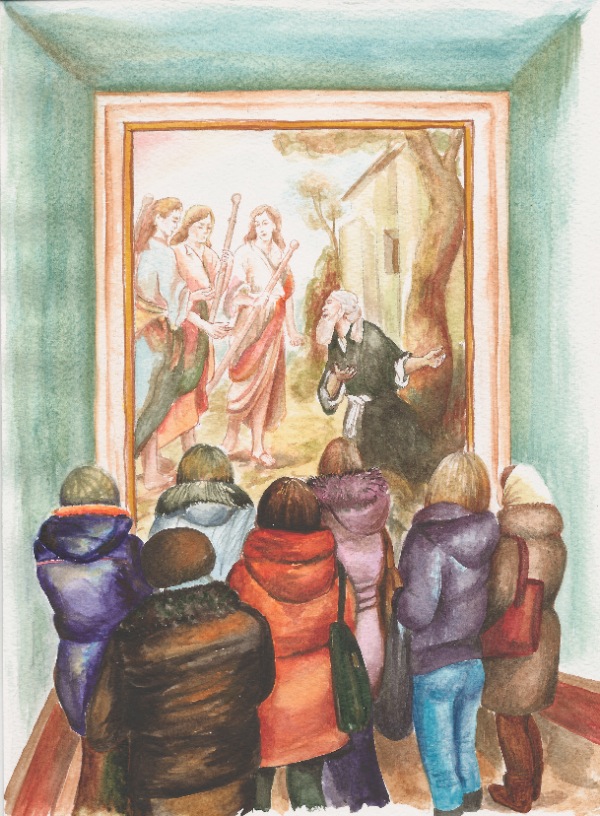
‘On The Group Of The Three Angels Before The Tent Of Abraham, By Raphael, In The Vatican’

O, now I feel as though another sense,
From heaven descending, had informed my soul;
I feel the pleasurable, full control
Of Grace, harmonious, boundless, and intense.
In thee, celestial Group, embodied lives
The subtle mystery, that speaking gives
Itself resolved; the essences combined
Of Motion ceaseless, Unity complete.
Borne like a leaf by some soft eddying wind,
Mine eyes, impelled as by enchantment sweet,
From part to part with circling motion rove,
Yet seem unconscious of the power to move;
From line to line through endless changes run,
O’er countless shapes, yet seem to gaze on One.

— Washington Allston (1779–1843)

Washington Allston was an American painter and poet, born in Waccamaw Parish, South Carolina.

Featured Image: Liza Voronin/The Epoch Times

Analysis by Christopher Nield:

This poem describes a Stendahl moment: a moment of incandescent beauty that overwhelms, dazes, and transfigures the viewer. The object is Raphael’s depiction of three angels visiting the prophet Abraham. The viewer is you.

Every reader reciting the words becomes the ‘I’ of the poem. It begins with a powerful, repeated assertion of personal emotion: “I feel.” This feeling is compounded by pleasure—a sensuous, gut response to line, color, and form. The rational mind is overpowered, smashed and yet intoxicated.

In Raphael’s painting, we see the prophet Abraham bowed down, half in fear, half in wonder, at three visitors in front of his humble home. They are richly dressed with billowing, colorful robes. Their gestures are flowing and rhythmical, as if they were dancing. They are otherworldly. They are angels. However, for Raphael, these three angels also evoke the three graces of Greek mythology.

What on earth do we do when angels come knocking on our door? In this story from the Book of Genesis, Abraham runs to fetch some meat, some butter, and some milk. He is then told that his wife Sarah will have a son, even though they are both “old and well stricken in age.” So this is the story of miraculous new life.

Raphael is so skilled that when we gaze upon his artistry, it is “as though” our five senses are replaced by a sixth “from heaven.” This conditional phrase subtly replaces the religious nature of the image, dating back to the Renaissance, with the Romantic cult of the sublime.

To understand the sublime, we only have to take a look at Allston’s own canvases. As a Romantic painter, he depicts black waves beneath brooding storms, glimmering streams dominated by ghastly full moons, sunlit sails by the balmy Mediterranean shore, and Biblical figures of lone prophets amid desert sands. He takes us away from the routine world of society into far-flung realms, both outer and inner.

Together, with Allston, as we look on Raphael’s three divine figures, we feel the “pleasurable, full control/Of Grace.” In other words, we are out of control. We are controlled by grace, in a kind of angelic possession. We are part now of a living universe that is “harmonious, boundless, intense.” The universe becomes meaningful, infinite, and full of feeling—and we are right at the center.

Somehow ceaseless “Motion” and the stillness of “Unity” are reconciled. “From line to line,” the painting and the poem appear to merge too. Gazing on both, our sight is “borne like a leaf.” This wind is the Holy Spirit, prana, or sheer inspiration. Our eyes are “impelled,” under the control of Grace, to dart to and fro—to take everything in. Their circling motion traces a figure of eternity, where “endless changes” and “countless shapes” resolve into a single image. The many reveals the “one.” To echo this, the poem begins and ends with an “O,” a sacred circle.

The Jungian analyst Erich Neumann writes that when we make ourselves vulnerable to art, there is “a streaming moment, as flowing and ungraspable as the vitality of life itself.” Allston is careful to frame his observations within a psychological context, using phrases like “as though” and “seem” to avoid being too certain, preachy, or excessive. The poem is less about a religious ideal than an imaginative one. It is through great art that religious and non-religious people can gather, in a shared experience of mute wonder.

Christopher Nield is a poet living in London.

Originally printed on The Epoch Times.

ShareTweetPin
The Society of Classical Poets does not endorse any views expressed in individual poems or commentary.
Read Our Comments Policy Here

RandomPoems

Poetry

Letting Go

August 20, 2012

By Evan Mantyk Get this thing out of my mind, It should never undermine, It should go and let me...

‘Kant’ by Connor Rosemond
Beauty

‘Kant’ by Connor Rosemond

July 24, 2018

  Out of the crooked timber laid by man, No straight foundation may ever be built. While Reason clinkers on...

Next Post

'Looking for Your Keys' and Other Poetry by Christopher W. Boyden

Art: An Angel Reads Li Bai

Art: An Angel Reads Li Bai

'To The Society of Classical Poets' by Steve Johns

Leave a Reply Cancel reply

Your email address will not be published. Required fields are marked *


  1. Gerard Maritato on ‘The Odyssey: Nolan and Solot Compared’: An Essay by Michael CurtisAugust 20, 2026

    It seems like the so called translation they used in the movie took an English translation and scrubbed out the…

  2. James A. Tweedie on ‘Act III’ and Other Poetry by C.B. AndersonAugust 20, 2026

    I most certainly do and the gratitude is all mine.

  3. C.B. Anderson on ‘Act III’ and Other Poetry by C.B. AndersonAugust 20, 2026

    As always, James, you are much too thoughtful, which is a virtue, not a vice. Mortality is always the elephant…

  4. C.B. Anderson on ‘Act III’ and Other Poetry by C.B. AndersonAugust 20, 2026

    Don't hope too hard, Roy. It will catch up to you before you know it, and you will be lucky…

  5. C.B. Anderson on ‘Act III’ and Other Poetry by C.B. AndersonAugust 20, 2026

    If I can't laugh at it, Joseph, who will? You must have noticed that your family gives you a lot…

Subscribe to Daily Poems

Enter your email address to subscribe to this blog and receive notifications of new posts by email.

Join 1,616 other subscribers

Recent Poems

  • ‘Act III’ and Other Poetry by C.B. Anderson
  • ‘God’s Funeral’: A Poem by James Sale
  • ‘Star Festival’: A Poem by Margaret Coats
  • ‘Song of the Frog Princess’: A Poem by Scharlie Meeuws
  • ‘The Odyssey: Nolan and Solot Compared’: An Essay by Michael Curtis
  • ‘Solitude’ and Other Poems by Mary Jane Myers
  • ‘The River Not Taken’ and Other Poetry by Brian Yapko
  • ‘Totentanz’: A Poem by James A. Tweedie
  • ‘In God Is Our Trust’: A Poem by Roy E. Peterson
  • ‘Confession’: A Poem by Jeffrey Essmann
  • ‘Religious Poetry, and Religionist Poetry’: An Essay by Joseph S. Salemi
  • The Zingers of Adam Sedia: A Review by Theresa Werba
  • ‘A Paradox’: A Poem by Shamik Banerjee
  • ‘A Prayer of Aristotle’: A Poem by Margaret Coats
  • ‘The Sparrow’: A Poem by Michael Pietrack
  • ‘Chemo Refusal’ and Other Poetry by Golan Shahar
  • ‘Deliverance’ and Other Poetry by Peter Venable
  • ‘Rain’ and Other Poems by Russel Winick
  • ‘The Story of a Plague’ and Other Poetry by Michael Robinson
  • ‘Javert Derailed’: A Poem by Zanna Barton
  • ‘People Forget’: A Poem by James Sale
  • ‘Good and Evil’: A Poem by Roy E. Peterson
  • ‘The Royal Arse Hortillery’: A Poem on the Spoonerism, by Jeff Eardley
  • ‘Who Hears a Robot’s Prayer?’ and Other Poetry by Brian Yapko
  • The Society of Classical Poets 2026 Haiku Competition
  • Four Love Sonnets by Adam Sedia
  • ‘Rasputina Confers with Her Cohorts’: A Poem by Joseph S. Salemi
  • ‘Warfare by Remote Control’: A Poem by Paul A. Freeman
  • ‘The Passing’: A Poem by Margaret Brinton
  • ‘Of Webs and Whispers’: A Poem by Susan Jarvis Bryant

Categories

  • Acrostic
  • Alexandroid
  • Alliterative
  • Art
  • Best Poems
  • Blank Verse
  • Chant Royal
  • Classical Poets Live
  • Clerihew
  • Covid-19
  • Deconstructing Communism
  • Educational
  • Epic
  • Epigrams and Proverbs
  • Essays
    • Interviews with Poets
    • Poetry Reviews
  • Featured
  • From the Society
  • Great Poets
    • Dante Alighieri
    • Edgar Allan Poe
    • Emily Dickinson
    • Geoffrey Chaucer
    • Henry Wadsworth Longfellow
    • Homer
    • John Keats
    • John Milton
    • Robert Frost
    • William Blake
    • William Shakespeare
    • William Wordsworth
  • Human Rights in China
  • Limerick
  • Love Poems
  • Music
  • Pantoum
  • Performing Arts
  • Poetry
    • Beauty
    • Children's Poems
    • Culture
    • Ekphrastic
    • Found Poems
    • High School Poets
    • Humor
    • Riddles
  • Poetry Challenge
  • Poetry Contests
  • Poetry Forms
    • Curtal Sonnet
    • Haiku
  • Poetry Readings
  • Rhupunt
  • Rondeau
  • Rondeau Redoublé
  • Rondel
  • Rubaiyat
  • Sapphic Verse
  • Satire
  • Science
  • Sestina
  • Shape Poems
  • Short Stories
  • Song Lyrics
  • Sonnet
  • Symposium
  • Terrorism
  • Terza Rima
  • The Environment
  • Translation
  • Triolet
  • Video
  • Villanelle

Quick Links

  • About Us
  • Submit Poetry
  • Become a Member
  • Members List
  • Support the Society
  • Advertisement Placement
  • Comments Policy
  • Terms of Use

Welcome Back!

Login to your account below

Forgotten Password?

Retrieve your password

Please enter your username or email address to reset your password.

Log In
No Result
View All Result
  • Poems
    • Beauty
    • Culture
    • Satire
    • Humor
    • Children’s
    • Art
    • Ekphrastic
    • Epic
    • Epigrams and Proverbs
    • Human Rights in China
    • Music
    • Performing Arts
    • Riddles
    • Science
    • Song Lyrics
    • The Environment
    • The Raven
    • Found Poems
    • High School Poets
    • Terrorism
    • Covid-19
  • Poetry Forms
    • Sonnet
    • Haiku
    • Limerick
    • Villanelle
    • Rondeau
    • Pantoum
    • Sestina
    • Triolet
    • Acrostic
    • Alexandroid
    • Alliterative
    • Blank Verse
    • Chant Royal
    • Clerihew
    • Rhupunt
    • Rondeau Redoublé
    • Rondel
    • Rubaiyat
    • Sapphic Verse
    • Shape Poems
    • Terza Rima
  • Great Poets
    • Geoffrey Chaucer
    • Emily Dickinson
    • Homer
    • Henry Wadsworth Longfellow
    • Dante Alighieri
    • John Keats
    • John Milton
    • Edgar Allan Poe
    • William Shakespeare
    • William Wordsworth
    • William Blake
    • Robert Frost
  • Love Poems
  • Contests
  • SCP Academy
    • Educational
    • Teaching Classical Poetry—A Guide for Educators
    • Poetry Forms
    • The SCP Journal
    • Books

© 2025 SCP. WebDesign by CODEC Prime.