


.
Officium Defunctorum
Spiritus meus attenuabitur, dies mei breviabuntur,
et solum mihi superest sepulcrum. —Job 17:1
There is no need for first or final vow;
Our cities all are monasteries now,
And every squalid garret is a cell
Where oblates reach for heaven out of hell.
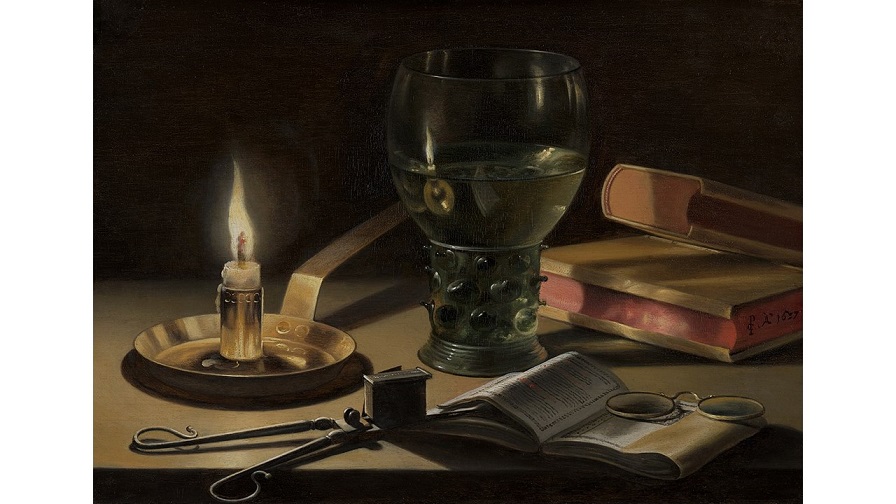
There is no light, no single light that burns
Unsnuffed, uncheapened by a vulgar sun
That mocks our petty candles, as it turns
Them into dying embers, one by one.
A struck match flares an instant, then it’s out
And shows us nothing but enshadowed doubt,
Uncertain as this photo-blur of time
We wade through, grasping out the human mime.
Dusk is here—the windows give less light;
Corners darken; only the sophist-glow
Of lying lamps remains to postpone night—
The night that will come, whether we will or no.
.
Note
The Office of the Dead (Officium Defunctorum) is recited in memory of the departed.
Job 17:1 – My spirit will be weakened, my days will be shortened, and only the tomb
remains for me.
.
.
For the Churlish Priest
…Lay her i’ the earth,
And from her fair and unpolluted flesh
May violets spring! I tell thee, churlish priest,
A minist’ring angel shall my sister be
When thou liest howling.
—Hamlet, Act V, scene 1
I have heard it said that death is sleep,
Gravity’s pull on sinful, fallen flesh
That must await a promised resurrection.
We are thrashed in turn by love and loss
And come at last to coffin-wood and stone,
The reticence of laconic epitaphs.
So bury her without the sacred rites—
I know the flowers that my sister keeps
Are more than candles or the golden cup.
.
.
Evensong
Twilight in my garden nods her head—
A slowly slipping diadem of rose
Creamy with the pastel-pink of seashells
Burns behind the yellowed leaves in rows,
Makes of them mute and shield-like cameos.
Does she salute the living, or the dead?
Is she a theme for poetry, or prose?
Do I weave hopeless fancies from inkwells?
Is that the life my savage spirit chose?
Light the votive candles. Late it grows.
.
.
Joseph S. Salemi has published five books of poetry, and his poems, translations and scholarly articles have appeared in over one hundred publications world-wide. He is the editor of the literary magazine TRINACRIA and writes for Expansive Poetry On-line. He teaches in the Department of Humanities at New York University and in the Department of Classical Languages at Hunter College.
















These are all exquisitely beautiful. I find “Officium Defunctorum” to be the most moving, particularly “Where oblates reach for heaven out of hell.” and the description of the way the sun turns our candles into dying embers. The short phrases “enshadowed doubt” and “photo blur of time” have so much more meaning than their few words would seem to be able to contain. Your description of sunset in “Evensong” also paints a vivid mental picture with a marvelous economy of words.
My sincerest thanks, Cynthia. I’m glad that you are moved by them.
Very nice, Joe. The first one, especially: haunting, made me feel like I was standing there in the dusk.
Thank you, Paul. The poems are quite old, having come from my notebooks dating to the late 1960s and early 70s. I was still in graduate school.
You have pulled off a hat trick here, Joseph. Behind every line, the heft of your vast knowledge of literature and its themes is almost palpable. The structure of the third poem leaves me bemused (in the good sense of the word) and inspired to create similar structures. Overall, these poems are deft and trenchant, which is all we ask of you.
Thanks, Kip! They’re oldies but goodies, I suppose. I used a rhyme scheme of ABCBB in the last poem just for the hell of it. I liked the idea of rhyming seashells with inkwells, and the use of a French rime riche with “rose” and ‘rows.”
I didn’t comment on your last poem here, so let me just say “Cat will mew, and dog will have his day!”
“Light the votive candles. Late it grows.” – poignant! I feel like that will become the preliminary quote to some poetry or prose of my own one of these days.
I hope it will, Jeremiah. I often wonder why so many titles and verbal reminiscences come from the poetry of Ernest Dowson: “Gone With The Wind,”
“Days of Wine and Roses,” “I have been faithful to thee, in my fashion.”
Such exquisite words and phrases in your first and last poems imparting imagery unparalleled propel your poetic prowess to the highest realms of the greatest poets.
Or something like that.
Joseph, I’m stunned by the bleak beauty and profundity of thought in Officium Defunctorum. That this was in fact written by you as a young man is almost startling as this feels very much like the sepulchral song of one approaching winter rather than summer. The aura of death is pervasive from the title to the Job quote to each carefully selected word. It’s frightening and it’s wonderful. I’m fascinated by the conceit of our cities all as monasteries and what I pick up from this is the observation that every single human soul is cloistered. There is pain here, and acceptance. Despite the modernistic “photo-blur” there is also an oblique Medieval sensibility which is added to with the idea of monastic cells, single lights that burn and the one thing that postpones the dusk: the sophist-glow – that awareness of philosophy which does nothing whatsoever to stop death but which at least allows a way through wisdom to accept it.
“For the Churlish Priest” is an interesting expansion of Laertes’ thoughts concerning the death of Ophelia and his rebuke of the priest. The idea that church candles and the chalice might be outweighed in Heaven by the flowers loved by Ophelia is irreverent but carries great emotional weight and something deep to ponder for it calls into question the relative values of the institutions of religion versus Creation itself. Nature versus artifice. This short poem and its expansion of Hamlet is deceptively simple.
Lastly, “Evensong” is a splendid meditation which feels rather personal – particularly with reference to the “life my savage spirit chose.” Interestingly, the aggressive boldness of the word “savage” in describing the speaker’s spirit is utterly at odds with every other image and thought in the piece. What makes it wonderful is it feels like a sudden, unexpected cri de coeur which is then immediately suppressed (repressed?) by order and duty. “Light the votive candles.” This colors the words “Late it grows” with a subtle world-weariness.
All three of these poems are remarkable.
No kidding.
To all commenters: I’m very grateful for your kind words. I don’t deserve over-the-top praise, because there are also plenty of rotten poems in those old notebooks.
To Cynthia and Brian — you both noticed the reference to monasteries and cells and oblates in the first piece. No accident there: I was seriously thinking of entering a contemplative order back around 1969-70. That influenced the imagery of the first two poems.
Aquinas says everyone capable of bearing its burdens should make trial of the religious life. Among the contemplatives, there must be more poetry than outsiders can know.
I like the several possible scansions of the final line in Officium Defunctorum. Double emphasis on “will” in
The NIGHT that WILL come, WHEther we WILL or NO.
Omitting a beat, with long pause and whisper, could work:
The NIGHT that will COME, whether WE will or NO.
Evensong (my favorite of these poems) seems to be taking place as the hour of Vespers is about to begin. Before clocks, wasn’t it Lucernarium, the hour for lighting lamps? Here I can see the distracted novice or the elder monk or the elder layman or anyone (including savage spirits) reflecting on a choice of life and moving toward a duty of prayer.
Actually, Margaret, I had the first “will” in that poem’s final line italicized, in order to make the intended scansion clear. Your comment made me notice that the italicization has been left out here. Maybe Mike Bryant can fix this.
Done, Doc.
These are all excellent and deeply moving poems; Officium Defunctorum is a great poem: it stretches way beyond the personal – Where oblates reach for heaven out of hell – to become a critique of our civilisation. The story of Job, from where the epigraph comes, is similarly not just about the travails of that one man but a cosmic engagement alongside the critique of the conventional views of his ‘comforters’. This is writing – poetry – at its best.
Many thanks, Jim. When I wrote the poems I thought they were just some personal grumbling. Looking back now, they seem more impersonal.
All three are lovely, Mr. Salemi, with “Evensong” my favorite also. I too, am astounded that they were written when you were a young man. I must also confess that I enjoyed the expositions almost as much as the poems.
Thank you, jd. I think the commentary and exposition in the talk threads here at the SCP are absolutely stellar, and one of the reasons our influence is growing.
I love “Evensong, with “A slowly slipping diadem of rose … Creamy with the pastel-pink of seashells”. We should always think twice before disposing of our so-called rotten poems in old notebooks. In my recently posted “Snowflakes” poem, for example, “fern-like fronds as delicate as feathers” was originally written as “feathered fronds of icy ferns” in a cheesy poem I wrote about frost some twenty years ago. You never know when you might be able to re-create or elevate an earlier poem or some element of it.
Very true. I hadn’t looked at those old notebooks in decades.
Joe, I am late to this conversation and would just like to add, these timeless and beautiful poems are an inspiration. They make me want to paint the heavens and earth in words… right now! Thank you very much indeed.
Many thanks, Susan.
These poems are well-constructed, and they show why we should never throw away our old poems even if we think they’re not good enough to publish, but I’m afraid I don’t really have anything to add that hasn’t already been said by the other commenters, other than keep up the good work!
Many thanks, Joshua.
Joseph! The Churlish Priest is an absolute beauty and a favorite for me. The last line left me breathless. Thank you for bing the outstanding poet you are.
Patricia
I’m very glad you like it, Patricia.
Very profound and sombre, meditations, Joe. You have a rare talent for articulating these timeless thoughts.
Many thanks, Morrison.
I read these again and it’s like taking things heavy and mysterious into my hands. Each is different in its treatment of their common themes and images, each ends on a strong but unsettled note.
“For a Churlish Priest” reminds me of Wordsworth’s Lucy poems. There’s anger in Hamlet’s words that introduce it and anger haunts the stanzas. The speaker stands guard over his dead and keeps the memory of something detractors and strangers can’t know. He bears his witness to it. “The flowers that my sister keeps”: it speaks of the familial love that is jealous for the sibling, for her name. The deprivation of cup and candle can’t harm the “sweet and virtuous soul.” The sacraments are for such as these and spiritually given when authorities would abusively hold them back.
Very obliquely these candles light the current darkness, flaring from the shook foil of decades-old notebooks (!). Spirit and truth triumph. The heart is a sanctuary no ban can bar.
Thank you for these kind words, Monika, and for your analysis.
I was a very young man (about 21 or 22) when I wrote these short poems. I was of prime military age, a war was raging, and I expected to be drafted at any moment, so death was a real possibility. But something other than the specter of physical mortality lay behind them — poem 1 was about the palpable collapse of faith, meaning, and tradition in the world around me; poem 2 expressed my rage against my church, which seemed to be going mad; and poem 3 was a general lament over the widespread sense of decline, of civilizational collapse, and fin-de-siecle emptiness.
The only things that seemed to survive of what I valued in life were “candles,” a kind of metaphor for cherished hopes that can easily be snuffed out or extinguished by a breath.