


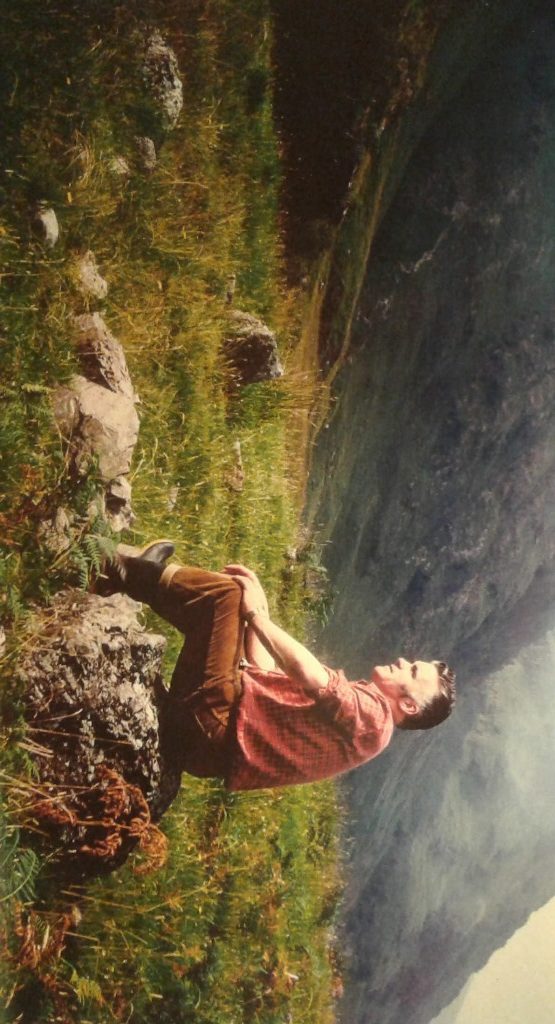
By Joseph Charles MacKenzie, for the Society of Classical Poets
Born in 1939 Samuel Gilliland attended the ancient Dreghorn School in an old mining village on the right bank of the river Irvine, said village having passed from the De Morville’s, Lord High Constables of Scotland, to Roland, Lord of Galloway in 1196. (The mansions are Annick Lodge, Cunninghamhead, Perceton, Springside, and Warwickhill.) At the height of the Scottish Renaissance, Mr. Gilliland founded the Ayrshire Writers and Artists Society, the umbrella organization for the now defunct Scottish International Open Poetry Competition launched by Henry Mair. Mr. Gilliland’s publications include: Masquerade Of The Pen, The Pen Masquerades (Arthur H Stockwell Publications) The Prizewinners (Wilfion Books) A Rickle O Banes (Penny Wheep Press.) Calvario & Other Poems (Poetry In Your Pocket Series – Penny Wheep Press) along with many publications in British literary magazines and abroad. In 2009, Mr. Gilliland won the illusive MacDiarmid Tassie, the most coveted literary prize in Scotland.
MacKenzie: When I first met you and your beautiful wife Anna in your gorgeous home in Springside, just off the medieval road between Irvine and Kilmarnock, it was part of a mandatory venture imposed on me by some of your youngest, most enthusiastic admirers. “You absolutely must meet Gilliland, a bard,” they told me, “the finest lyric poet in Scotland.” While I had met many of your more famous colleagues in Edinburgh, none were introduced to me as bards, much less lyric poets. Can you help us American readers understand why people consistently apply these epithets to you?
Gilliland: The nomenclature Bard, of course, alludes to the ancient Celtic order of poets, though, more recently, I would aver that simply because of my stand in defence of Lallans then the truly uninformed amongst us use the term very loosely by associating me with “our” Scottish language. Nowadays, scarce contemporary intelligence concerns itself with poetry so you are to be again congratulated. I still say that Burns did us a great disservice by not writing wholly in our natural tongue; but he was guided by pecuniary motives as well as the usual poetic ones; hence the tremendous loss our ancient tongue has suffered since his ‘renaissance’.
MacKenzie: With the ancient order virtually extinguished, your winning the MacDiarmid Tassie confirmed your bold continuation of Scotland’s bardic past not only through your defense of the Lallans, but also your poetic use of this quintessentially bardic language…
Gilliland: The question of our ancient order being fully extinguished is far too complex and inflammatory to discuss here; however, the pervasive powers of, for example, Dunbar, Burns and MacDiarmid, add much to the equation; poetical renascence conforms only to the ideals of the revolutionary upon whom the mantle of defense has been thrown. It must be said that whatever marks the fickle features of a ‘national’ poet also questions the quality of the poet’s intensity towards a wholly Scottish movement compared to that of English poetical zeal. One need only mention Chaucer, whose panegyric needs no further airing here, to introduce the distinction between our Northern bards and those of other arts. Critics of rare respectability have literally fought over the right of our ancient will to exist as a recognized movement, and, this, I claim, is simply because Lallans as a language is firmly set, in the consciousness of many poetasters, below the pinnacles of poetic endeavor.
MacKenzie: Everyone is dying to ask you: What was it like to receive the immortal Tassie, the highest literary honor ever to be given in your country and therefore the world?
Gilliland: As to receiving the MacDiarmid Tassie, strangely, I felt a certain tinge of sadness. It brought home to me the knowledge that after Flodden Field, when many distinguished Scots did not return, our literary aspirations were so demoralized as to virtually disappear. One must love our language to persist in placing it amongst the most beautiful of European tongues and set it apart from what many feel is simply a dialect within the lingua franca of an island. With that in mind, and given the many bards who continue to express the intensity and beauty of Lallans, I am proud to have been the recipient of the MacDiarmid Tassie.
MacKenzie: Many poets in the United States possess only some form of English as their one language. Has our cultural and linguistic parochialism spread to Scottish literary or pseudo-literary circles?
Gilliland: Poets respond to the general characteristics of the age in which they live—only a very few dedicated bards delve so deeply into their historic past as to make it matter. One could argue that MacDiarmid was a composite construction of the influences that eventually shaped his work; and then one needs must divorce the man from his art to get at the true poet. Very difficult. Crass materialism in the case of MacDiarmid and Dunbar and their like, mattered not as Burnsian poverty was certainly a driving force in their lives. Frankly, without looking at the intricate tapestry of American parochialism, with regards to reflection in pseudo-literary circles, hardly matters and I am anyway not nearly well versed enough in that area to make an informed analysis. I would have looked at that question from a wholly distinct perspective. Think about the input of the early Scottish pioneers there and an inkling of their capabilities certainly emerges; but not from a poetic perspective unless one lays hands on early manuscripts or collections.
MacKenzie: You were the youngest and last to bear the torch of the Scottish Renaissance—at the time not nearly old enough to be among the figures we see in Alexander Moffat’s famous painting, The Poets Pub (now in the Scottish National Portrait Gallery). The path you took in your work seems radically to diverge from, say, Norman MacCaig’s or even William Neill’s, as your bardic qualities have taken on an undeniably lyrical aspect which even the best of the movement achieved but rarely. What are the sources of lyricism in your poems?
Gilliland: Genuine poetry is conceived firstly in the brain and transposed to the soul, where it undoubtedly flowers. The burden of intellect brings forth the complexity and beauty of speech, but it takes a true poet to deliver himself of this burden and initiate the correct poetical response amongst the masses; this is where lyricism lusts after those weary spaces that do nothing for the poetasters amongst us. It is my deeply held belief that reasonable passion may posit that which we poets long for, the ability to invest the audience in the dream world so that the absolute beauty of his work can be felt universally. Perhaps the ‘romance’ poets of the past have much to do with influencing lyricism, but the honest truth is that without the avowed intention of the poet to express intensely personal feelings and lift his critic (very particularly his critic) into allusions of absolute grandeur and, by the way, love; tis then we suddenly realize that lyricism in poetry is a bit like a heart beating, just as necessary for life as lyricism is for the lust of life. That, my dear friend, is true poetry.
Sam Gilliland Poetry and Prose Published by the Society
https://classicalpoets.org/the-adobe-building-new-mexico-by-sam-gilliland/
https://classicalpoets.org/haunted-by-sam-gilliland/
https://classicalpoets.org/the-mausoleum-dumfries-and-other-poetry-by-sam-gilliland/
https://classicalpoets.org/essay-a-tribute-to-john-keats-by-sam-gilliland/















I would like to congratulate our young editor, Evan Mantyk, for opening our world to Scotland via the marvelous bridge of Samuel Gilliland’s poetry. This is editing at its very finest.
Yes, I congratulate Evan Mantyk too: Sam Gilliland is clearly a fine poet, though as an Englishman on the same island as him I take a somewhat more jaundiced, and less romantic view of Scotland and Scottish poetry generally. What I think unites me with Sam Gilliland – if he were to accept this – is the calling, the vocation, the bardic quality of poetry and the poet, which in its nature derives from the essential soul and the Muse, and also in its nature is trans-national, but which of course has to be expressed through specific languages. The tragedy that we experience with Scottish poetry (of which I am not expert, but reading this thread …) is not dissimilar to one we experience in England: where are the bards? The poetasters, as Sam Gilliland reminds us, seem to be everywhere – hey, welcome to England!
I absolutely agree, James, with your good self as well as with Joseph Charles MacKenzie – takes someone like Evan Mantyk to give trans-national poetry the impetus it deserves. The effective inversion you spoke about, with regards to the situation in England, is a story I met with unfailing regularity when dealing with the Scottish International Open poetry competition. Thousands of poets felt rejected by the very movement they sought to embrace! The subliminal mind enters our elegant art as a commitment to life – the calling you speak about, James. Recent setbacks have laid me low – but I shall return to literature simply to cultivate the creative self that lies within. Aye & Aye, Sam.
Is Sam Gilliland still living?
The last we heard, Mr. Gilliland is alive and well. See the comments in this recent poem: https://classicalpoets.org/2020/03/08/a-poem-on-sam-gilliland-the-last-bard-of-scotland-by-joseph-charles-mackenzie/
Hi Donna Mackert my father Sam Gilliland is still with us keeps good health still putting pen to paper.
Alan Gilliland
Guid tae ken he’s still oorby in guid health in a guid place.