


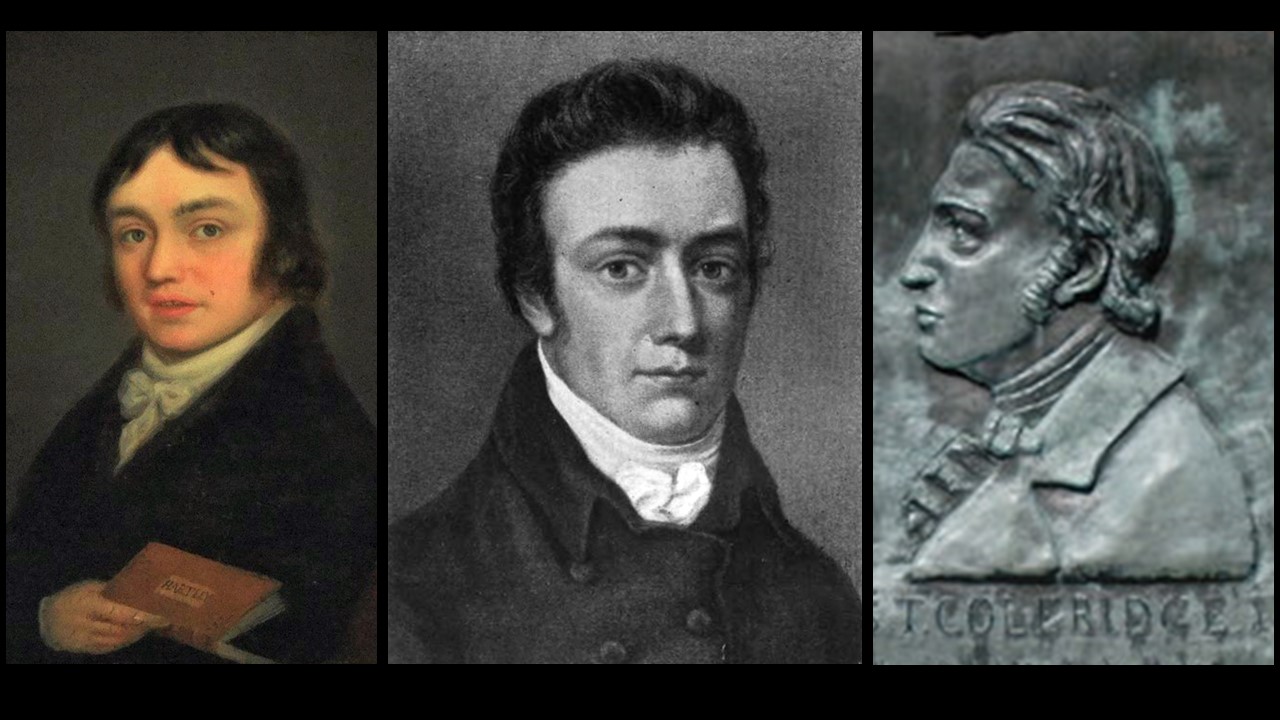
Weave a circle round him thrice,
__And close your eyes with holy dread,
__For he on honey-dew hath fed,
And drunk the milk of Paradise.
—Coleridge, “Kubla Khan”
Sam Coleridge smoked opium. Ho hum.
If that’s what fueled the fire in his pupils
I think Sam would have been a trifle dumb
To pass it up because of petty scruples.
Talent and morals have no fixed relation—
A poet can do anything he pleases:
Take drugs, bed whores, drink whiskey, court stupration…
He’s not meant to be Socrates or Jesus.
Who are these little moralizing schmucks
Who wag their fingers at poor poets’ failings?
I’m tired of their prim schoolmarmish clucks,
Their preachy disapproval, and their railing.
If Coleridge enjoyed a whiff of dope
You’ve got no call to question the man’s preference.
DeQuincey liked it too, and I sure hope
You’ll treat their work with due respect and reverence.
Dowson took the prize for taboo things—
Absinthe, hashish, and prepubescent lasses.
And yet the man could write in fluent rings
Around his dull contemporary asses.
Old Hemingway drank vodka by the quart;
F. Scott Fitzgerald went around half-pickled.
Charles Dickens lived on Bombay gin and port
And frankly, anybody would be tickled
To generate the literature they gave
The world, despite their liquor-sodden brains.
So who the hell are you to try to save
Great genius from itself? My patience strains
When listening to critics who grow stern
And judge a poet’s lifestyle, not his skill.
Who knows but that those faults and flaws may earn
Him psychic strength to climb the Muses’ hill?
The point is this: Weigh artists by their work.
It doesn’t matter if a man’s a cad,
A liar, drunkard, lecher, or a jerk—
Is what he puts on paper good or bad?
You pious moralists whose tongues are dripping
With priggish cant and strictures against Sam—
I’d rather see you stoned, or drunk, or tripping,
If you’d then write a poem worth a damn.
from Skirmishes (2010)
Joseph S. Salemi has published five books of poetry, and his poems, translations and scholarly articles have appeared in over one hundred publications world-wide. He is the editor of the literary magazine Trinacria and writes for Expansive Poetry On-line. He teaches in the Department of Humanities at New York University and in the Department of Classical Languages at Hunter College.

















A perfectly wrought amazing poetic observation that may well change the course of my literary destiny!
I fear my work’s become somewhat humdrum
It’s lacking all that’s frolicsome and frisky.
I think the time has come for me to plumb
The depths of brimming barrelfuls of whisky
Along with lusty puffs of nicotine.
I’ll rock the ribald traits of Dylan Thomas
With language that will soar beyond obscene
Until my odes and prose are blessed with promise. 😉
The Doctor has a way of doing that.
He once wrote about “a finely chiseled poem” and it’s guided me ever since.
Hello! Moral assessments aside, I’m wondering … just like steriods enhance athletic performance, does opium enhance a poet’s compositions? How about pot? Just curious. This poem evokes the memory of Leo Yankevich. I like the poem, and the meaning is clear. The meter confuses me. Could you talk about it a little bit? Thanks.
Yes, Leo Yankevich was a profound influence on me, and without his fierce and fiery example I would have never composed such a poem.
The meter is regular iambic pentameter. Sometimes the lines have ten syllables, but frequently they have eleven, a normal variation:
sam CO le RIDGE smoked O pi UM. ho HUM. (ten syllables)
if THAT’S what FUELED the FI re IN his PU pils (eleven syllables)
Can drug use, heavy drinking, wild sex, and other vices help a poet’s poetry? It’s hard to say. They certainly provide him with a lot more interesting subject matter than the attempt to be piously edifying. Any extreme physical excess will tend to to destroy a poet’s prosodic abilities and his verbal control, but those gifts come to the poet long before he grows old enough to develop adult vices. If he chooses to destroy those gifts through overindulgence, that’s his look-out, nobody else’s.
The plain fact is that it is hard to analyze what motivates a person to do his best work. Sometimes it is anger and rage. Sometimes it is greed and avarice. Sometimes it is pride and arrogance. Sometimes it is lust or hatred. In short, the Seven Deadly Sins have a lot of horsepower in them.
Thank you. Doesn’t the extra syllable break the rhyme pattern? Or, is it okay if it’s just one extra unstressed syllable?
Beth, you may find this essay addresses your question: https://classicalpoets.org/2020/07/13/the-spice-of-life-metric-variation-in-formal-verse-an-essay/
@ Evan: Thanks! Yes, you’re right! This essay hits the mark. I’m going to print it out for future reference. Wasn’t there a “Tutorial” tab? It would be great to have all the tutorials together for quick, easy reference.
I’ve read this one before, in RAINTOWN REVIEW, I believe, and it’s as good as it was the first time I read it, which is to say that your poetry stands the test of time. I wish I had written it.
Being impressed with Daphne du Maurier’s Rebecca I once read her entire oeuvre, and no other of her novels came anywhere near. But what struck me when I’d finished the last was that, so terrified was she, apparently, of committing gaffes of accidental anachronism that she rarely spoke of anything that could be at all narrowly dated, so that I could finish reading a book and not even know in which century it was set. In Dr Salemi’s works he quite happily and confidently moves from one century to another secure in the knowledge of who and what would have been around when and where, what people drank, what they ate, how they cleaned their carpets. He would know that matchlocks were typically used in the seventeenth century, flintlocks in the eighteenth, percussion locks in the nineteenth. It is the amount of detail heaped on archaeological detail that gives his poetry verisimilitude and (I’m thinking about the recent pirates poem) convinces us that there is something worth reading here before we even start. The present poem does not disappoint (although it may need an ess at the end of line twelve).
Peter, you have a sharp eye. I thought about that “s” for a long time. The late Tim Murphy used to scream against the omission of an “s” when the letter was present in the corresponding rhyme-line. I tended to agree with him, but I left it out here because if I had written “railings,” it might bring to mind guard rails or banisters.
You’re the only person I know who can distinguish between a matchlock, a flintlock, and a percussion lock. But don’t forget the wheel-lock, a really great firing mechanism from the early 17th century.
All best wishes.
I am the man from Porlock,
You can put the blame on me.
For interrupting Samuel
In his joyful reverie.
For it was I, supplying him
With all the dope he used.
The rendered him incapable,
Be-fuddled and confused.
His poem may have been too long,
For folk like us to care.
So Mr. Taylor Coleridge,
Aren’t you glad I stopped you there?
It’s one thing to take drugs or drink if it serves as a catalyst to great creativity. It’s quite another to wallow in the state of being a perpetual pothead.
The writing of poetry requires “great creativity”, and one may choose to take drugs to enhance that creativity; playing the drums requires “great creativity”, and one may choose to take drugs to enhance that creativity . . . quelle est la différence?
I agree Monty, except that it’s not always a choice and that there is always a risk of diminishing returns.
Someone recently sent me a podcast of a feminist discussing one of my favorite poets, Christine de Pisan. The feminist was plugging her new book claiming that sin helps women become powerful, using Cleopatra, Lucrezia Borgia, and Catherine the Great as prime examples. She tried desperately to draw Christine into that company, first pointing out that Christine had written about sinful women, such as Mary Magdalene. This was a weak argument even to the feminist interviewer. Finally, it turned out that Christine’s great sin was writing (going beyond the bounds of what women were supposed to do). This seems to me a weak argument, or all of us at SCP would be rather powerful from overindulging in meter and rhyme (as poets are no longer supposed to do).
Whoa Nellie, Margaret. This is a rather involuted comment. I’ve lain in bed with with many a “sinful” woman, but the power was always rather evenly distributed. And I like the idea that contemporary formalists might gain power from having stuck their offensive rhyme & meter into the faces of the herd of modern-day unstructured conformists.
Thanks for accepting the portion of the comment (re formal poetry) that comes from Lady Reason.
Kip Anderson is right. The small formalist movement in poetry gains much more attention and power as a result of being “transgressive” against the smug pieties of contemporary modernism and other structureless movements. We’re telling the po-biz world, in all its pomposity and influence, to bugger off and drop dead.
One only has to listen to The Beatles “Abbey Road” to appreciate the power of mind enhancing substances colliding with unsurpassed musical abilityThat is, apart from “Maxwell’s Silver Hammer.”
I believe, Jeff, that the Beatles were doing a lot more than “drugs.” Pot, for instance, is merely incidental in the great confluence of musical talent, historical circumstances, and the ever-present human impulse to explore new territories. If you had seen me back then, you would have called me a hippie. The Beatles, as artists, were not hippies — they MADE hippies.
Oh this is just brilliant Dr Salemi! I particularly liked your verse about Dowson. I felt a little sad that Byron was omitted as I believe he liked a puff of opium now and again – more now than again perhaps but after reading this excellent work I shall not judge him…… or anyone else for that matter.
Lord Byron’s basic sins lay in the area of lust, and perhaps a somewhat cavalier attitude towards his family duties. I don’t think abuse of opium was a major problem for him, though of course in those days smoking the stuff was perfectly legal.
There is an honesty and forthrightness in this poem which provides it with punch. The Yiddish word ‘Schmucks’ seems to be one of your favorites; and I must say, you use it to great effect.
The word “schmuck” is very common here in Noo Yawk, and is used by both Jews and gentiles, so for me it is just a part of my regular vocabulary. I do tend to use many foreign words in my poetry because they expand the opportunities for rhyme.
There is no doubt that foreign words enrich poetry and add interest. Opportunities for rhyme pairs such as orange/Blorenge (a Welsh mountain) also become possible. There is much to be said for a wide vocabulary, and a broad general knowledge.
It is good to be reminded by Mr. Salemi of Coleridge. In weighing his artistry’s influence, the following tennos was composed.
Of Samuel Taylor Coleridge
by Basil Drew Eceu
His life was as a ship wreck—Samuel Taylor Coleridge—
who, like his near contemporary Friedrich Hölderlin,
crashed into transcendental consciousness poetic’lly;
he heard a crystal bell on shore, when he was out at sea.
His sails flapping in the wind, his torn wings slapping it,
as Lamb expressed, archangel damaged but a little bit;
in dialogue with Wordsworth, lyric balladry his take,
the Sage of Highgate at the end who toasted William Blake;
around the whirl of Adm’ral Nelson at Trafalgar’s clash,
suspended disbelief in laudanum, sublime the splash.