• Submit Poetry
  • Support SCP
  • About Us
  • Members
  • Join
Saturday, July 18, 2026
Society of Classical Poets
  • Poems
    • Beauty
    • Culture
    • Satire
    • Humor
    • Children’s
    • Art
    • Ekphrastic
    • Epic
    • Epigrams and Proverbs
    • Human Rights in China
    • Music
    • Performing Arts
    • Riddles
    • Science
    • Song Lyrics
    • The Environment
    • The Raven
    • Found Poems
    • High School Poets
    • Terrorism
    • Covid-19
  • Poetry Forms
    • Sonnet
    • Haiku
    • Limerick
    • Villanelle
    • Rondeau
    • Pantoum
    • Sestina
    • Triolet
    • Acrostic
    • Alexandroid
    • Alliterative
    • Blank Verse
    • Chant Royal
    • Clerihew
    • Rhupunt
    • Rondeau Redoublé
    • Rondel
    • Rubaiyat
    • Sapphic Verse
    • Shape Poems
    • Terza Rima
  • Great Poets
    • Geoffrey Chaucer
    • Emily Dickinson
    • Homer
    • Henry Wadsworth Longfellow
    • Dante Alighieri
    • John Keats
    • John Milton
    • Edgar Allan Poe
    • William Shakespeare
    • William Wordsworth
    • William Blake
    • Robert Frost
  • Love Poems
  • Contests
  • SCP Academy
    • Educational
    • Teaching Classical Poetry—A Guide for Educators
    • Poetry Forms
    • The SCP Journal
    • Books
No Result
View All Result
Society of Classical Poets
  • Poems
    • Beauty
    • Culture
    • Satire
    • Humor
    • Children’s
    • Art
    • Ekphrastic
    • Epic
    • Epigrams and Proverbs
    • Human Rights in China
    • Music
    • Performing Arts
    • Riddles
    • Science
    • Song Lyrics
    • The Environment
    • The Raven
    • Found Poems
    • High School Poets
    • Terrorism
    • Covid-19
  • Poetry Forms
    • Sonnet
    • Haiku
    • Limerick
    • Villanelle
    • Rondeau
    • Pantoum
    • Sestina
    • Triolet
    • Acrostic
    • Alexandroid
    • Alliterative
    • Blank Verse
    • Chant Royal
    • Clerihew
    • Rhupunt
    • Rondeau Redoublé
    • Rondel
    • Rubaiyat
    • Sapphic Verse
    • Shape Poems
    • Terza Rima
  • Great Poets
    • Geoffrey Chaucer
    • Emily Dickinson
    • Homer
    • Henry Wadsworth Longfellow
    • Dante Alighieri
    • John Keats
    • John Milton
    • Edgar Allan Poe
    • William Shakespeare
    • William Wordsworth
    • William Blake
    • Robert Frost
  • Love Poems
  • Contests
  • SCP Academy
    • Educational
    • Teaching Classical Poetry—A Guide for Educators
    • Poetry Forms
    • The SCP Journal
    • Books
No Result
View All Result
Society of Classical Poets
No Result
View All Result
Home Poetry Beauty

‘Curiosity’ by David Jilk

February 5, 2021
in Beauty, Poetry
A A
7
poem/macgregor/education

.

You ask me “why?”—the question seems to burn
like you were made to seek out novelty,
to stimulate your mind, explore, and learn:
exactly why your curiosity
is not so curious at all, to me!
Your brain contains an elemental drive
that underlies a trait to quest and strive.

This craving is the hunger of your mind,
more subtle than your body’s urgent need,
and unlike sustenance, you soon will find
that memories and knowledge won’t recede –
instead accumulate—then freely breed
and shift in shape, a mesh of plasticine,
identity that outranks any gene.

“What is it for?” predictably you ask.
The word originates from care, then cure,
and both illuminate its crucial task:
concern about your world compels a tour;
avoiding harm is vital, to endure.
In either case the knowledge that you gain
is keen equipment, thwarting future pain.

Too often, letdowns—setbacks—injury
will on your sweet serenity intrude!
Respond by stoking curiosity;
do not indulge a dismal attitude,
but rather grow your worldly aptitude
through learning how to render differently
and reckon outcomes more reliably.

Yet even if there is no grievous cue,
it largely pays to be inquisitive
about a topic when it interests you:
done well, and should it seep through Fortune’s sieve,
your research just might prove transformative
with unexpected pleasures brought to light,
a danger dodged, a need secured outright.

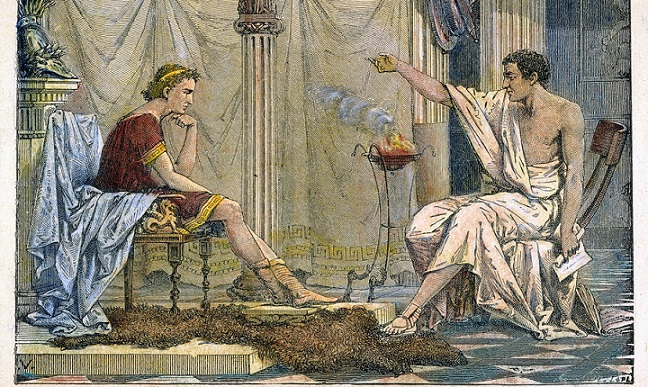
A teacher is the answer to your “How?”
Do not assume you know how teachers look,
for I am one, and I am teaching now,
but when alone, your teacher is a book,
(at once repast and remedy and cook)
or written words served as a smaller dish,
or film, or any form of art you wish.

Your greatest teacher is the world itself
and glory comes to those who find her codes;
for she is coy, no book upon a shelf,
and must be queried via crab-walk modes:
your question is, which questions make inroads?
Instruction thus proceeds aesthetically
with obverse strokes of creativity.

Some warning words: from heedless hands comes due
the steep cat-cost of curiosity—
yet like the cat, you might recover too;
though circumspection guides concern, set free
it breeds addiction to mere novelty;
when knowledge turns to dogma strictly true
it shackles life like fauna in a zoo.

In time your probing, literary mind
builds wisdom as it judges right from wrong,
and seeing many ways to live, will find
a purpose that becomes your pilot song;
yet exploration dwells with you lifelong—
your curiosity will spin a tale
worth telling, like a quest to find the grail.

.

.

Dave Jilk is the author of two books of poems: Rejuvenilia (2018) and Distilled Moments (2020). His work has appeared in The Avocet: A Journal of Nature Poetry, and won first prize in the Samuel Eells Literary & Educational Foundation graduate competition in both 2017 and 2018.


ShareTweetPin
The Society of Classical Poets does not endorse any views expressed in individual poems or commentary.
Read Our Comments Policy Here

RandomPoems

‘Chasing Time’ and Other Poetry by Warren Bonham
Beauty

‘Chasing Time’ and Other Poetry by Warren Bonham

August 8, 2024

. Chasing Time  "But do not forget this one thing, dear friends: With the Lord a day is like a...

Pastoral Calls—Part 2 of 3: Poetry by Retired Pastor James A. Tweedie
Beauty

Pastoral Calls—Part 2 of 3: Poetry by Retired Pastor James A. Tweedie

March 11, 2023

Pastoral Calls—Part 2 of 3 . Face-to-Face A weeping woman called me on the phone And said, “My daughter’s in...

Next Post
‘Titanic’s Survivors’ by Mike Ruskovich

'Reality Check' by James A. Tweedie

‘Eight and a Half (Going on Twenty)’ by Frank De Canio

'Eight and a Half (Going on Twenty)' by Frank De Canio

‘Chairman Xho’ (Pronounced ‘Joe’) by Joe Tessitore

'Chairman Xho' (Pronounced 'Joe') by Joe Tessitore

Comments 7

  1. C.B. Anderson says:
    5 years ago

    What better stanzaic form than rhyme royal, David, could there be to express and develop a long philosophical exposition? I myself have had a couple such poems published in the past, and Clive James has done it himself more than once. For some reason, the form is well suited to this kind of thing. I don’t know why this is so, but I am reminded that it behooves me to try it again because it worked so well before. Any ideas about that?

    I liked very much your discussion of curiosity. I, too, am quite interested in what I might call essential abstract psychology. Without curiosity, intelligence is shackled, and I might go so far as to say that there can be no intelligence without it. That’s my two cents’ worth on that.

    I especially liked the sieve/transformative rhyme, but I shouldn’t need to remind you that “inquisitive” is not a good third, because all you are doing there is rhyming “-tive” with “-tive.” Anything like “live,” “give” or “shiv” (slang) would be much better.

    Reply
    • DaveJ says:
      5 years ago

      Thank you for the kind words. This was my first foray into rhyme royal; for some reason I found it more difficult than ottava rima. Perhaps it is the odd number of lines. Though this does amount to a philosophical exposition, it is in the form of an advice monologue, not unlike Chaucer’s Ballade of Good Counsel, which is an early example of rhyme royal. Perhaps that is the connection?

      This poem is actually an excerpt from a much longer work in which the question of what constitutes intelligence plays a major role. Curiosity and novelty play an important survival role in all mammals (at least), as that is how they find food and mates, and there is plenty of evidence in cognitive psychology that without curiosity, intelligence is stunted. For human intelligence, the other essential drive is social interaction, since without that we would not learn language and concepts.

      I am sure you know better than me on the ‘-tive’ rhyme. My understanding of rhyming forms is not deep enough to understand why it is not sufficient that the two words rhyme. My defense would be first, that it is not just ‘-tive’ that rhymes but ‘uh-tive’. Second, in rhyme royal (according to Wikipedia) the stanza tends to be perceived as either a tercet and two couplets, or a quatrain and a tercet. In both those cases the final ‘uh-tive’ is separated from the first, and the perceived rhyme is with “sieve.” But I am just shooting in the dark here since I’m not familiar with the guideline on which you base your comment – please share!

      Reply
      • DaveJ says:
        5 years ago

        C.B., my curiosity drove me to look into this, and I now understand the issue with the identical rhyme not being perfect rhyme. Thank you – how did I get to this point without knowing that?

        Nevertheless, Chaucer (as best we can tell, inventor of Rhyme Royal) in Parlement of Fouls occasionally uses an identical rhyme or even identical words on the first and third. I will take his precedent as convenient license to do the same in my own work.

        Reply
      • C.B. Anderson says:
        5 years ago

        Yes, the first problem is the idea of the “identity” rhyme. It’s not that identical words or word-parts do not rhyme, it’s that such rhymes are trivial. A “perfect” rhyme usually involves two words with the same vowels sounds & final consonants, but with different initial consonants (e.g. smart/part or taut/thought) or with no initial consonant at all (e.g. tart/art). In two-syllable rhymes (e.g. trouble/rubble) the heart of the rhyme lies in the stressed syllables. When you try to make a rhyme such as inquisitive/transformative, a couple of things are happening. In both words the major accent falls on the second syllable, so, for instance, “normative” would be a better rhyme for “transformative.” (Yes, I know that “norm-” is the first, not second, syllable, but we are talking about stresses here. The second thing that happens is that in an iambic line, “-tive,” which in normal speech may lack a stress, it is promoted to a light stress: transFORMaTIVE.

        In stanza 7 this idea comes up again where you make the rhyme CODES/MODES/INroads, as “-roads” here is an unstressed syllable. Of course, you are free to make your rhymes in any manner you like, but, in my opinion, a careful rhymer should take these principles into consideration. Many writers, here and elsewhere do not. Sometimes you will read something as egregious as able/awful and be expected to take ble/ful as a decent rhyme, but not on my watch.

        Reply
      • DaveJ says:
        5 years ago

        Thank you for the detailed explanation, particularly on the element involving stresses. I agree that it is valuable to know the principles; I want my decisions to deviate from formal constraints always to be intentional. In the cases you cite they surely were not.

        Reply
  2. Susan Jarvis Bryant says:
    5 years ago

    David, I love this poem. It reminds me of this Albert Einstein quote; “The important thing is to not stop questioning. Curiosity has its own reason for existing” and your poem explores this very human trait beautifully.

    I particularly like; “This craving is the hunger of your mind,/more subtle than your body’s urgent need” and, for me, the older I get and the more I learn the more curious I become… perhaps these lines should read the other way around in my case lol. But then, there’s the penultimate stanza to consider. I fear I’m on my eighth life and must rein my curiosity in… before it’s too late!

    You have made excellent use of the form, and inspire me to try it for myself. Thank you very much!

    Reply
    • DaveJ says:
      5 years ago

      I’m so glad you enjoyed it! And thank you for the Einstein quote, I had not heard that one.

      Apparently in the early 20th century, the older proverb “Curiosity killed the cat” was augmented with “but satisfaction brought it back.” This suggests that rather than rein it in, you should just satisfy it. Of course, there remains Heidegger’s concern about its becoming mere distraction, as suggested in the subsequent lines.

      Reply

Leave a Reply Cancel reply

Your email address will not be published. Required fields are marked *

  1. Cynthia L Erlandson on ‘The Gold Star Mother’: A Poem by Gerard MaritatoJuly 18, 2026

    I don't know how anyone could read this without tears. It's just beautiful.

  2. Susan Jarvis Bryant on ‘My Pyjamas!’ and Other Poems by Susan Jarvis BryantJuly 18, 2026

    C.B., please know that laughter is beneficial to one's health and temper. Suing me will undoubtedly cause you immense stress,…

  3. Jan Mennite on National Poetry Month Limerick ChallengeJuly 18, 2026

    Cass There once was a teacher named Cass who expelled much malodorous gas. One day after starting, she couldn't stop…

  4. Susan Jarvis Bryant on ‘My Pyjamas!’ and Other Poems by Susan Jarvis BryantJuly 18, 2026

    Adam, thank you very much for your appreciative and encouraging words. I hope your children enjoyed "My Pyjamas." I believe…

  5. Theresa Werba on ‘American Dreams’: A Poem by Adam SediaJuly 18, 2026

    Congrats on your Finalist win Adam, such an excellently-wrought and powerful poem!

Subscribe to Daily Poems

Enter your email address to subscribe to this blog and receive notifications of new posts by email.

Join 1,594 other subscribers

Recent Poems

  • Winners and Rankings of The Great American Poetry Competition
  • ‘The Gold Star Mother’: A Poem by Gerard Maritato
  • ‘An American Dash’: A Poem by Linda Ellis
  • ‘The Anonymous Soldier’: A Poem by Lucy Lind
  • ‘For Those We Never Meet’: A Poem by Aneesh Agarwal
  • ‘Ben Franklin’s Copper Fugio Cent’: A Poem by Geoffrey Smagacz
  • Three Brief Poems by Luxorius, Translated by Joseph S. Salemi
  • ‘The American Spirit’: A Poem by Dusty Grein
  • ‘The Ballad of Zebulon Pike’: A Poem by M.D. Skeen
  • ‘We Are the Ones’ and Other Poetry by Cheryl Corey
  • ‘My Pyjamas!’ and Other Poems by Susan Jarvis Bryant
  • ‘A Snowy Egret’: A Poem by Bruce Dale Wise
  • ‘The Swearing-in of Calvin Coolidge’: A Sonnet by Robert W. Crawford
  • ‘Ballad of the Sequoia’: A Poem by Lauren V. Leon
  • ‘The 51st State’: A Poem by James Sale
  • ‘La Uva’ (The Grape): A Poem by Michael Pietrack
  • ‘There’s Blood that Flows Within the Stripes’: A Poem by Lauren V. Leon
  • ‘Birdsong’: A Poem by Jeffrey Essmann
  • ‘The Melody That Lingers On’ and Other Poetry by John McPherson
  • ‘American Dreams’: A Poem by Adam Sedia
  • ‘An American Fabius’: A Poem by John Hernandez
  • ‘Vernal Clinic’ and Other Poetry by C.B. Anderson
  • ‘Omaha Beach’ and Other Poetry by Bradford Skow
  • ‘Music to Part the Veil’: A Poem by T.M. Moore
  • ‘A Gentleman’s Guide to Losing a War’ and Other Poetry by Arnon Peterson
  • ‘Black Shuck’: A Poem by Martin Briggs
  • ‘When the Last World War II Veteran Passes Away’: A Poem by N.S. Boone
  • ‘A Fallow Year at Worthy Farm’: A Poem by Paul A. Freeman
  • ‘Outstanding in Afghanistan’: A Poem by Jared S. Chang
  • ‘250 More’: A Poem by Miguel Moreno

Categories

  • Acrostic
  • Alexandroid
  • Alliterative
  • Art
  • Best Poems
  • Blank Verse
  • Chant Royal
  • Classical Poets Live
  • Clerihew
  • Covid-19
  • Deconstructing Communism
  • Educational
  • Epic
  • Epigrams and Proverbs
  • Essays
    • Interviews with Poets
    • Poetry Reviews
  • Featured
  • From the Society
  • Great Poets
    • Dante Alighieri
    • Edgar Allan Poe
    • Emily Dickinson
    • Geoffrey Chaucer
    • Henry Wadsworth Longfellow
    • Homer
    • John Keats
    • John Milton
    • Robert Frost
    • William Blake
    • William Shakespeare
    • William Wordsworth
  • Human Rights in China
  • Limerick
  • Love Poems
  • Music
  • Pantoum
  • Performing Arts
  • Poetry
    • Beauty
    • Children's Poems
    • Culture
    • Ekphrastic
    • Found Poems
    • High School Poets
    • Humor
    • Riddles
  • Poetry Challenge
  • Poetry Contests
  • Poetry Forms
    • Curtal Sonnet
    • Haiku
  • Poetry Readings
  • Rhupunt
  • Rondeau
  • Rondeau Redoublé
  • Rondel
  • Rubaiyat
  • Sapphic Verse
  • Satire
  • Science
  • Sestina
  • Shape Poems
  • Short Stories
  • Song Lyrics
  • Sonnet
  • Symposium
  • Terrorism
  • Terza Rima
  • The Environment
  • Translation
  • Triolet
  • Video
  • Villanelle

Quick Links

  • About Us
  • Submit Poetry
  • Become a Member
  • Members List
  • Support the Society
  • Advertisement Placement
  • Comments Policy
  • Terms of Use

Welcome Back!

Login to your account below

Forgotten Password?

Retrieve your password

Please enter your username or email address to reset your password.

Log In
No Result
View All Result
  • Poems
    • Beauty
    • Culture
    • Satire
    • Humor
    • Children’s
    • Art
    • Ekphrastic
    • Epic
    • Epigrams and Proverbs
    • Human Rights in China
    • Music
    • Performing Arts
    • Riddles
    • Science
    • Song Lyrics
    • The Environment
    • The Raven
    • Found Poems
    • High School Poets
    • Terrorism
    • Covid-19
  • Poetry Forms
    • Sonnet
    • Haiku
    • Limerick
    • Villanelle
    • Rondeau
    • Pantoum
    • Sestina
    • Triolet
    • Acrostic
    • Alexandroid
    • Alliterative
    • Blank Verse
    • Chant Royal
    • Clerihew
    • Rhupunt
    • Rondeau Redoublé
    • Rondel
    • Rubaiyat
    • Sapphic Verse
    • Shape Poems
    • Terza Rima
  • Great Poets
    • Geoffrey Chaucer
    • Emily Dickinson
    • Homer
    • Henry Wadsworth Longfellow
    • Dante Alighieri
    • John Keats
    • John Milton
    • Edgar Allan Poe
    • William Shakespeare
    • William Wordsworth
    • William Blake
    • Robert Frost
  • Love Poems
  • Contests
  • SCP Academy
    • Educational
    • Teaching Classical Poetry—A Guide for Educators
    • Poetry Forms
    • The SCP Journal
    • Books

© 2025 SCP. WebDesign by CODEC Prime.