• Submit Poetry
  • Support SCP
  • About Us
  • Members
  • Join
Friday, January 9, 2026
Society of Classical Poets
  • Poems
    • Beauty
    • Culture
    • Satire
    • Humor
    • Children’s
    • Art
    • Ekphrastic
    • Epic
    • Epigrams and Proverbs
    • Human Rights in China
    • Music
    • Performing Arts
    • Riddles
    • Science
    • Song Lyrics
    • The Environment
    • The Raven
    • Found Poems
    • High School Poets
    • Terrorism
    • Covid-19
  • Poetry Forms
    • Sonnet
    • Haiku
    • Limerick
    • Villanelle
    • Rondeau
    • Pantoum
    • Sestina
    • Triolet
    • Acrostic
    • Alexandroid
    • Alliterative
    • Blank Verse
    • Chant Royal
    • Clerihew
    • Rhupunt
    • Rondeau Redoublé
    • Rondel
    • Rubaiyat
    • Sapphic Verse
    • Shape Poems
    • Terza Rima
  • Great Poets
    • Geoffrey Chaucer
    • Emily Dickinson
    • Homer
    • Henry Wadsworth Longfellow
    • Dante Alighieri
    • John Keats
    • John Milton
    • Edgar Allan Poe
    • William Shakespeare
    • William Wordsworth
    • William Blake
    • Robert Frost
  • Love Poems
  • Contests
  • SCP Academy
    • Educational
    • Teaching Classical Poetry—A Guide for Educators
    • Poetry Forms
    • The SCP Journal
    • Books
No Result
View All Result
Society of Classical Poets
  • Poems
    • Beauty
    • Culture
    • Satire
    • Humor
    • Children’s
    • Art
    • Ekphrastic
    • Epic
    • Epigrams and Proverbs
    • Human Rights in China
    • Music
    • Performing Arts
    • Riddles
    • Science
    • Song Lyrics
    • The Environment
    • The Raven
    • Found Poems
    • High School Poets
    • Terrorism
    • Covid-19
  • Poetry Forms
    • Sonnet
    • Haiku
    • Limerick
    • Villanelle
    • Rondeau
    • Pantoum
    • Sestina
    • Triolet
    • Acrostic
    • Alexandroid
    • Alliterative
    • Blank Verse
    • Chant Royal
    • Clerihew
    • Rhupunt
    • Rondeau Redoublé
    • Rondel
    • Rubaiyat
    • Sapphic Verse
    • Shape Poems
    • Terza Rima
  • Great Poets
    • Geoffrey Chaucer
    • Emily Dickinson
    • Homer
    • Henry Wadsworth Longfellow
    • Dante Alighieri
    • John Keats
    • John Milton
    • Edgar Allan Poe
    • William Shakespeare
    • William Wordsworth
    • William Blake
    • Robert Frost
  • Love Poems
  • Contests
  • SCP Academy
    • Educational
    • Teaching Classical Poetry—A Guide for Educators
    • Poetry Forms
    • The SCP Journal
    • Books
No Result
View All Result
Society of Classical Poets
No Result
View All Result
Home Poetry Culture

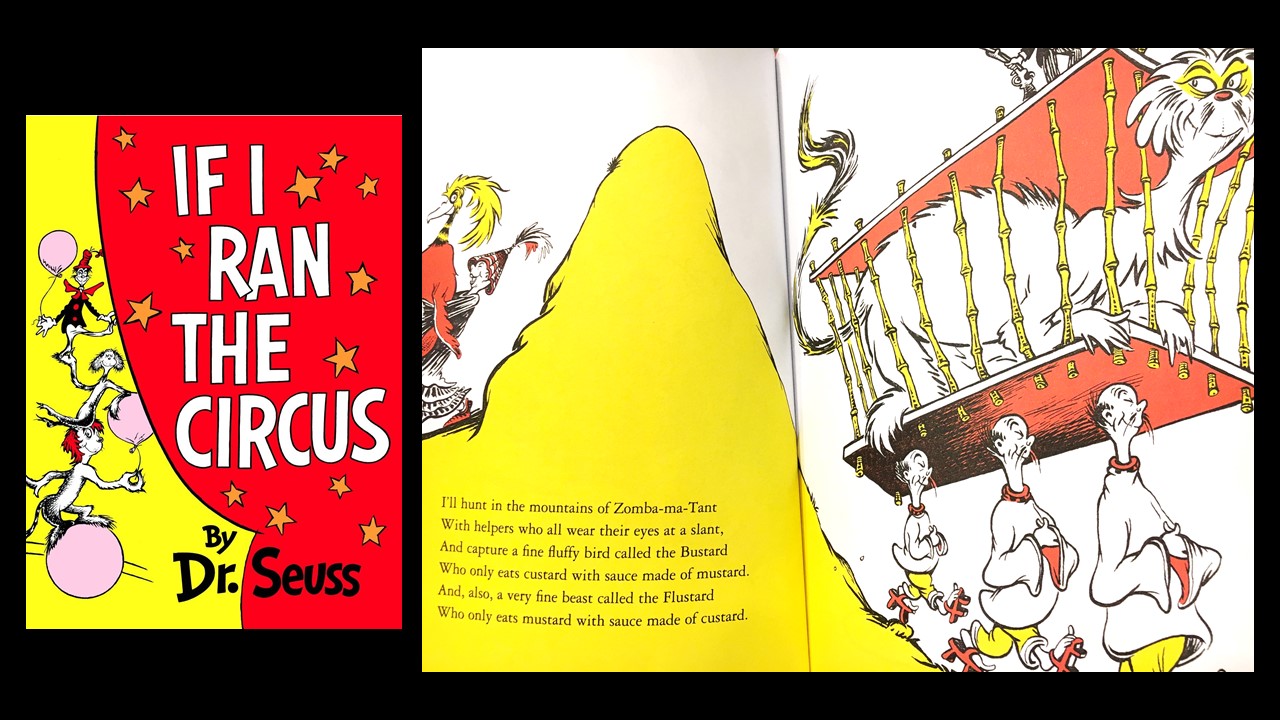
An Essay on the Canceling of Dr. Seuss: ‘If I Ran the Circus’ by Michael Curtis

March 9, 2021
in Culture, Essays, Humor, Poetry
A A
5
poems An Essay on the Canceling of Dr. Seuss: 'If I Ran the Circus' by Michael Curtis

.

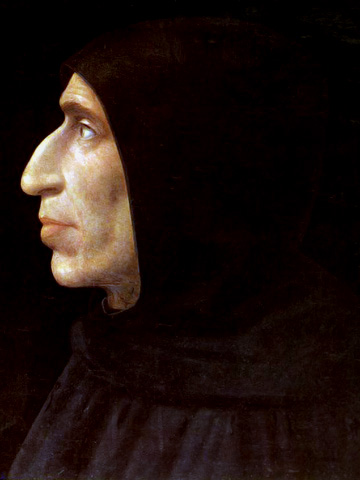
Girolamo Savonarola.jpg
Girolamo Savonarola

Here we are at circus, you and me and all the others, facing each and every way in the Age of Absurdity. Rather alike some Swiftian satire, some Aesopian consequence, some Seussian phantasmagoria where all the world is upside down, facing sideways in slow-motion walking backwards into a psychedelic truth. Yet, who can say, this day seems alike most other days in Washington, D.C., sunny, easy, grown wealthy by coast-to-coast plebs who pay us to mock them, to destroy their lives, to take from them what is most dear, most good.

Savonarola took from others the most good. You remember Savonarola, the persuasive pastor who worked upon the open minds of questioning Florentines, the Medici, the Albizzi, the Pazzi and other putz who did not know the difference between the intellectual pose and the intellectual throes of a burning in passionate argument and a burning of the person with whom you are arguing.

Well, if you do not remember, we shall here recall the great circus, the Carnival of Savonarola’s preaching damnation to his congregation (the whole of Florence), the rooting of the devil that lived within the dark, silent places of each Florentine, the rooting-out of the devil, of the Florentine vanities, the pride, the prettiness, the wealth of pictures, of draperies, of books and manuscripts, those great piles of privilege set magnificently to flame in a bonfire of vanities most good, most humane.

Do you see, there, in the flames, that portrait exquisite of style, the glaze crackling horribly; Botticelli himself fed this his picture to the flame. There! A Lorenzo di Credi, his self-fed picture glows, a pretty orange … there, flames shoot from the eyes, the lips melt. And that? Why, that is the floating silver-ash of a Dante, the red specks yet hot above the heads of the dancing, self-flagellating crowd. Oh. And look there, a pinkish smoke, pretty in its way floating airily away, the last, the only, the is-no-other copy of an Ovid. Good bye, sweet thoughts.

Do you know; the Magnificent Lorenzo, patron of Michelangelo, Leonardo, architects and poets, grew to despise his generosity, his inspiration to creation of great works in art and literature, that he retired ignominiously in failure, that at death he begged the forgiveness of the beauties burning friar, Savonarola. Old, broken, will-wary, great Lorenzo. Savonarola forgave the broken, penitent Lorenzo his generosity, his goodness. Some few years later, the dancing, flagellating Florentines grew weary of burning their beauties, because they were running short of beauties to burn, so they burned Savonarola, instead.

For the most part, a preaching, an education is a good thing. Edu, caritas, to draw out knowledge; to bring-up, to rear, to train. Just now, in Fairfax county, named for The Right Honorable Thomas Fairfax, Sixth Lord Fairfax of Cameron, the only resident Peer of the Thirteen (original) British Colonies, youngsters are being trained to hate themselves—in truth, only children of European ascendency are being trained in self-disgust—by the influence of Ibram Kendi, by his “critical race theory,” by all the District’s teachers under order to train, to rear, to tell youngsters that they are vain, that they are privileged, that they should renounce themselves, that the bright, innocent, rose-cheeked face seen each morning in the mirror is a thing vain, racially ugly. Will these good children offer themselves to flame in auto-da-fé; too early to say; though, if history will be our guide, yes, they shall. But smile: even after all is ash, bright flowers will grow from the black. Was that a, “trigger”: yes, though just in fun.

Well, here we are, little to do but to watch the circus, to smile at the absurdity of it all. We humans are silly creatures, silly, both in the word “silly” original meaning, “alike an angel,” and as “silly” has become, “foolish, alike an idiot,” alike a child chasing a blind butterfly that airily flits both along into the hard gray mede of the ten-thousand-ton bumper of a red, rushing Mack truck. Can you see what Swift, what Aesop might have done, might have written of this circus of us. Expect you can. I can, too. What, do you suppose, a Dr. Seuss might write of this moment’s circus.

I have no need of telling you, Dr. Seuss would not be writing, would not be read: Dr. Seuss is being “disappeared,” disappeared as were inconvenient “soviets” disappeared from photographs, from wordy Russian sentences, from family and friends, from breath and from life. Yes, the little Savonarola’s have shamed the old, weary Dr. into silence, have disappeared him; today, some six little Seuss books into one fire; tomorrow, into two fires; into three fires, into me fires, into you fires.

Why is Dr. Seuss disappeared? No reason, really. Reason’s got nothing to do with disappearing a person. Posing, preening, posturing, proselytizing are the causes of disappearing your neighbor. In the instance of the good doctor Seuss, orthodox relations omitted him from his Canon, that the Canon might be purified, sanctified by the Progressive. And the sin? Well, don’t you know: picturing people, silly. No. Not the “silly” part, the part of, the “people” pictured silly.

Of course, I know, I have eyes, I notice that every person pictured by Seuss, pink, white, purple, yellow, chartreuse, heliotrope, is absurd, is silly, is a caricature. And you know this, too. You are a poet, you caricature everything, persons, planets, platitudes, petunias, whatever particular you draw in words is a caricature, sometimes, a caricature of a caricature. Caricature is the nature of our art.

Now, I might go on to detail who is allowed to caricature, who must be caricatured, who must not be caricatured; yet, the argument grows tedious, because obvious. You know as-well-as I: hate today who today you are told to hate, tomorrow hate, et cetera, and the next day, hate et cetera for whichever hateful et cetera next tomorrow is in fashion.

So then, to the finale, to the point, to the moral: With Truman, friends, please, “Strike a blow for Liberty.” Write, freely. Speak your minds, caricature your caricatures; if caricatured, smile, knowing that someone saw you for who you are, silly, that curious person this morning reflected gangly, Seussianingly in the mirror. Yes, both you and I know, you have faults, I have faults, best to laugh one-another our faults, for, if not, where shall we end, Savonarola, in flames? No, let us smile, together.

.

.

Michael Curtis is an architect, sculptor, painter, historian, and poet, has for more than 40 years contributed to the revival of the classical arts. He has taught and lectured at universities, colleges, and museums, including The Institute of Classical Architecture, The National Gallery of Art, et cetera; his pictures and statues are housed in over four hundred private and public collections, including The Library of Congress, The Supreme Court, et alibi; his verse has been published in over twenty journals; his work in the visual arts can be found at TheClassicalArtist.com, and his literary work can be found at TheStudioBooks.com.
ShareTweetPin
The Society of Classical Poets does not endorse any views expressed in individual poems or commentary.
Read Our Comments Policy Here
Next Post
An Ode to Anti-French Revolution Hero ‘Charlotte Corday,’ by Jeremy Gadd

'Bang!' and Other Poetry by Susan Jarvis Bryant

‘The Final Solution, Take Two’ by Joe Tessitore

'The Final Solution, Take Two' by Joe Tessitore

‘Kismet’ and Other Poetry by Theresa Rodriguez

'Kismet' and Other Poetry by Theresa Rodriguez

Comments 5

  1. Joe Tessitore says:
    5 years ago

    Bravo, Mr. Curtis!

    Reply
  2. Yael says:
    5 years ago

    Nice rant and poetic too. I love the details that fit the larger picture so well, like in a fine tapestry, tightly woven. Good job on the juxtaposition of the historical with the contemporary state of affairs.

    Reply
  3. Susan Jarvis Bryant says:
    5 years ago

    Michael, this essay says everything, succinctly, poetically, hard-hittingly and beautifully. I am with you all the way! Thank you.

    Reply
  4. Sally Cook says:
    5 years ago

    Dear Michael Curtis –

    To the point. through the cloth and right to the heart of it. Horrible example of what can happen with just one fanatic at the helm. But I despair of what can happen when they are legion, as they presently seem to be.
    In any case, I was very glad to see your work here.

    Reply
  5. Michael Curtis says:
    5 years ago

    Thank you to each for your comments. Wishing the best to us all; sincerely…

    Reply

Leave a Reply Cancel reply

Your email address will not be published. Required fields are marked *

  1. Paul A. Freeman on ‘King of Poets’: A Poem by Margaret CoatsJanuary 9, 2026

    In the interim, while 'the scholarly controversy continues', you've created a wonderful piece of poetry that as usual educates as…

  2. Paul A. Freeman on ‘Wall of Ice’ and Other Poetry by James BontragerJanuary 9, 2026

    Most of us can relate to 'A Poet's Lament', though through disillusionment comes much of our more honest poetry. Beyond…

  3. Joseph S. Salemi on Two Sonnets by Nino Martoglio, Translated by Joseph S. SalemiJanuary 9, 2026

    You're welcome, Paul.

  4. Margaret Coats on ‘King of Poets’: A Poem by Margaret CoatsJanuary 8, 2026

    Roy, I am so happy you like this gift! Certainly most of us know David's works in translation as a…

  5. C.B. Anderson on ‘Art and Nature’ and Other Poetry by C.B. AndersonJanuary 8, 2026

    To be perfectly honest, Michael, I never know how what I write will strike a reader. Sometimes things just work…

Receive Poems in Your Email

Enter your email address to subscribe to this blog and receive notifications of new posts by email.

Join 1,621 other subscribers
Facebook Twitter Youtube

Recent Poems

  • Two Sonnets by Nino Martoglio, Translated by Joseph S. Salemi
  • ‘Wall of Ice’ and Other Poetry by James Bontrager
  • ‘King of Poets’: A Poem by Margaret Coats
  • ‘Watercolors’: A Poem by Susan Steele Rives
  • ‘Art and Nature’ and Other Poetry by C.B. Anderson
  • ‘Star of Wonder’: A Poem by James A. Tweedie
  • ‘Yeonmi Park’s Advice to Americans’: A Poem by Warren Bonham
  • ‘Caravaggio’: A Poem by Lisa J. Roberts
  • ‘Refrigerator Bird’ and Other Poetry by Armaan Fatteh-Patil
  • ‘The Oak Trees’: A Poem by Bhikkhu Nyanasobhano
  • ‘A Cardinal on a Snowy Day’: A Poem by Rob Fried
  • Poets Susan Jarvis Bryant and James Sale Respond to Mamdani’s Swearing In as NYC Mayor
  • ‘Single Room Cigarette, 17th Floor Yale Club of Manhattan’: A Poem by Alec Ream
  • ‘Legacy of Light’: A Poem by Martin Briggs
  • ‘The Swarm’ and Other Poetry by Cheryl Corey
  • ‘Lament of a Poet Falsely Accused of Using AI’ and Other Poetry by Paul Buchheit
  • ‘A Gift from the South’: A Poem by Julian Woodruff
  • ‘New Year’s Peeve’: A Poem by Susan Jarvis Bryant
  • ‘Homage to Brigitte Bardot’: A Poem by Joseph S. Salemi
  • ‘Dearth of Emotional Intelligence’ and Other Poems by Russel Winick
  • ‘Fireflies’: A Poem by Mark Stellinga
  • ‘Real Poetry’: A Poem by Eric v.d. Luft
  • ‘Flaws’: A Poem by Joshua Thomas
  • Two Final Poems by Sally Cook
  • ‘Twelve Labors More, Part I’: A Poem by Evan Mantyk
  • ‘A Perfect Match is Found’: A Poem by Roy E. Peterson
  • ‘The Seven Crossings’: A Poem by Ulysses Arlen
  • ‘An Open Book’ and Other Poetry by David McMahon
  • A Video Poetry Reading by Paul Erlandson
  • ‘Otto and Octavius at Christmas’: A Children’s Poem by Mary Gardner

Categories

  • Acrostic
  • Alexandroid
  • Alliterative
  • Art
  • Best Poems
  • Blank Verse
  • Chant Royal
  • Classical Poets Live
  • Clerihew
  • Covid-19
  • Deconstructing Communism
  • Educational
  • Epic
  • Epigrams and Proverbs
  • Essays
    • Interviews with Poets
    • Poetry Reviews
  • Featured
  • From the Society
  • Great Poets
    • Dante Alighieri
    • Edgar Allan Poe
    • Emily Dickinson
    • Geoffrey Chaucer
    • Henry Wadsworth Longfellow
    • Homer
    • John Keats
    • John Milton
    • Robert Frost
    • William Blake
    • William Shakespeare
    • William Wordsworth
  • Human Rights in China
  • Limerick
  • Love Poems
  • Music
  • Pantoum
  • Performing Arts
  • Poetry
    • Beauty
    • Children's Poems
    • Culture
    • Ekphrastic
    • Found Poems
    • High School Poets
    • Humor
    • Riddles
  • Poetry Challenge
  • Poetry Contests
  • Poetry Forms
    • Haiku
  • Poetry Readings
  • Rhupunt
  • Rondeau
  • Rondeau Redoublé
  • Rondel
  • Rubaiyat
  • Sapphic Verse
  • Satire
  • Science
  • Sestina
  • Shape Poems
  • Short Stories
  • Song Lyrics
  • Sonnet
  • Symposium
  • Terrorism
  • Terza Rima
  • The Environment
  • Translation
  • Triolet
  • Video
  • Villanelle

Quick Links

  • About Us
  • Submit Poetry
  • Become a Member
  • Members List
  • Support the Society
  • Advertisement Placement
  • Comments Policy
  • Terms of Use

Welcome Back!

Login to your account below

Forgotten Password?

Retrieve your password

Please enter your username or email address to reset your password.

Log In
No Result
View All Result
  • Poems
    • Beauty
    • Culture
    • Satire
    • Humor
    • Children’s
    • Art
    • Ekphrastic
    • Epic
    • Epigrams and Proverbs
    • Human Rights in China
    • Music
    • Performing Arts
    • Riddles
    • Science
    • Song Lyrics
    • The Environment
    • The Raven
    • Found Poems
    • High School Poets
    • Terrorism
    • Covid-19
  • Poetry Forms
    • Sonnet
    • Haiku
    • Limerick
    • Villanelle
    • Rondeau
    • Pantoum
    • Sestina
    • Triolet
    • Acrostic
    • Alexandroid
    • Alliterative
    • Blank Verse
    • Chant Royal
    • Clerihew
    • Rhupunt
    • Rondeau Redoublé
    • Rondel
    • Rubaiyat
    • Sapphic Verse
    • Shape Poems
    • Terza Rima
  • Great Poets
    • Geoffrey Chaucer
    • Emily Dickinson
    • Homer
    • Henry Wadsworth Longfellow
    • Dante Alighieri
    • John Keats
    • John Milton
    • Edgar Allan Poe
    • William Shakespeare
    • William Wordsworth
    • William Blake
    • Robert Frost
  • Love Poems
  • Contests
  • SCP Academy
    • Educational
    • Teaching Classical Poetry—A Guide for Educators
    • Poetry Forms
    • The SCP Journal
    • Books

© 2025 SCP. WebDesign by CODEC Prime.

This website uses cookies. By continuing to use this website you are giving consent to cookies being used. Visit our Privacy and Cookie Policy.