• Submit Poetry
  • Support SCP
  • About Us
  • Members
  • Join
Wednesday, July 29, 2026
Society of Classical Poets
  • Poems
    • Beauty
    • Culture
    • Satire
    • Humor
    • Children’s
    • Art
    • Ekphrastic
    • Epic
    • Epigrams and Proverbs
    • Human Rights in China
    • Music
    • Performing Arts
    • Riddles
    • Science
    • Song Lyrics
    • The Environment
    • The Raven
    • Found Poems
    • High School Poets
    • Terrorism
    • Covid-19
  • Poetry Forms
    • Sonnet
    • Haiku
    • Limerick
    • Villanelle
    • Rondeau
    • Pantoum
    • Sestina
    • Triolet
    • Acrostic
    • Alexandroid
    • Alliterative
    • Blank Verse
    • Chant Royal
    • Clerihew
    • Rhupunt
    • Rondeau Redoublé
    • Rondel
    • Rubaiyat
    • Sapphic Verse
    • Shape Poems
    • Terza Rima
  • Great Poets
    • Geoffrey Chaucer
    • Emily Dickinson
    • Homer
    • Henry Wadsworth Longfellow
    • Dante Alighieri
    • John Keats
    • John Milton
    • Edgar Allan Poe
    • William Shakespeare
    • William Wordsworth
    • William Blake
    • Robert Frost
  • Love Poems
  • Contests
  • SCP Academy
    • Educational
    • Teaching Classical Poetry—A Guide for Educators
    • Poetry Forms
    • The SCP Journal
    • Books
No Result
View All Result
Society of Classical Poets
  • Poems
    • Beauty
    • Culture
    • Satire
    • Humor
    • Children’s
    • Art
    • Ekphrastic
    • Epic
    • Epigrams and Proverbs
    • Human Rights in China
    • Music
    • Performing Arts
    • Riddles
    • Science
    • Song Lyrics
    • The Environment
    • The Raven
    • Found Poems
    • High School Poets
    • Terrorism
    • Covid-19
  • Poetry Forms
    • Sonnet
    • Haiku
    • Limerick
    • Villanelle
    • Rondeau
    • Pantoum
    • Sestina
    • Triolet
    • Acrostic
    • Alexandroid
    • Alliterative
    • Blank Verse
    • Chant Royal
    • Clerihew
    • Rhupunt
    • Rondeau Redoublé
    • Rondel
    • Rubaiyat
    • Sapphic Verse
    • Shape Poems
    • Terza Rima
  • Great Poets
    • Geoffrey Chaucer
    • Emily Dickinson
    • Homer
    • Henry Wadsworth Longfellow
    • Dante Alighieri
    • John Keats
    • John Milton
    • Edgar Allan Poe
    • William Shakespeare
    • William Wordsworth
    • William Blake
    • Robert Frost
  • Love Poems
  • Contests
  • SCP Academy
    • Educational
    • Teaching Classical Poetry—A Guide for Educators
    • Poetry Forms
    • The SCP Journal
    • Books
No Result
View All Result
Society of Classical Poets
No Result
View All Result
Home Poetry Beauty

“John Adams in Heaven,” from Legends of Liberty by Andrew Benson Brown

January 22, 2023
in Beauty, Culture, Epic, Poetry
A A
18
poems “John Adams in Heaven,” from <em/>Legends of Liberty</em> by Andrew Benson Brown

.

John Adams in Heaven

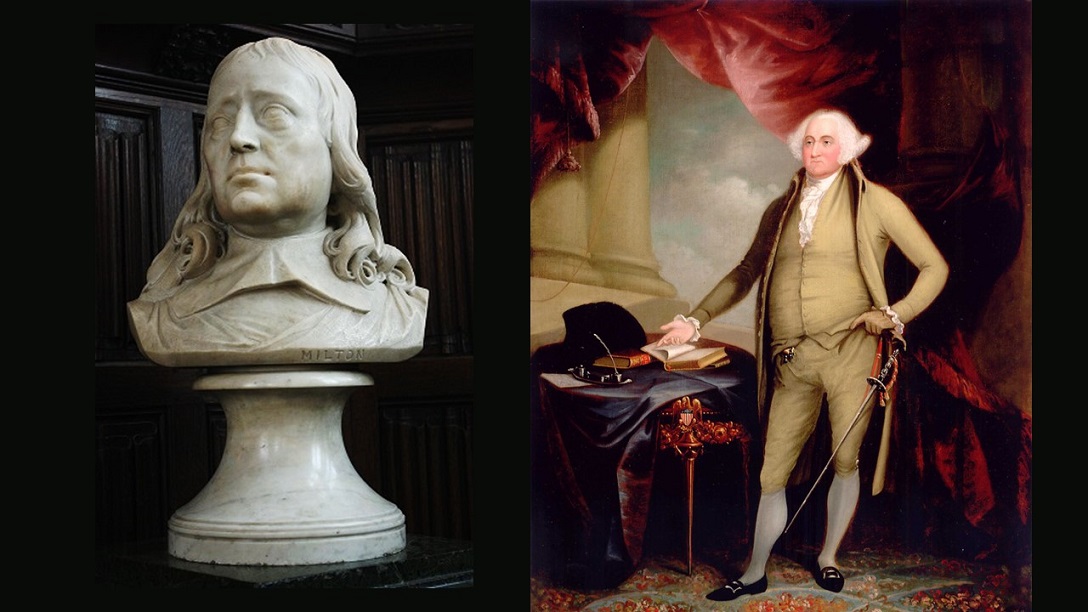
John and Abigail Adams are being guided through
heaven by John Milton. He takes them to a villa in
the Elysian Fields, where they meet a famous
Roman who shows them a vision of their political
ancestors.

Near spartan fields that nurtured simple roots,
A villa sprawled with hints of pagan faith.
Through lavish gardens hanging with ripe fruits,
They entered, crossed a room of marble wraiths
(Ancestral busts, the mugs of common farmers)
Its murals cracked and laced with creeping vines,
And saw a sitting figure chiseled firmer
Than stone, pure morals whitening his veins.
Great statesmen all belong in bliss, ergo
John Adams gazed upon his hero, Cicero.

Stiff muscles creaked and flexed off marble crust.
Two grinding elbows moved to steady knees.
Tan sandals squeaked and shook a robe of dust.
“One needs the fortitude of Socrates
To wait for you, John Adams,” uttered Marcus.
John gaped to speak. A finger silenced words.
“Just follow, or you’ll soon become a carcass.”
A fountain filled a pipette up two-thirds.
Sweet Abby closed her husband’s open mouth.
They followed Tully down a hallway leading south.

“Three eyedrops from the Well of Life. The mind
Needs vision, too,” said Cicero. They both
Leaned backward. Pupils drowned in fluid, blind.
A light-filled tunnel, granting them new birth,
Washed over John and Abby as they stood.
The busts receded from the hall. “Behold
Your ancestors,” said Cicero. Instead
Of marble casts, a line of figures rolled
Before their eyes, seeming of flesh and blood—
Civilization’s leaders, risen from the mud.

Stout Moses stands with tablets lightning-seared;
King David plays his harp; wise Solomon,
In his temple, strokes his even-whiskered beard;
Cyrus reclines upon an Ottoman,
Holding his cylinder of human rights;
Lycurgus promulgates his warrior code
To Spartans; Solon scribbles his insights,
Arranging Athen’s laws within an ode;
Romulus picks a hill (his twin won’t hearken);
The Palatine established, Brutus ousts proud Tarquin.

Augustus maps the Pax Romana’s reach
And five good emperors keep it in vogue;
Justinian’s wise jurists grant no breach
Of justice as he lies in bed with plague;
Next Arthur, throned on high in Avalon,
Charges his knights recite the Pentecostal
Oath, each sword around his table drawn:
To never kill or quarrel in a hostile
Manner, to flee from treason, give the ladies
Succor and rivals mercy—under pain of Hades.

This oath is taken up by Charlemagne
And mouthed by Roland, that great paladin;
The Lionheart, to honor his domain,
Embraces chivalry and Saladin;
His brother, John the Dog, signs Magna Carta
In front of all the English noblemen;
Then last, in contrast to laconic Sparta,
A queen in armor puts a global spin
On verbal virtues when, the Spanish drowned,
This Gloriana gathers bays to see bards crowned.

.

.

Andrew Benson Brown has had poems and reviews published in a few journals. His epic-in-progress, Legends of Liberty, will chronicle the major events of the American Revolution if he lives to complete it. Though he writes history articles for American Essence magazine, he lists his primary occupation on official forms as ‘poet.’ He is, in other words, a vagabond.

ShareTweetPin
The Society of Classical Poets does not endorse any views expressed in individual poems or commentary.
Read Our Comments Policy Here

RandomPoems

Book Review: Groans From Old Bones by William F.E. Morley (1920 – )
Essays

Book Review: Groans From Old Bones by William F.E. Morley (1920 – )

September 25, 2017

Click here to download the entire book as a pdf file. By Leonard Dabydeen In the fraternity of poetic minds we...

‘Letter to England: For Tommy Robinson’ by Joseph Charles MacKenzie
Beauty

‘Letter to England: For Tommy Robinson’ by Joseph Charles MacKenzie

July 15, 2018

I. But yesterday, your noble fathers bled Upon the fields of France, where countless dead Had found among the vines...

Next Post
‘Pinhead’ and Other Poetry by Michael Curtis

'Ever Flowing' by Dusty Grein

‘On a Terrible Orchestral-chorale Concert’ by Peter Venable

'On a Terrible Orchestral-chorale Concert' by Peter Venable

poem/woodruff/wef/davos 2023

A Poem on the World Economic Forum's Davos 2023, by Julian D. Woodruff

Comments 18

  1. jd says:
    4 years ago

    So imaginative and knowledgeable! I enjoyed your poem very much, Mr. Brown. Thank you!

    Reply
    • ABB says:
      4 years ago

      Thanks for reading, jd. Glad my expensive education ended up being good for something.

      Reply
  2. James Sale says:
    4 years ago

    I have just read Mark Stone’s wonderful spoof on metrics, Barktameter – and now, on the same day, I am reading the incredible Benson Brown’s spoof – but with a great satirical edge – on American and European history: laugh-out-loud funny. But on a serious note, despite my overall view that BB is the inheritor from Byron, the first stanza in particular has a marvellously Keatsian feel to it – the language wraps around you in a sensuous way. Some of the imagery is striking if not downright brilliant: ‘ a sitting figure chiseled firmer
    Than stone, pure morals whitening his veins’. ‘Pure morals whitening his veins’ is, I think, a genius image. Add to all this the amazing rhyming – ‘ergo/hero, Cicero’ or ‘hearken/Tarquin’ (never saw that one coming!) and you have the makings of a modern classic.

    Reply
    • ABB says:
      4 years ago

      Thanks for your comments, James. With this vision I actually had a relatively serious intention, though I can’t help but being a bit jokey even when this is the case. There is actually a second vision in the chapter that occurs after this one, unpublished here, where Cicero shows Adams a vision of the future and a line of some of our great (and not so great) presidents that ends on a more satirical edge. Maybe will submit that at some point in the future.

      Political visions in epics have been a standard thing from Virgil to Tasso and Ariosto. Of course in the latter two cases their visions culminated in the reigns of patrons like the d’Este family, which in retrospect has kind of an unintentionally laughable aspect considering how corrupt many of the condotierri-style rulers were. But one thing that struck me about all of these examples is how stone-cold serious their intentions were; I don’t think there’s ever been a good lighthearted example in mock-epic (to my knowledge).

      Reply
  3. Paul Buchheit says:
    4 years ago

    Very imaginative, Andrew! Filled with interesting references.

    Reply
    • ABB says:
      4 years ago

      Thank you, Paul.

      Reply
  4. Mark F. Stone says:
    4 years ago

    Andrew, This poem shows great craftsmanship. Many fabulous rhymes, and I enjoyed the story to boot! Mark

    Reply
    • ABB says:
      4 years ago

      Thanks Mark. From one craftsman to another, much appreciated.

      Reply
  5. Sally Cook says:
    4 years ago

    Who writes about morals today, or even thinks about them? Can’t think how long it’s been since any of my ancestors have been given the slightest bit of attention. This poem reminds me of the excitement of the hunt as I worked my way from generation to generation; and finally finding the clues from generation to generation and then, climbing the centuries to find where I finally fit.
    Andrew, you are a brilliant man. I look forward to meeting you someday.

    Reply
    • ABB says:
      4 years ago

      While I used to be a Wildean, ‘art for art’s sake’ guy, I have come around to the fact that aesthetics and morals share a necessary connection that, when severed, revels in weirdness or grotesque titillation.

      If there’s not another SCP get-together soon, I might have to just drive to NY to see you, Sally!

      Reply
  6. Cheryl Corey says:
    4 years ago

    A fascinating piece. The only thing I’d like to call into question is the line,
    “Cyrus reclines upon on an Ottoman”. Is it me, or is this grammatically incorrect?

    Reply
    • Mike Bryant says:
      4 years ago

      Fixed typo! And I loved the brush up on history. Wonderful.

      Reply
    • ABB says:
      4 years ago

      Oof, thanks for catching the error. Have changed this in the MS too.

      Reply
  7. Joseph S. Salemi says:
    4 years ago

    What a marvelous conceit — Cicero coming to life again from a marble statue, and guiding the Adamses through a gallery of the West’s great lawgivers and leaders. I love the rhymes of “hearken” and “Tarquin,” and “Marcus” and “carcass.” They are delightful and unexpected.

    Reply
    • ABB says:
      4 years ago

      Thank you, sir. Because Cicero was a “new man” in Rome, he didn’t have a hall of ancestors like other noble Romans from old families. So he makes the case for a sort of alternative lineage and wrote that a man aspiring to greatness in the present has to look to historical figures as personal examples. Tried to capture that philosophy here.

      Cicero’s reputation seems to be at a historical low point in our current academic age, in marked contrast to his high intellectual status from Petrarch until the last century.

      Reply
  8. Susan Jarvis Bryant says:
    4 years ago

    ABB, I thoroughly appreciate the craft that has gone into this highly amusing poem, chock full of elaborate vocabulary that elevates the piece to giddy heights. I especially like the nod to the Magna Carta. Thank you!

    Reply
    • ABB says:
      4 years ago

      Thanks Susan. The Magna Carta is, of course, a landmark document in history. None of the preindustrial societies that abruptly switched to being communist countries in the 20C ever developed anything like it (to my knowledge), hence the terrible abuses of power that occur in those places. Critics who talk about doing away with the Constitution today have little appreciation for the historical evolution of power checks summarized in the listing of law codes mentioned here.

      Reply
  9. jd says:
    3 years ago

    Again, congratulations!

    Reply

Leave a Reply Cancel reply

Your email address will not be published. Required fields are marked *


  1. James A. Tweedie on ‘What Folly Dares’ and Other Love Poems by James A. TweedieJuly 29, 2026

    Thank you, Gerard. A poet can only hope that loving sentiments thoughtfully expressed in a well-written poem will be well…

  2. James A. Tweedie on ‘What Folly Dares’ and Other Love Poems by James A. TweedieJuly 29, 2026

    Little things such as allusions can have a multiplying effect as the allusion extends the meaning beyond the bounds of…

  3. Paul Freeman on ‘The Passing’: A Poem by Margaret BrintonJuly 29, 2026

    Being presently ensconced in the British countryside, I appreciate this poem all the more, though the desert in its vastness…

  4. Cynthia L Erlandson on ‘Of Webs and Whispers’: A Poem by Susan Jarvis BryantJuly 29, 2026

    Abuses of language like "A spider spinning scripture" in order to kill; loose, gossiping "grapevine" lips; and eavesdroppers making truth…

  5. Cynthia L Erlandson on ‘The Passing’: A Poem by Margaret BrintonJuly 29, 2026

    What a great idea, Margaret. Something like this would be much less dehumanizing than the way many deaths are handled…

Subscribe to Daily Poems

Enter your email address to subscribe to this blog and receive notifications of new posts by email.

Join 1,592 other subscribers

Recent Poems

  • ‘The Passing’: A Poem by Margaret Brinton
  • ‘Of Webs and Whispers’: A Poem by Susan Jarvis Bryant
  • Poetry Book Review: Petrarch’s Canzoniere, Translated by A.M. Juster
  • ‘What Folly Dares’ and Other Love Poems by James A. Tweedie
  • ‘Allegrezza’ and Other Poetry by Rob Griffith
  • ‘The Lessons of Lot’: A Poem by Adam Wasem
  • ‘Prophecy and Divine Intervention in Virgil’s Aeneid’: An Essay by Kaitlyn Brown
  • ‘The Last Voyage of Barnaby Bear’: A Poem by Tashvi Reddy
  • ‘Impressions’ and Other Poems by Russel Winick
  • ‘The Reveal of the Rocks’: A Poem by Kyle Fiske
  • ‘Art Work’: A Poem by T.M. Moore
  • ‘A Strange Sun’: A Poem by Patricia Rogers Crozier
  • ‘Shave Off Those Whiskers’: A Poem by Roy E. Peterson
  • ‘The Man from China’: A Poem by Evan Mantyk
  • ‘The Ballad of the Ghost Mountain Boys’: A Poem by Rachel Lott
  • ‘The Threat of Virtue’: A Poem by Zumwalt
  • ‘A Poet at the Tower’ and Other Poetry by Michael C. Paul
  • ‘Florence Foster Jenkins’ and Other Poetry by Brian Yapko
  • Winners and Rankings of The Great American Poetry Competition
  • ‘The Gold Star Mother’: A Poem by Gerard Maritato
  • ‘An American Dash’: A Poem by Linda Ellis
  • ‘The Anonymous Soldier’: A Poem by Lucy Lind
  • ‘For Those We Never Meet’: A Poem by Aneesh Agarwal
  • ‘Ben Franklin’s Copper Fugio Cent’: A Poem by Geoffrey Smagacz
  • Three Brief Poems by Luxorius, Translated by Joseph S. Salemi
  • ‘The American Spirit’: A Poem by Dusty Grein
  • ‘The Ballad of Zebulon Pike’: A Poem by M.D. Skeen
  • ‘We Are the Ones’ and Other Poetry by Cheryl Corey
  • ‘My Pyjamas!’ and Other Poems by Susan Jarvis Bryant
  • ‘A Snowy Egret’: A Poem by Bruce Dale Wise

Categories

  • Acrostic
  • Alexandroid
  • Alliterative
  • Art
  • Best Poems
  • Blank Verse
  • Chant Royal
  • Classical Poets Live
  • Clerihew
  • Covid-19
  • Deconstructing Communism
  • Educational
  • Epic
  • Epigrams and Proverbs
  • Essays
    • Interviews with Poets
    • Poetry Reviews
  • Featured
  • From the Society
  • Great Poets
    • Dante Alighieri
    • Edgar Allan Poe
    • Emily Dickinson
    • Geoffrey Chaucer
    • Henry Wadsworth Longfellow
    • Homer
    • John Keats
    • John Milton
    • Robert Frost
    • William Blake
    • William Shakespeare
    • William Wordsworth
  • Human Rights in China
  • Limerick
  • Love Poems
  • Music
  • Pantoum
  • Performing Arts
  • Poetry
    • Beauty
    • Children's Poems
    • Culture
    • Ekphrastic
    • Found Poems
    • High School Poets
    • Humor
    • Riddles
  • Poetry Challenge
  • Poetry Contests
  • Poetry Forms
    • Curtal Sonnet
    • Haiku
  • Poetry Readings
  • Rhupunt
  • Rondeau
  • Rondeau Redoublé
  • Rondel
  • Rubaiyat
  • Sapphic Verse
  • Satire
  • Science
  • Sestina
  • Shape Poems
  • Short Stories
  • Song Lyrics
  • Sonnet
  • Symposium
  • Terrorism
  • Terza Rima
  • The Environment
  • Translation
  • Triolet
  • Video
  • Villanelle

Quick Links

  • About Us
  • Submit Poetry
  • Become a Member
  • Members List
  • Support the Society
  • Advertisement Placement
  • Comments Policy
  • Terms of Use

Welcome Back!

Login to your account below

Forgotten Password?

Retrieve your password

Please enter your username or email address to reset your password.

Log In
No Result
View All Result
  • Poems
    • Beauty
    • Culture
    • Satire
    • Humor
    • Children’s
    • Art
    • Ekphrastic
    • Epic
    • Epigrams and Proverbs
    • Human Rights in China
    • Music
    • Performing Arts
    • Riddles
    • Science
    • Song Lyrics
    • The Environment
    • The Raven
    • Found Poems
    • High School Poets
    • Terrorism
    • Covid-19
  • Poetry Forms
    • Sonnet
    • Haiku
    • Limerick
    • Villanelle
    • Rondeau
    • Pantoum
    • Sestina
    • Triolet
    • Acrostic
    • Alexandroid
    • Alliterative
    • Blank Verse
    • Chant Royal
    • Clerihew
    • Rhupunt
    • Rondeau Redoublé
    • Rondel
    • Rubaiyat
    • Sapphic Verse
    • Shape Poems
    • Terza Rima
  • Great Poets
    • Geoffrey Chaucer
    • Emily Dickinson
    • Homer
    • Henry Wadsworth Longfellow
    • Dante Alighieri
    • John Keats
    • John Milton
    • Edgar Allan Poe
    • William Shakespeare
    • William Wordsworth
    • William Blake
    • Robert Frost
  • Love Poems
  • Contests
  • SCP Academy
    • Educational
    • Teaching Classical Poetry—A Guide for Educators
    • Poetry Forms
    • The SCP Journal
    • Books

© 2025 SCP. WebDesign by CODEC Prime.