


.
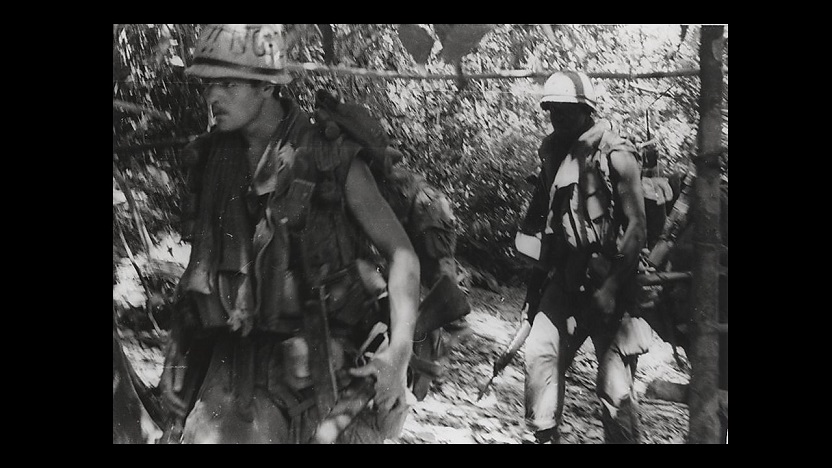
South Vietnam Warfare
.
Northern Jungle
The rat-tat-tat of machine gun
Split through the mist of morning sun.
The sympathetic Montagnard
Were blown apart from near to far.
The boom of friendly howitzer
Made opposition disappear.
The screams of death fell silently
As hell consumed with entropy.
How free the flow of fertile blood
Encrusted red the mountain mud.
The virile verdant chunks of green
Were thrown about the jungle scene.
.
Southern Delta Rice Paddies
The Delta paddies came alive
As peasants to their work arrive.
The night annihilation past,
The Delta dawn arrived at last.
The Viet Cong with dawn would fade
Into the population shade.
The terror of tormented place
Devolved into a smiling face.
No one could know who’s friend or foe—
Only the terror troops would know.
Exacting tax and death in droves,
Some melted into the mangroves.
.
Poet’s Note
1. Montagnard is pronounced: mɒn tənˈyɑr. It is a French term for Mountain Man. The Montagnard ethnic group fought with the Americans in the Central and Northern Highlands.
2. See my autobiographical true war book, Fight of the Phoenix. I was assigned to Military Region IV, the Delta, as a Phoenix Advisor. I was one of the last Americans to leave the Delta in December 1972. The Phoenix program was for the assassination of the Viet Cong.
.
.
LTC Roy E. Peterson, US Army Military Intelligence and Russian Foreign Area Officer (Retired) has published more than 5,000 poems in 78 of his 101 books. He has been an Army Attaché in Moscow, Commander of INF Portal Monitoring in Votkinsk, first US Foreign Commercial Officer in Vladivostok, Russia and Regional Manager in the Russian Far East for IBM. He holds a BA, Hardin-Simmons University (Political Science); MA, University of Arizona (Political Science); MA, University of Southern California (Int. Relations) and MBA University of Phoenix. He taught at the University of Arizona, Western New Mexico University, University of Maryland, Travel University and the University of Phoenix.
















Roy,
Two very fine war poems. Also love how you include the Montagnards in the first poem. Very subtly done.
Best regards,
Paddy
Oh, just noticed you meant it to be one poem, contrasting the Northern Jungle with the Southern Delta Paddies.
Fine poem, but they read equally well as two independent poems!
Best regards,
Paddy
Thank you, Paddy. The Viet Cong, the internal enemy tended to operate in the Delta Region, while most of the overt war was fought in the northern and central portions of South Vietnam.
When I was an Army Attaché in Moscow, a Vietnamese General told a gathering of the Moscow Association of Military Attachés in 1985, that the government in the north was ready to unconditionally surrender within one week if Nixon continued bombing of the North. Nixon bowed to American internal political pressure and ceased bombing. I was one of the last American advisors in the Delta and departed in December 1972. I was an Advisor for the Phoenix program, the assassination of the Viet Cong, which was established by the CIA. Operating alone near the end, I advised to arrest anyone out at night, as in martial law without a declaration. That program intercepted all the commo-liaison Viet Cong that were intent on guiding North Vietnamese Army (NVA) combatants coming down the Ho Chi Minh trail in Cambodia to safe locations in the Delta at night. This eliminated 4,000 of them, because they ran into South Vietnamese troops in bunkers at night and mobile counterinsurgency teams. I know this because I received a call from Col Kelleher in Saigon asking what I was doing down there in the Delta and congratulating me on the resultant kills.
This poem in two parts, Roy, is so vividly written I can feel the roasting humidity and smell the stench of blood emanating from a country ripped in two by war. The most terrifying thing about this poem is the way the enemy simply slips melts into “the population shade.” To be surrounded by enemies without being able to identify them is a hellish nightmare. Very evocative, Roy. Well done. And may I reiterate what I have said on prior occasions: thank you very much for your service to our country — your service and your many sacrifices.
Your thoughts are deeply appreciated. The NVA usually fought in the north, but tried to infiltrate into the Class C (determined by us) villages, forested terrain and mangrove swamps. The Viet Cong, the indigenous South Vietnamese enemy, lived in villages and killed those who they thought posed a threat. In my book I have some of my daily briefing notes from Military Region IV, the Delta, detailing the killing of schoolteachers, children and noncompliant villagers. It was almost like two different wars. Through a FOIA request, I had declassified a Confidential document of about 20 pages with the stamping of the classification still top and bottom, I was the originating classification authority. The document was a twenty-page report I prepared acquired from my requests from each province for the levels of Viet Cong taxation, often in the form of chickens, pigs, or rice.
Vivid imagery, indeed, of a war that’s disappearing from the collective memory, but needs to be kept alive by documentation like this, Roy.
Thanks for the read.
Thank you, Paul. My book, “Fight of the Phoenix,” as mentioned in footnote 2 was praised by a military reviewer as a significant contribution to understanding the Vietnam War.
Roy, what role did the media and people like Cronkite play in turning public sentiment against the war? I was too young (and ignorant) to comprehend the war, but my understanding is that they made it appear that we were losing, when in fact we were winning.
Cheryl, we won the war, but lost the peace! If you read my separate note after the exchange between Paddy and myself, you will see one of the things that transpired. Walter Cronkite was not the problem, but Dan Rather and other media contributed to the antiwar movement glorification and together exerted tremendous political pressure to get out.
I recall that the American media (both broadcast and print) were divided on their personal views of the Vietnam War. Many of course (like Rather and Vanocur) were leftish-liberal, and they made it very clear by innuendo and suggestion that they thought the war was unjust and a mistake. Others in the media were moderates or conservative, but they took their responsibility as journalists seriously and tried to present the facts dispassionately.
One glaring act of media cover-up was the overall refusal to discuss the savage mass murders that took place when the enemy overran the city of Hue, killing anyone, from schoolteachers to government employees to clerks and to typists, whom they considered to be politically untrustworthy. This included many others of the city’s residents who were judged to be “bourgeois” or Christian. All were shot and shoveled into mass graves.
The only print journal in America to cover this story fully, with photographs, was the National Review, at that time a conservative magazine. My own view is that the larger media outlets (NBC, CBS, ABC, and the big newspaper chains) had received orders from higher-ups to downplay the Hue atrocities, lest it generate ferocious support for the war among ordinary Americans.
Today things are different. ALL the mainstream media outlets are fully controlled, and will cover no story at all that the government does not want covered. As for the “conservative” opposition, they are merely tolerated as a useful outlet for popular anger, and when push comes to shove on some stories, they will purge themselves quickly. Ask Tucker Carlson at FOX News.
LTC Peterson, thank you for your service in the Phoenix Program. If every initiative and program during the Vietnam War had been as realistic and tough as Phoenix, the war’s outcome might have been different.
Joseph, you have provided an extremely accurate portrayal of the news media then and now. Thank you for your insights and kind words. I completely agree with everything you said!
Thank you for your courageous and prodigious service, sir.
Bless you, Cynthia!
Roy, you and I have never met and, as I live on this side of the Atlantic and you on that, nor are we ever likely to. But this was not always the case. In fact, I was born in Newark in 1949, which means also that we must be about the same age. My parents, British Jews, wanted to have a member of the family with US citizenship. So, when my mother became pregnant, they moved over to your side and then came back before I was a year old. Since then I have never returned to the US mainland. By the mid-1960s, watching the news in London and hearing new expressions like “body bags” and “body count”, it became apparent that there were unwanted consequences to my parents’ decision. Accordingly, around my 18th birthday, in 1967, I was marched off to the Embassy to renounce my US citizenship. Thus it was that you went to the War and I didn’t.
I remember sharing a moment of elation with my mother after the brief ceremony when coming down the steps in Grosvenor Square in central London. But now, more than fifty years later, I recognise that, in a way that would have been difficult for her to comprehend, you were the winner and I was the loser. I write this knowing full well that you must have gone through absolute hell, experiencing things and pushed beyond limits of endurance that people who have not seen military service will never understand. Yet nevertheless, I envy you, just as I am filled with admiration and respect for what you did for your country.
In the end, if the moderator will allow me to say this, we are all dead meat who take to the grave nothing but what we achieved as human beings. To go through what soldiers like you did on behalf of a noble ideal that you believed in, and then to come back to world that turned its back on so many, enduring from day to day and year to year things which perhaps haunt you still, that, it seems to me, is a colossal human achievement. And who, though not wanting to go though what you’ve been through, would not wish to be a man like you?
My deepest respect, sir.
Paul, I am humbled and honored by your precious words. I thank you from the bottom of my heart, just as I respect you regardless of how things were planned out for you and the decisions that were made. Life has many fulfilling opportunities, and it seems you have made the most of the hand you were dealt. Bless you.
Colonel Peterson, thanks for your service, your book, and the double poem that will provide an important brief sketch of the warfare for many, and a memory for veterans. I served stateside along with many young men finishing off enlistment years after combat in Vietnam. Heard many little stories about how things went in the field. I remember to pronounce man-grove with equal stress on both syllables, as those swamps were frequently found to be inhabited. Thus the rhyme in your last couplet is perfect!
Thank you for the personal note, Margaret, and bless you for your service stateside. The man-grove swamps in the southern provinces of the Delta were also locations where many POWs were placed in concentration camps. One of my goals was to find them and free the prisoners from their tiger cages using human intelligence. That proved to be futile, but the effort was there. That likely was because those swamps and the U Minh Forest at the southern tip of Vietnam, but part of the Delta, were sparsely populated, except for Viet Cong (internal) enemy combatants and their cohorts. Major (James) Nick Rowe was captured along with others in 1963 (before the war was officially entered in 1965). In 1968, he managed to escape when the guards who were going to shoot him failed to pay full attention. He gave the best account he could of his location in the U Minh Forest.
Wow, Roy, you’ve done a good job of conveying the horrors of that war! Even without your footnotes, I knew you had seen those sights.
Thank you for serving our country. It’s awful how liberals “welcomed” Vietnam War soldiers back with insults.
The same thing happened to Italian POWs when they returned from captivity in the Soviet Union in the late 1940s. The Italian Communist Party arranged for left-wing thugs to meet the returning soldiers at the train stations, and to threaten them and their families with violence if they said anything negative about the Soviet Union.
The left can’t stand criticism, or testimony about leftist crimes.
Roy, thank you for sharing this informatively poetic first-hand account. And thank you for your service.