• Submit Poetry
  • Support SCP
  • About Us
  • Members
  • Join
Friday, August 14, 2026
Society of Classical Poets
  • Poems
    • Beauty
    • Culture
    • Satire
    • Humor
    • Children’s
    • Art
    • Ekphrastic
    • Epic
    • Epigrams and Proverbs
    • Human Rights in China
    • Music
    • Performing Arts
    • Riddles
    • Science
    • Song Lyrics
    • The Environment
    • The Raven
    • Found Poems
    • High School Poets
    • Terrorism
    • Covid-19
  • Poetry Forms
    • Sonnet
    • Haiku
    • Limerick
    • Villanelle
    • Rondeau
    • Pantoum
    • Sestina
    • Triolet
    • Acrostic
    • Alexandroid
    • Alliterative
    • Blank Verse
    • Chant Royal
    • Clerihew
    • Rhupunt
    • Rondeau Redoublé
    • Rondel
    • Rubaiyat
    • Sapphic Verse
    • Shape Poems
    • Terza Rima
  • Great Poets
    • Geoffrey Chaucer
    • Emily Dickinson
    • Homer
    • Henry Wadsworth Longfellow
    • Dante Alighieri
    • John Keats
    • John Milton
    • Edgar Allan Poe
    • William Shakespeare
    • William Wordsworth
    • William Blake
    • Robert Frost
  • Love Poems
  • Contests
  • SCP Academy
    • Educational
    • Teaching Classical Poetry—A Guide for Educators
    • Poetry Forms
    • The SCP Journal
    • Books
No Result
View All Result
Society of Classical Poets
  • Poems
    • Beauty
    • Culture
    • Satire
    • Humor
    • Children’s
    • Art
    • Ekphrastic
    • Epic
    • Epigrams and Proverbs
    • Human Rights in China
    • Music
    • Performing Arts
    • Riddles
    • Science
    • Song Lyrics
    • The Environment
    • The Raven
    • Found Poems
    • High School Poets
    • Terrorism
    • Covid-19
  • Poetry Forms
    • Sonnet
    • Haiku
    • Limerick
    • Villanelle
    • Rondeau
    • Pantoum
    • Sestina
    • Triolet
    • Acrostic
    • Alexandroid
    • Alliterative
    • Blank Verse
    • Chant Royal
    • Clerihew
    • Rhupunt
    • Rondeau Redoublé
    • Rondel
    • Rubaiyat
    • Sapphic Verse
    • Shape Poems
    • Terza Rima
  • Great Poets
    • Geoffrey Chaucer
    • Emily Dickinson
    • Homer
    • Henry Wadsworth Longfellow
    • Dante Alighieri
    • John Keats
    • John Milton
    • Edgar Allan Poe
    • William Shakespeare
    • William Wordsworth
    • William Blake
    • Robert Frost
  • Love Poems
  • Contests
  • SCP Academy
    • Educational
    • Teaching Classical Poetry—A Guide for Educators
    • Poetry Forms
    • The SCP Journal
    • Books
No Result
View All Result
Society of Classical Poets
No Result
View All Result
Home Poetry

‘Some Post-Animated Protestations of Goliath of Gath’: A Poem by James Sale

August 3, 2023
in Poetry, Satire
A A
27
poem/sale/satire

.

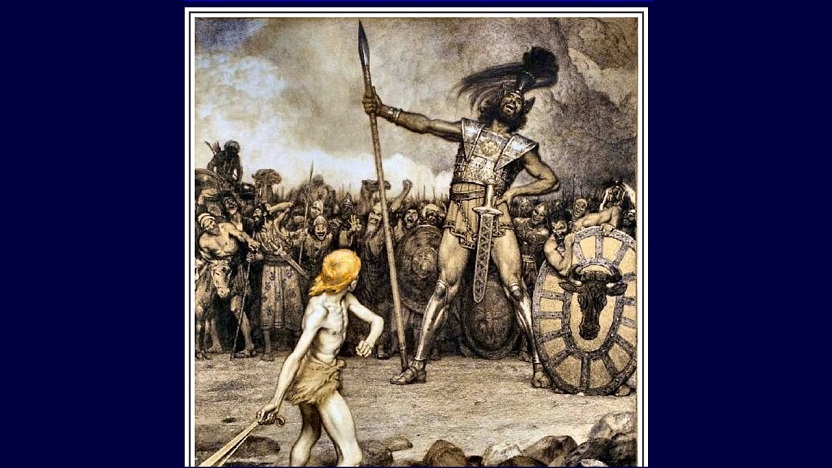
Some Post-Animated Protestations
of Goliath of Gath

Firstly, I protest
That this protestation
Is useless nonetheless.

Secondly, I object
To prejudice pronounced
In so-called holy text.

Thirdly, I revolt
Against the pipsqueak king
Whose crown was not my fault.

Fourthly, I dismiss
All Jewish, idle tales
That boast of his prowess.

Fifthly, I reject
Suggestions that defeat
Was other than by hex.

Sixthly, I demand
An explanation why
I fell by murderous hand?

Lastly, I confess
This hole in my head hurts
Like aching endlessness.

.

.

James Sale has had over 50 books published, most recently, “Mapping Motivation for Top Performing Teams” (Routledge, 2021). He has been nominated by The Hong Kong Review for the 2022 Pushcart Prize for poetry, has won first prize in The Society of Classical Poets 2017 annual competition, and performed in New York in 2019. He is a regular contributor to The Epoch Times. His most recent poetry collection is “StairWell.” For more information about the author, and about his Dante project, visit https://englishcantos.home.blog. To subscribe to his brief, free and monthly poetry newsletter, contact him at [email protected]

ShareTweetPin
The Society of Classical Poets does not endorse any views expressed in individual poems or commentary.
Read Our Comments Policy Here

RandomPoems

A Poem on BLM Riots: ‘The Enemy Within’ by Susan Jarvis Bryant
Culture

A Poem on BLM Riots: ‘The Enemy Within’ by Susan Jarvis Bryant

July 25, 2020

"One does not establish a dictatorship in order to safeguard a revolution; one makes a revolution in order to establish...

‘Bound Verse’ by Alan Nordstrom
Culture

‘Bound Verse’ by Alan Nordstrom

July 2, 2015

Bound verse, ironically, is quite unbound, For writing it you have nothing to say, Since sense comes after you have...

Next Post
poem/essmann/beauty

'Conversion': A Poem by Jeffrey Essmann

poem/rainbolt/culture

'On Water & Evil': A Poem by D.R. Rainbolt

poem/medical assistance in dying/MAID

'The Blame Game' and Other Poetry by Susan Jarvis Bryant

Comments 27

  1. Cheryl Corey says:
    3 years ago

    Love the use of “pipsqueak”, as well as your slant rhymes.

    Reply
    • James Sale says:
      3 years ago

      Thank you Cheryl – glad that ‘pipsqueak’ pleases you; as for slant rhymes, also pleased you noticed them. Rhyming that is too fluent – unless for a specific purpose (the wit of Dryden, for example!) – can be tedious!

      Reply
  2. Brian A Yapko says:
    3 years ago

    This is very funny, James! I’ve never considered David & Goliath from Goliath’s point of view! What a litany of post-mortem complaints not one of which holds water! That the giant is so illogical yet whiny and entitled is very modern. Thanks for a most unexpected treat!

    Reply
    • James Sale says:
      3 years ago

      Cheers Brian – yea, well everyone truly does have their own perspective, but against modernist thought, not all perspectives are ‘equally’ valid as you quite rightly infer. Goliath – a type of our age? How easily overcome – when you have the right strategy!

      Reply
  3. Joseph S. Salemi says:
    3 years ago

    Goliath has always been a symbol of strength without humility. Here we also get a comic picture of his side of the story. (We should also remember that David himself turned out to be something of a disappointment).

    As a small point — note how Sale uses seven separate verbs (“protest, object, revolt…”) to tell us what the speaker is doing. As with the slant rhymes, this is a sign of a poet who is conscious of his craft.

    Reply
    • James Sale says:
      3 years ago

      Hi Joe, thanks so much for your comments. As for your ‘small point’, well, of course, as you know so well – and I see in your expert poetry – it is actually a giant point (Goliathean if I may put it that way): for the strength of any language is always in the verbs, and weak poets failing to understand this, focus on adjectives and – worse – adverbs, which movement actually (adverb here!) moves us away from ‘being’ towards description of being; in other words, towards a secondary mode of existence. Long live the verb!

      Reply
  4. Roy Eugene Peterson says:
    3 years ago

    I fear Goliath’s protestations are falling on deaf ears. This is a fun read from first positing that his protestations are useless to the conclusion that the hole in his head is an endless headache that went down in history and thus is on a repetitive endless cycle of doom. Loved your tercets!

    Reply
    • James Sale says:
      3 years ago

      Thanks Roy – so pleased you love the tercets: so don’t forget, I’ve written a lot more of them in HellWard and StairWell. You have given me the idea to promote my books on the basis of your comment: ‘You’ve topped up on vitamin C, on vitamin D, now top up on your tercets – get your copy of StairWell right now; you’ll feel so much better after you’ve digested it!’

      Reply
  5. Paul Freeman says:
    3 years ago

    I was reminded of John Belushi in The Blues Brothers, using a bunch of lame excuses in an attempt to convince Carrie Fisher that he didn’t deliberately stand her up at their wedding.

    Very funny. Thanks for the read.

    Reply
    • James Sale says:
      3 years ago

      Thanks Paul – a film I must remember to re-visit soon; as you say, very funny!

      Reply
  6. Morrison Handley-Schachler says:
    3 years ago

    A very amusing protestation, James, but I fear Goliath brought about his own downfall by arrogantly believing that nobody would ever take up his challenge and, therefore, that his fighting abilities would never really be tested – especially by someone with a long-range missile system.

    Reply
    • James Sale says:
      3 years ago

      Thanks Morrison: you are of course right – it’s called hubris in the Greek tradition and in some sense we are all architects of our own downfalls!

      Reply
  7. Susan Jarvis Bryant says:
    3 years ago

    Hilarious! Goliath – a gargantuan victim of self-inflicted circumstances. How well he would fit in today’s society. I love it!

    Reply
    • James Sale says:
      3 years ago

      Indeed, Susan, a perfect fit for today: all that me-me-me virtue signalling! Thanks.

      Reply
  8. Michael Pietrack says:
    3 years ago

    Those who deny God and disregard his standards found in the Bible, though they are a composite giant, will fall to the ground as did Goliath.

    Reply
    • James Sale says:
      3 years ago

      I get your point, Michael: as GK Chesterton once wisely observed: “Morality did not begin by one man saying to another, ‘I will not hit you if you do not hit me’; there is not trace of such a transaction. There is a trace of both men having said, ‘We must not hit each other in the holy place’. They gained their morality by guarding their religion.”

      Reply
  9. ABB says:
    3 years ago

    This is one of your funniest short poems, James! I wonder if the brutish Goliath required a lawyer-scribe to explicate his arguments? The hole in the head hurting “like aching endlessness” is a fitting conclusion for both poem and man.

    Reply
    • James Sale says:
      3 years ago

      Yes, Andrew – he did require a lawyer: his feelings were hurt, and ‘David’ made him feel ‘uncomfortable’; all of this requires compensation … PS. Glad you liked it!

      Reply
  10. Margaret Coats says:
    3 years ago

    James, I must disagree with my distinguished colleagues who find this a funny poem. You have well used the psychological skills you developed in portraying damned souls. Goliath’s plight is not humorous, and yet your presentation of him does not elicit any sympathy. You show him forever maintaining enmity with God, and continuing in sins such as pride, hatred, and blasphemy. There is a nice progression from the mild opening protest despite knowing its uselessness, to the aching final confession that he feels endless pain. The best touch there is how the pain felt in the soul derives from the mortal pain experienced in the body. This is very sensitive work.

    Reply
    • Susan Jarvis Bryant says:
      3 years ago

      Margaret, I disagree. Many a grave point is made through satire. This does not mean that those who write and find such works humorous are oblivious to the sensitive and sad underlying issues. The whole point of satire is to highlight them… to point out pitfalls from a creative angle.

      Reply
      • James Sale says:
        3 years ago

        Thanks Susan: satire can do many things – sometimes in pity, sometimes in rage – outrage even! Appreciate your thoughts on this.

        Reply
    • Monika Cooper says:
      3 years ago

      I also didn’t think the poem was funny but the form created an expectation of humor. I think there’s a form-content tension here. I was trying to decide myself if Goliath was a sympathetic figure or not. Not really, yet at the end of the poem, we’re literally (or at least metaphorically) in his head and it’s not a very comfortable place to be.

      Reply
      • James Sale says:
        3 years ago

        Ha ha ha!!! You’ll find a lot of my poems are not a ‘comfortable place to be’ – why, take HellWard as a case in point! But for more on the topic of beauty, do see my latest article for the Epoch Times on beauty and Genesis chapter 1: https://www.theepochtimes.com/bright/the-creation-of-meaning-and-beauty-genesis-ch-1-post-5435201 I think you’ll enjoy it. Regards.

        Reply
      • Monika Cooper says:
        3 years ago

        Yes, I did enjoy it! Thank you.

        The six day creation account is completely indispensable for what it reveals about God and the order and beauty of His making, His doings. The words of Genesis are to be esteemed and treasured beyond the words of men, whoever they may be. Every seven day week of time is a liturgical witness to the truth of the first book of Moses.

        Reply
    • James Sale says:
      3 years ago

      Thank you Margaret: you are right in maintaining what kind of a character Goliath is – a character like Capaneus the proud! And yes, how our souls and bodies interact is a key issue.

      Reply
  11. The Mindflayer says:
    3 years ago

    Whether we find the poem funny or not – for what could be more subjective than humour? – it is certainly playful, and, as Monika observed, full of tensions: modern vocabulary (pipsqueak) contrasting with ancient (hex), the grandiose (I fell by murderous hand) with the bathetic (I protest / That this protestation / Is useless nonetheless). The idea of a re-animated Goliath justifying his defeat is Dante-esque, for the sinners in the Inferno so often resort to self-justification even in the face of divine arbitration (and of course, even in The Inferno Dante had many moments of humour in his Comedy too, as the name would suggest!). In typical Sale style, the ending rises above playfulness and reaches transcendence – in this case of an existential kind. It evokes the words of the Christian rapper Bizzle, who, writing from the perspective of God in the Book of Job, wrote, “You without Me is what Death is.” This is the human condition of sin and oh-so-true of Goliath: without the Divine, he has become “aching endlessness”, aka, a state of perpetual suffering.

    Reply
    • James Sale says:
      3 years ago

      Thank you Mindflayer for this deeply appreciative dive into the mechanics of the poem: your comments on the linguistic tensions are, I think, very perceptive. Plus, your reference to Dante does suggest I could do – once the English cantos are complete – some supplementary follow-up poems where I include characters who intrigue me but whom I haven’t included in the main body of the work!!! A great idea! Thanks.

      Reply

Leave a Reply Cancel reply

Your email address will not be published. Required fields are marked *


  1. Kimberly Fore on The Society of Classical Poets 2026 Haiku CompetitionAugust 14, 2026

    My previous formatting did not come through as intended so I will type directly into this box instead of taking…

  2. Margaret Coats on ‘Confession’: A Poem by Jeffrey EssmannAugust 14, 2026

    An excellent plan for the poem, Jeffrey--bringing out emotional aspects of the experience, by referring to the material surroundings. I'm…

  3. Margaret Coats on ‘A Prayer of Aristotle’: A Poem by Margaret CoatsAugust 14, 2026

    Thank you, Jonathan. In traditional study of philosophy, we do start with human reason and what it can achieve. We…

  4. Joseph S. Salemi on ‘A Prayer of Aristotle’: A Poem by Margaret CoatsAugust 14, 2026

    There is a new translation by Michael Palma of the complete Divine Comedy, published last year. It renders into English…

  5. Gerard Maritato on ‘A Prayer of Aristotle’: A Poem by Margaret CoatsAugust 14, 2026

    In studying the Divine Comedy, scholars over the centuries have marveled at Dante’s ingenious terza rima. Translators have found that…

Subscribe to Daily Poems

Enter your email address to subscribe to this blog and receive notifications of new posts by email.

Join 1,612 other subscribers

Recent Poems

  • ‘Confession’: A Poem by Jeffrey Essmann
  • ‘Religious Poetry, and Religionist Poetry’: An Essay by Joseph S. Salemi
  • The Zingers of Adam Sedia: A Review by Theresa Werba
  • ‘A Paradox’: A Poem by Shamik Banerjee
  • ‘A Prayer of Aristotle’: A Poem by Margaret Coats
  • ‘The Sparrow’: A Poem by Michael Pietrack
  • ‘Chemo Refusal’ and Other Poetry by Golan Shahar
  • ‘Deliverance’ and Other Poetry by Peter Venable
  • ‘Rain’ and Other Poems by Russel Winick
  • ‘The Story of a Plague’ and Other Poetry by Michael Robinson
  • ‘Javert Derailed’: A Poem by Zanna Barton
  • ‘People Forget’: A Poem by James Sale
  • ‘Good and Evil’: A Poem by Roy E. Peterson
  • ‘The Royal Arse Hortillery’: A Poem on the Spoonerism, by Jeff Eardley
  • ‘Who Hears a Robot’s Prayer?’ and Other Poetry by Brian Yapko
  • The Society of Classical Poets 2026 Haiku Competition
  • Four Love Sonnets by Adam Sedia
  • ‘Rasputina Confers with Her Cohorts’: A Poem by Joseph S. Salemi
  • ‘Warfare by Remote Control’: A Poem by Paul A. Freeman
  • ‘The Passing’: A Poem by Margaret Brinton
  • ‘Of Webs and Whispers’: A Poem by Susan Jarvis Bryant
  • Poetry Book Review: Petrarch’s Canzoniere, Translated by A.M. Juster
  • ‘What Folly Dares’ and Other Love Poems by James A. Tweedie
  • ‘Allegrezza’ and Other Poetry by Rob Griffith
  • ‘The Lessons of Lot’: A Poem by Adam Wasem
  • ‘Prophecy and Divine Intervention in Virgil’s Aeneid’: An Essay by Kaitlyn Brown
  • ‘The Last Voyage of Barnaby Bear’: A Poem by Tashvi Reddy
  • ‘Impressions’ and Other Poems by Russel Winick
  • ‘The Reveal of the Rocks’: A Poem by Kyle Fiske
  • ‘Art Work’: A Poem by T.M. Moore

Categories

  • Acrostic
  • Alexandroid
  • Alliterative
  • Art
  • Best Poems
  • Blank Verse
  • Chant Royal
  • Classical Poets Live
  • Clerihew
  • Covid-19
  • Deconstructing Communism
  • Educational
  • Epic
  • Epigrams and Proverbs
  • Essays
    • Interviews with Poets
    • Poetry Reviews
  • Featured
  • From the Society
  • Great Poets
    • Dante Alighieri
    • Edgar Allan Poe
    • Emily Dickinson
    • Geoffrey Chaucer
    • Henry Wadsworth Longfellow
    • Homer
    • John Keats
    • John Milton
    • Robert Frost
    • William Blake
    • William Shakespeare
    • William Wordsworth
  • Human Rights in China
  • Limerick
  • Love Poems
  • Music
  • Pantoum
  • Performing Arts
  • Poetry
    • Beauty
    • Children's Poems
    • Culture
    • Ekphrastic
    • Found Poems
    • High School Poets
    • Humor
    • Riddles
  • Poetry Challenge
  • Poetry Contests
  • Poetry Forms
    • Curtal Sonnet
    • Haiku
  • Poetry Readings
  • Rhupunt
  • Rondeau
  • Rondeau Redoublé
  • Rondel
  • Rubaiyat
  • Sapphic Verse
  • Satire
  • Science
  • Sestina
  • Shape Poems
  • Short Stories
  • Song Lyrics
  • Sonnet
  • Symposium
  • Terrorism
  • Terza Rima
  • The Environment
  • Translation
  • Triolet
  • Video
  • Villanelle

Quick Links

  • About Us
  • Submit Poetry
  • Become a Member
  • Members List
  • Support the Society
  • Advertisement Placement
  • Comments Policy
  • Terms of Use

Welcome Back!

Login to your account below

Forgotten Password?

Retrieve your password

Please enter your username or email address to reset your password.

Log In
No Result
View All Result
  • Poems
    • Beauty
    • Culture
    • Satire
    • Humor
    • Children’s
    • Art
    • Ekphrastic
    • Epic
    • Epigrams and Proverbs
    • Human Rights in China
    • Music
    • Performing Arts
    • Riddles
    • Science
    • Song Lyrics
    • The Environment
    • The Raven
    • Found Poems
    • High School Poets
    • Terrorism
    • Covid-19
  • Poetry Forms
    • Sonnet
    • Haiku
    • Limerick
    • Villanelle
    • Rondeau
    • Pantoum
    • Sestina
    • Triolet
    • Acrostic
    • Alexandroid
    • Alliterative
    • Blank Verse
    • Chant Royal
    • Clerihew
    • Rhupunt
    • Rondeau Redoublé
    • Rondel
    • Rubaiyat
    • Sapphic Verse
    • Shape Poems
    • Terza Rima
  • Great Poets
    • Geoffrey Chaucer
    • Emily Dickinson
    • Homer
    • Henry Wadsworth Longfellow
    • Dante Alighieri
    • John Keats
    • John Milton
    • Edgar Allan Poe
    • William Shakespeare
    • William Wordsworth
    • William Blake
    • Robert Frost
  • Love Poems
  • Contests
  • SCP Academy
    • Educational
    • Teaching Classical Poetry—A Guide for Educators
    • Poetry Forms
    • The SCP Journal
    • Books

© 2025 SCP. WebDesign by CODEC Prime.