


.
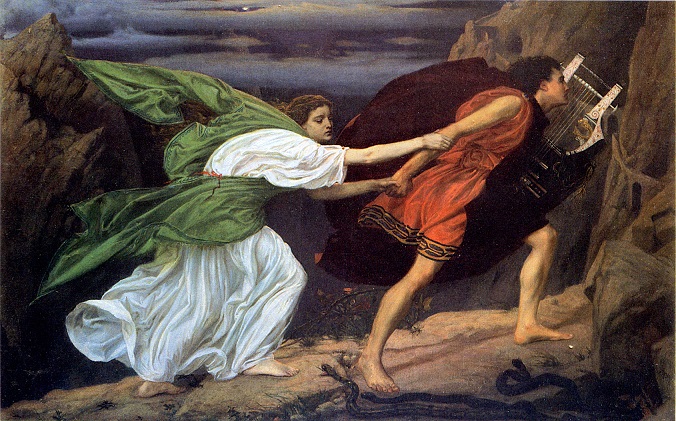
To Her Ghost: a Sequence from Orpheus Looks Back
—in memoriam Emily Desire Gaynor Rothman, 1964-2020
.
1. Breaking Open
A sonnet tells the lover’s tale because
It is the lover’s sonnet. Lovers love
To talk about themselves, making what was
Supposed to be a labor of their love
Into an avatar of self-regard:
“Oh look how I have loved and lost. Come see.
She’s dead and I am suffering. It’s hard.
Let me tell you what she meant…to me.”
Now, sonnet, break: her bunions; dancer’s gait;
One breast a little larger than the other;
Her little cat-like growl to indicate
Sarcastic irritation; her rare, deep laugh.
That’s it! Let more in. Let it in. A start.
And now, in breaking open: break, heart.
.
2. The Ratios of Chance
“Ducunt volentem fata, nolentem trahunt.” —Seneca
Funny to run into you again.
Want to take a run? The snow is great…
I’d love to, but we’re eating lunch and then
I have to head back home. I can’t be late…
Too bad. Where’s home?
New York.
No kidding! Me
Too…
Where?
Downtown.
Me too.
That’s funny. Where?
West Village.
Seriously? That’s got to be
A sign.
[cute laugh]
Charles Street.
What? I live there!
Perhaps it was a sign. Who knows how these
Things work, or why. A half a block. Of course
I got her number and went over. Seize
The day! That’s all I thought. And yet a force
Far greater than the ratios of chance
Seemed interested. Fate? Well, at least romance.
.
3. Something To Do
What a day. The sun is out, the temp
Is perfect. Bees work thoughtfully among
The lavender. The rains and cool nights tempt
The pear tree to go big. The vine is hung
With thousands of green clusters that show promise.
It’s a Monday in late June and right
On schedule garbage trucks descend upon us.
The cats lay plans for each songbird in flight.
The world is full of work. It doesn’t matter
If it’s paid or not, it’s useful. Things are growing.
People have their duties and they scatter
To them. Someone has to do the mowing.
Say something. I loved doing things for you.
Isn’t there anything that I can do?
.
4. Home, No More Home To Me
Born with an inexpressible hunger
Into families where troubled fathers
Were passed down through hard decades that were longer
Than the time we could perceive, by others
Who somehow could not, did not want to break
Through history to the living warmth of touch,
We lived as large as we could in the wake
Of loss, and grew into the role of so much
And such great passion as passion discovers:
To climb, to learn, to sing, and make the life
Of people who, to live, must become lovers.
Then, in our human flaws, I and my wife
Brought sons into the world and did our best
To help them fledge from a more happy nest.
.
5. To Her Ghost
I don’t think our life was unusual.
Or, if it was, that’s not what will have mattered.
The world is big and with big things is full,
And in the end each of us will be shattered.
Last night, no doubt like many, first I read
A bit, then watched some vids, done with my labors.
I saw one man blow off another’s head
Then rob his store. One guy killed his neighbors.
It’s just what showed up on my phone. I guess
That’s how we live today, force-fed real violence,
Rough sex, the cult of greed. What can we bless
In this sad state? What is there left but silence?
I drifted off. But this is also true.
I dreamed the memory of our love. Of you.
.
.
When young, David J. Rothman had the good fortune to study with Czesław Miłosz, Derek Walcott, Seamus Heaney, Mark Strand and Robert Fitzgerald. His most recent books are a textbook, Learning the Secrets of English Verse (Springer 2022), co-authored with Susan Spear, and My Brother’s Keeper (Lithic 2019), a Finalist for the Colorado Book Award in poetry. In 2019 he won a Pushcart Prize for the poem “Kernels,” which originally appeared in The New Criterion.














These precious poems of remembrance are somber soliloquies that themselves were a labor of love and fond memories. They flowed and rhymed so beautifully in appealing to the senses of the reader with captivating words of endearment. Thank you for sharing them with us.
If you are who I think you are, David, then I am not surprised. This sequence was terrific, and the individual poems are worthy additions to the English canon. They were touched with classic strokes and with the hyper=modern at the same time. I could read such poems every day for breakfast, and not feel hungry till suppertime.
Dear C. B. Anderson —
I’m curious if we have met….but whether or not we have, thanks for these generous words….the ms. is almost done and many of the poems have been appearing in various journals….soon I’ll send it all out.
Best,
Dave R.
This is an impressive post-modern sequence of genuine sonnets in the Petrarchan mode. The title suggests they are selected from a larger work, but the non-narrative effect tightly reproduces some canzoniere commonplaces.
“Breaking Open,” in an original manner, introduces the lover’s writings as both authentic (speaking of true love) and “scattered” (Petrarch’s Rime sparse).
“The Ratios of Chance” is an innamoramento, describing the first meeting when the lover is captivated. Conventionally, this happens through sight alone, and for Petrarch, the lady speaks words intelligible to him only in a dream after she has died. Here it all happens through conversation presented in short lines, though the colloquy makes up one quatrain of a formal sonnet. The “chanciness” preserves the conventional idea of a fated meeting, as does the epigraph.
“Something To Do” is one of those “uncertain” poems that could take place before or after the lady’s death, while hinting at the lover’s premonitions or regrets.
“Home” is a retrospective of both the lover’s life with his wife and his own upbringing. As do several of Petrarch’s sonnets, it serves to sketch the lover’s personality more fully.
“To Her Ghost” is a typical sonnet “in morte” with the lover objecting to the world proceeding as usual with his lady no longer present. He is more sensitive to its faults and finds consolation only in memory.
These are masterfully done, David, in your own expert style but with recognizable reference to literary love conventions, whether you thought explicitly of Petrarch as I do, or not.
Dear Margaret Coats:
Forgive the lag here, but I just circled back to these website to make sure I had the addresses correct on another document and saw your comments.
You can perhaps imagine my astonishment at reading your post–no one, absolutely no one, has yet seen what you have, and you are absolutely correct about what I am trying to do, which becomes quite clear in the full ms. While there are also extensive debts to many others, Petrarch is, as he should be, perhaps the preeminent presiding literary ghost. How can I put this? I always of course admired him….but in the wake of Emily’s death, I found the rima sparsi (along with, in particular, La Vita Nuova) to become far more immediate. I no longer felt as if I were reading them through such a distant lens, but rather as in fact quite emotionally direct, despite their foregrounded conventions.
I am curious when you were at Harvard and with whom you studied there–I am class of ’81. though took a year off so graduated in ’82 (undergrad). The professor who had the greatest influence on me (and many others…) and set me on the path of truly working to understand how verses are made was Robert Fitzgerald.
I am at [email protected] if you want to be in touch directly. I would enjoy that.
Thanks, David. I’m letting you know I noticed, and I will be in touch, though it may take a day or two.
Dear Margaret Coats:
I tried to post a note just now, but cannot see it here, so am recomposing…
Imagine my astonishment at reading your comment, which I just came across when cycling back here to make sure I had the website address correct. You are the first and still only reader to see the deep background of what I am doing here, which becomes more clear in the full ms., where there are a number of presiding literary ghosts, though Petrarch is, as he should be, preeminent. As I expect you know, the very first sonnet to appear in English is Canzonieri 310, translated by Surrey, in Tottel, which is a love poem, but of course written after Laura has died–and I translate it myself and then respond in the book, along with a sonnet from La Vita Nuova and other work.
I cannot tell you how grateful I am that you saw this — a delight to be so carefully read. Just one observation….I of course enjoyed Petrarch when I was young, but after Emily died the poems were utterly transformed for me, along with others, e.g La Vita Nuova. Whereas in the past I had seen them as brilliant but — what? — overly mannered? — they now spoke to me in an utterly direct way, despite the simultaneous sense of their high artifice. I came to a far deeper understanding of why they have survived.
Oh — in the ms., the stichomythia of “The Ratios of Chance” is laid out to make the full lines visible. As it is laid out here I am again delighted that you saw what is happening. Like Juliet, Emily speaks back in many of the sonnets in the ms., indeed a number are mostly or entirely in her voice.
Thanks again. If you’d like to be directly in touch, I’m at [email protected]. I am curious what years you were at Harvard. I am AB 1981 (’82). The great poet/translator/critic and professor who set me on this track was Robert Fitzgerald.
Best,
Dave R.
These poems are from the heart – and from the Muse.
As a retired clinical psychiatrist I was particularly struck by “Home, No More Home to Me” The narrator seems to be a special kind of hero that I call a chain-breaker. In some families the disfiguring hang-ups of each generation disfigure the next in the same way – e.g. relentless terrorizing degrading child-abuse mixed with genuine parental love. A. E. Houseman characterized these cycles thus: “Souls undone, undoing others – long time since the tale began …”
As a therapist I never in my 50 years of practice led a patient to be a chain-breaker, but I’ve had patients who had previously done it on their own. They’d spotted their intergenerational chain when they were young, and had resolved to break it and had succeeded in rescuing their own children and posterity from the family curse.
They were seeing me later in their life about some unrelated condition. Still, inside myself I had to salute the heroism of their backstory.
There are many psychiatric patients who ain’t sissies.
Dear Dan Pugh:
My gosh, that’s a compelling set of observations. It is a very long story, of course, but yes, there were chains that needed to be broken. Perhaps some day we will discuss it over a bottle of wine — thank you so much for this careful reading.
Best,
Dave R.
Not only are these finely crafted, they are poignant, intimate reflections on love and loss. The reference to Orpheus and Eurydice ties the cycle together as a tribute — evoking its subject perhaps just as Orpheus with his songs almost brought Eurydice back to life. The epigraph from Seneca seems tragic, but you give it a happy ending. For me, the closing sonnet brings it all together: in a world of tragedy and ugliness, we are blessed to enjoy what is beautiful and pure, and what could be more so than true love? Thank your for sharing this rich and enjoyable cycle.