• Submit Poetry
  • Support SCP
  • About Us
  • Members
  • Join
Tuesday, June 30, 2026
Society of Classical Poets
  • Poems
    • Beauty
    • Culture
    • Satire
    • Humor
    • Children’s
    • Art
    • Ekphrastic
    • Epic
    • Epigrams and Proverbs
    • Human Rights in China
    • Music
    • Performing Arts
    • Riddles
    • Science
    • Song Lyrics
    • The Environment
    • The Raven
    • Found Poems
    • High School Poets
    • Terrorism
    • Covid-19
  • Poetry Forms
    • Sonnet
    • Haiku
    • Limerick
    • Villanelle
    • Rondeau
    • Pantoum
    • Sestina
    • Triolet
    • Acrostic
    • Alexandroid
    • Alliterative
    • Blank Verse
    • Chant Royal
    • Clerihew
    • Rhupunt
    • Rondeau Redoublé
    • Rondel
    • Rubaiyat
    • Sapphic Verse
    • Shape Poems
    • Terza Rima
  • Great Poets
    • Geoffrey Chaucer
    • Emily Dickinson
    • Homer
    • Henry Wadsworth Longfellow
    • Dante Alighieri
    • John Keats
    • John Milton
    • Edgar Allan Poe
    • William Shakespeare
    • William Wordsworth
    • William Blake
    • Robert Frost
  • Love Poems
  • Contests
  • SCP Academy
    • Educational
    • Teaching Classical Poetry—A Guide for Educators
    • Poetry Forms
    • The SCP Journal
    • Books
No Result
View All Result
Society of Classical Poets
  • Poems
    • Beauty
    • Culture
    • Satire
    • Humor
    • Children’s
    • Art
    • Ekphrastic
    • Epic
    • Epigrams and Proverbs
    • Human Rights in China
    • Music
    • Performing Arts
    • Riddles
    • Science
    • Song Lyrics
    • The Environment
    • The Raven
    • Found Poems
    • High School Poets
    • Terrorism
    • Covid-19
  • Poetry Forms
    • Sonnet
    • Haiku
    • Limerick
    • Villanelle
    • Rondeau
    • Pantoum
    • Sestina
    • Triolet
    • Acrostic
    • Alexandroid
    • Alliterative
    • Blank Verse
    • Chant Royal
    • Clerihew
    • Rhupunt
    • Rondeau Redoublé
    • Rondel
    • Rubaiyat
    • Sapphic Verse
    • Shape Poems
    • Terza Rima
  • Great Poets
    • Geoffrey Chaucer
    • Emily Dickinson
    • Homer
    • Henry Wadsworth Longfellow
    • Dante Alighieri
    • John Keats
    • John Milton
    • Edgar Allan Poe
    • William Shakespeare
    • William Wordsworth
    • William Blake
    • Robert Frost
  • Love Poems
  • Contests
  • SCP Academy
    • Educational
    • Teaching Classical Poetry—A Guide for Educators
    • Poetry Forms
    • The SCP Journal
    • Books
No Result
View All Result
Society of Classical Poets
No Result
View All Result
Home Poetry Beauty

‘The Blackbird’ and Other Poetry by Peter Hartley

June 23, 2021
in Beauty, Poetry
A A
18
poems 'The Blackbird' and Other Poetry by Peter Hartley

.

.

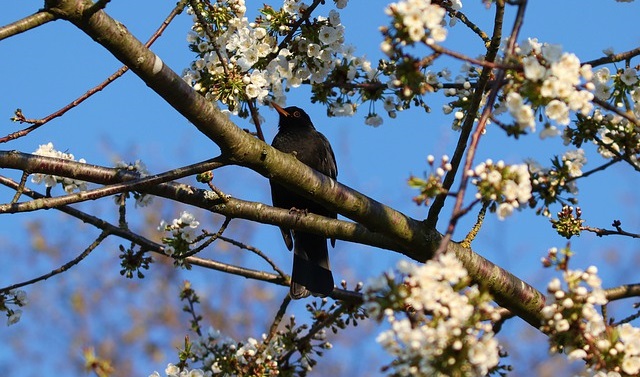
The Blackbird

So what can make this joyous songbird sing
That cannot but proclaim its blackbirdhood?
In fairest weather and in foul it could
Convey nought but the utmost joys of spring.
So fling right open all the doors, and fling
The windows wide: they don’t feel, as they should,
The cold beyond the dingle in the wood,
So let the blackbird sing of warmth and bring

New life as from the rhododendron bud,
The prospect of the spring now fills the wood
With songbirds’ song and in such fluting voice
To celebrate creation and rejoice:
The blackbird sings with glee, for he knows he,
As he himself, no other self can be.

.

.

The Mistle-Thrush

The mistle-thrush, there is no braver bird,
So keen in its defence of nest and young,
But during incubation rarely heard,
In silence broods; it lightly skulks among

The higher shoots and leaves. A hedge contrives
To hide its beating heart. The thieving crow
That feeds upon the flesh of lesser lives
Now struts about importantly below.

The courage of the weaker bird rebels
Against the arrogance that arrogates
Defenceless foetal lives in fragile shells,
And for his hidden unhatched prey awaits.

No crows need feud for food, for foetus or
For brood to burgeon in the balmy hall
Of Chloris: fare aplenty, “hidden” store
Of squirrel and a free-for-all for all.

Survival of the fittest means no more
Than forte of the fattest to persist
In pinching from the poor as they ignore
All better thoughts, unable to resist.

All praise be to the homely mistle-thrush
Who guards a flimsy nest with care and zest,
And ever watchful from that laurel bush,
Its heart loud-beating in its fearful chest.

.

.

Peter Hartley is a retired painting restorer. He was born in Liverpool and lives in Manchester, UK.

ShareTweetPin
The Society of Classical Poets does not endorse any views expressed in individual poems or commentary.
Read Our Comments Policy Here

RandomPoems

Three Poems on the Spread of the CCP Virus (COVID-19)
Covid-19

Three Poems on the Spread of the CCP Virus (COVID-19)

March 17, 2020

The Society of Classical Poets refers to the COVID-19 coronavirus as the CCP virus because the Chinese Communist Party’s coverup...

A Poem for April Fools’ Day, 2025: ‘Spot the Fool!’ by Susan Jarvis Bryant
Culture

A Poem for April Fools’ Day, 2025: ‘Spot the Fool!’ by Susan Jarvis Bryant

April 1, 2025

. Spot the Fool! ---for April Fools’ Day, 2025 . I.  Today’s the day to fox and fool. Today’s the...

Next Post
‘A Progressive Englishman Speaks to Jews’ by Damian Robin

'A Progressive Englishman Speaks to Jews' by Damian Robin

‘The Hanging Tree’ and Other Poetry by Joe Tessitore

'The Hanging Tree' and Other Poetry by Joe Tessitore

‘The Anchor’ by Steven Shaffer

Poetry Challenge: A 'Raven'-like Poem on the Death of Edgar Allan Poe

Comments 18

  1. Sally Cook says:
    5 years ago

    These are two very unusual poems, Peter.
    I, too, am a bird lover – I see you also know that
    birds themselves are microcosms of society.

    Reply
    • Peter Hartley says:
      5 years ago

      Thank you, Sally, for the kind comment. I was hoping to suggest in these little contributions the special qualities that make these birds individually what they are. G M Hopkins called it “instress” from the “thisness” or “haecceity” of the followers of Duns Scotus (who unfortunately also, I think, gave us our word “dunce”). I have seldom written a happy poem and I must try it again some time. Thank you again for the reassurance you give me to do more.

      Reply
  2. Susan Jarvis Bryant says:
    5 years ago

    Peter, these latest poems sing with a beauty and bravery that has touched my heart. You have pulled out all the stops when it comes to poetic device and I love it; ” No crows need feud for food, for foetus or/For brood to burgeon in the balmy hall/Of Chloris…” being one of my many favourites – wholly inspirational.

    I will admit to being a twitcher with an immense love of for our winged wonders. You have taken me back to England with ‘The Blackbird’. The song of the blackbird is hauntingly beautiful and I adore the term ‘blackbirdhood’ used to muse upon its melodious bent. I also love the bravery of the mistle-thrush in defending its ‘flimsy nest’. I would like to think I was blessed with a mere iota of the courage the mistle-thrush exhibits. We could learn an awful lot from our fine and feisty feathered friends.

    My only peeve is that I am unable to comment on your masterly poetry in Phoenician – that’s how darn good they are!

    Reply
    • Peter Hartley says:
      5 years ago

      Susan – Thank you for the kind remarks and especially for that free admission to twitcherdom. I too would have been a twitcher were it not that I am as blind as a bat (although oddly enough I can see bats). Thanks to the magpies we don’t see so many birds worth twitching for as you see in Texas but last year a pair of long-tailed tits (as small as gold rests, were it not for their tail) nested in my garden, their domed nests being the most sumptuous and feathery of any in the U.K. (as you will probably know). And when you SEE a blackbird sing, doesn’t it seem to be so proud of being itself?
      All right, I will admit it: my Phoenician is not quite up to scratch, but as Mike once remarked, “Give a man a trout and you will feed him for a day. Give that man a flux brush, a Dino-Rod and a badger and you will feed him for life.”

      Reply
  3. Mike Bryant says:
    5 years ago

    !09W +9+ꓘ

    Reply
  4. Paul Freeman says:
    5 years ago

    Wordsworth would have loved these poems, and as a townie with little twitcher knowledge, I really enjoyed them. Along with ‘blackbirdhood’, the oddly phrased ‘free-for-all for all’ I also found inspired.

    Your personification of the mistle-thrush and its potential enemies (‘pinching from the poor’, etc.) was masterful.

    Thanks for your inspiring reads – I’ll now go and write about the feral parrots we have all over the show here.

    Reply
    • Peter Hartley says:
      5 years ago

      Thank you, Paul, for your kind remarks. If you have lots of feral parrots around you I’m suspecting you are from the London area where I believe they flourish. In Derbyshire not so very far from me we had a snurd*of wild wallabies but I think they may have died out by now. The mistle thrush is the biggest British songbird (if you exclude the crow family ‘cos they can’t sing anyway) which is why I thought it deserved a poem to itself. (*I made this up.)

      Reply
  5. Jeff Eardley says:
    5 years ago

    Peter, as I was reading this in the garden today, one of our resident blackbirds was giving me a beady little yellow-eye. He only scarpered when our resident pheasant showed up, and carried on sparring with his many friends. We get the occasional mistle thrush and what a delightful sight they are. The feeding of birds during this Covid period has been one of life’s pleasures. Thank you for these two that I enjoyed immensely.

    Reply
    • Peter Hartley says:
      5 years ago

      Jeff, I don’t know who put this bird in the Turdus genus but I think it was rather unkind. One of the most distinguished and most beautiful birds there is, its song is a delight to hear. I have one that follows me round the garden when I am mowing the lawn but unfortunately it is far too busy to sing.

      Reply
      • Jeff Eardley says:
        5 years ago

        Peter, as an ex-scouser, and I assume Beatles fan, “Turdus singing in the dead of night” is just so wrong.

        Reply
  6. Margaret Coats says:
    5 years ago

    Peter, both poems show you moving on in the avian cosmos, after attention to the passerines (along with so much else of universal import) in your recent volume. “The Mistle-Thrush” is certainly a fine tribute to that species, as well as a treatment of traits we see among humans. “The Blackbird” is even better as a model of triumphant exultation in what the creature was created to be. And the final couplet suggests not only the full use of his species potential, but individuality verging on personhood. That is very well done, and makes me think the blackbird might be Peter Hartley’s bird the way the skylark is Shelley’s, or the green linnet Wordsworth’s.

    Reply
    • Peter Hartley says:
      5 years ago

      … Or Coleridge’s albatross?Perceptive as ever, Margaret, you are right about the blackbird being the new Hartley bird, having long since ousted the martlet from my scutcheon. Among thrushes the finest songster of all it seems to flourish in the U.K. where the mistle-thrushes and song-thrushes (two more unfortunately named Turdidae) appear to be in a steep decline.

      Reply
  7. Cynthia Erlandson says:
    5 years ago

    These are lovely bird poems! I love the word “blackbirdhood”, and the phrases “struts about importantly below”, and “”free-for-all for all”.

    Reply
    • Peter Hartley says:
      5 years ago

      Thank you Cynthia, and if any bird could inspire anyone to poetry it must be the blackbird. Although I have never heard the sound of a shrike.

      Reply
  8. Mike Bryant says:
    5 years ago

    !09W +9+ꓘ
    Peter, really beautiful and meaningful poetry. I tried to say it Phoenician above but have obviously failed. The Phoenician fonts are quite difficult to approximate, however the Canaanite letters are at least recognizable using Roman characters (slightly altered).

    Reply
    • Peter Hartley says:
      5 years ago

      Mike – You CANNOT get a Phoenician keyboard for a big clock, but what you have written above seems like perfect Phoenician to me, “Carthago delenda est,” as the actress said to the Bishop. And thank you enormously for your kind remarks about my poems.

      Reply
  9. David Watt says:
    5 years ago

    Peter, your two poems are full of avian character, and quite distinctive in their inventive phrasing. For instance:
    ‘The blackbird sings with glee, for he knows he,
    As he himself, no other self can be.”
    You paint a lovingly detailed picture of each bird. But these pictures require no restoration.

    Reply
    • Peter Hartley says:
      5 years ago

      David – thank you for your comment and you point out another characteristic of all birds (apart from pigeons in very urban environments), that they always contrive (no they don’t contrive to do anything) they always look so clean and dapper don’t they? The blackbird looks as though he should have a fob watch dangling at his chest and a top hat cocked at an angle. Not a feather out of place, perfect symmetry, unless he is a partial albino. As I said above, he seems so proud to be and to be his own unique self.

      Reply

Leave a Reply Cancel reply

Your email address will not be published. Required fields are marked *

  1. Joseph S. Salemi on ‘Archaic Torso of Apollo’ by Rainer Maria Rilke, Translated by Mary Jane MyersJune 30, 2026

    Brian -- yes, I think "or pulse as starlight flares" would be absolutely right. It gets rid of "quasar" and…

  2. Brian Yapko on ‘Archaic Torso of Apollo’ by Rainer Maria Rilke, Translated by Mary Jane MyersJune 30, 2026

    Mary Jane, this is a wonderful translation of Rilke's original German. I love how you maintained the rhyme-scheme and the…

  3. Zumwalt on ‘Archaic Torso of Apollo’ by Rainer Maria Rilke, Translated by Mary Jane MyersJune 30, 2026

    Wow! Very impressive, and imaginatively creative, translation feat!

  4. James Sale on ‘Then and Now’: A Sonnet by James SaleJune 30, 2026

    Good advice Nathan - totally agree.

  5. Russel Winick on ‘Not Small At All’ and Other Short Poems by Russel WinickJune 29, 2026

    Thanks Margaret. Speaking of Langston Hughes, it’s an endless fascination to me that my (and many other people’s) two favorite…

Subscribe to Daily Poems

Enter your email address to subscribe to this blog and receive notifications of new posts by email.

Join 1,592 other subscribers

Recent Poems

  • ‘Archaic Torso of Apollo’ by Rainer Maria Rilke, Translated by Mary Jane Myers
  • ‘The Council of Infinite Opinions’: A Poem by David Lee
  • Odyssey Audiobook Serialization Begins: First Fully Dramatized Version
  • ‘Not Small At All’ and Other Short Poems by Russel Winick
  • ‘The Roommate’: A Poem by Jeffrey Essmann
  • ‘Pouting Polly’: A Poem by Robert Nachtegall
  • Two Satirical Sonnets by Joseph S. Salemi
  • ‘Then and Now’: A Sonnet by James Sale
  • ‘The Ministry of Twee’: A Poem by Susan Jarvis Bryant
  • ‘Breath of Night’: A Poem by Paulette Calasibetta
  • A Song Inspired by Edward Rowland Sill’s ‘Among the Redwoods’, by Gunny Markefka
  • ‘Kaddish for My Father’: A Poem by Brian Yapko
  • ‘Canceled’ and Other Limericks by Joseph Mason
  • ‘The Diamond’: A Marriage Proposal Poem by Adam Sedia
  • ‘The Dancer’ and Other Rondeaux by David Murphy
  • ‘Chastity’: A Sonnet Sequence by Justin Dasher
  • Horace Odes I.11 and III.30, Translated by Mary Jane Myers
  • ‘The Bird with the Ugly Voice’: A Poem by Scharlie Meeuws
  • ‘The Dryads’: A Poem by Patricia Rogers Crozier
  • ‘Stories of Saint Anthony’: Poems by Margaret Coats
  • ‘An Englishman to World Cups Past’: A Poem by Paul A. Freeman
  • ‘Faux Pas’ and Other Poetry by C.B. Anderson
  • ‘Trip to Italy: A Poetry Travel Journal’ by James A. Tweedie
  • ‘Spring Song’: A Poem by Rohini Sunderam
  • ‘The Eagle’: A Poem by Bruce Dale Wise
  • ‘Good Night’ and Other Poetry by Kevin Ahern
  • ‘Mothiavelli’ and Other Poetry by Susan Jarvis Bryant
  • ‘Poetic Justices: The Poetry of United States Supreme Court Justices’: An Essay by Adam Sedia
  • ‘Blur’ and Other Poems by Anna J. Arredondo
  • ‘The Cottage on the Ridge’ and Other Poetry by Martin Rizley

Categories

  • Acrostic
  • Alexandroid
  • Alliterative
  • Art
  • Best Poems
  • Blank Verse
  • Chant Royal
  • Classical Poets Live
  • Clerihew
  • Covid-19
  • Deconstructing Communism
  • Educational
  • Epic
  • Epigrams and Proverbs
  • Essays
    • Interviews with Poets
    • Poetry Reviews
  • Featured
  • From the Society
  • Great Poets
    • Dante Alighieri
    • Edgar Allan Poe
    • Emily Dickinson
    • Geoffrey Chaucer
    • Henry Wadsworth Longfellow
    • Homer
    • John Keats
    • John Milton
    • Robert Frost
    • William Blake
    • William Shakespeare
    • William Wordsworth
  • Human Rights in China
  • Limerick
  • Love Poems
  • Music
  • Pantoum
  • Performing Arts
  • Poetry
    • Beauty
    • Children's Poems
    • Culture
    • Ekphrastic
    • Found Poems
    • High School Poets
    • Humor
    • Riddles
  • Poetry Challenge
  • Poetry Contests
  • Poetry Forms
    • Curtal Sonnet
    • Haiku
  • Poetry Readings
  • Rhupunt
  • Rondeau
  • Rondeau Redoublé
  • Rondel
  • Rubaiyat
  • Sapphic Verse
  • Satire
  • Science
  • Sestina
  • Shape Poems
  • Short Stories
  • Song Lyrics
  • Sonnet
  • Symposium
  • Terrorism
  • Terza Rima
  • The Environment
  • Translation
  • Triolet
  • Video
  • Villanelle

Quick Links

  • About Us
  • Submit Poetry
  • Become a Member
  • Members List
  • Support the Society
  • Advertisement Placement
  • Comments Policy
  • Terms of Use

Welcome Back!

Login to your account below

Forgotten Password?

Retrieve your password

Please enter your username or email address to reset your password.

Log In
No Result
View All Result
  • Poems
    • Beauty
    • Culture
    • Satire
    • Humor
    • Children’s
    • Art
    • Ekphrastic
    • Epic
    • Epigrams and Proverbs
    • Human Rights in China
    • Music
    • Performing Arts
    • Riddles
    • Science
    • Song Lyrics
    • The Environment
    • The Raven
    • Found Poems
    • High School Poets
    • Terrorism
    • Covid-19
  • Poetry Forms
    • Sonnet
    • Haiku
    • Limerick
    • Villanelle
    • Rondeau
    • Pantoum
    • Sestina
    • Triolet
    • Acrostic
    • Alexandroid
    • Alliterative
    • Blank Verse
    • Chant Royal
    • Clerihew
    • Rhupunt
    • Rondeau Redoublé
    • Rondel
    • Rubaiyat
    • Sapphic Verse
    • Shape Poems
    • Terza Rima
  • Great Poets
    • Geoffrey Chaucer
    • Emily Dickinson
    • Homer
    • Henry Wadsworth Longfellow
    • Dante Alighieri
    • John Keats
    • John Milton
    • Edgar Allan Poe
    • William Shakespeare
    • William Wordsworth
    • William Blake
    • Robert Frost
  • Love Poems
  • Contests
  • SCP Academy
    • Educational
    • Teaching Classical Poetry—A Guide for Educators
    • Poetry Forms
    • The SCP Journal
    • Books

© 2025 SCP. WebDesign by CODEC Prime.